



Wondering what makes a mechanical watch tick?
In a world filled with digital gadgets, there's something captivating about a finely crafted mechanical watch.
These timepieces don't rely on batteries but run on the intricate workings of springs and gears. This is the charm of a mechanical watch—a perfect blend of engineering and craftsmanship.
Join us as we explore the captivating world of mechanical watches. We will cover everything from gaining a deeper understanding of their complexities to exploring their rich history and intricate components.
We'll also provide a comprehensive buying guide to help watch enthusiasts cherish these timeless pieces worldwide.
What is a Mechanical Watch?
A mechanical watch is a finely crafted timepiece that operates without batteries. Instead, it is powered by a mainspring, a tightly coiled metal strip that stores energy when wound. As the mainspring unwinds, it releases energy through a series of gears, which drive the movement of the watch hands.
This process is regulated by the escapement mechanism, which controls the energy release and ensures accurate timekeeping. The balance wheel oscillates back and forth to help maintain the watch's precision.
Unlike quartz watches, which rely on batteries, mechanical watches are appreciated for their intricate design and their second hand's smooth, continuous movement. They often require manual winding and come with a self-winding movement that works through the motion of the wearer's wrist. The craftsmanship of a mechanical watch makes it a symbol of tradition, skill, and timeless elegance.
History of Mechanical Watches
It all started with ancient civilizations using sundials, relying on the sun's movement to mark time. The early history of timekeeping is fascinating, with each civilization developing unique methods to measure the passage of hours.
Fast-forward to the 14th century in Europe, where spring-driven mechanisms emerged, making portable timepieces possible. To learn more about the early history of timekeeping, visit the blog.
In the 16th century, the pocket watch was innovated, a marvel of intricate spring-driven mechanics gracing nobility's pockets. These watches transformed timekeeping into an art form. In the 17th century, Christiaan Huygens introduced the pendulum clock, a breakthrough that brought unprecedented accuracy.
By the 18th century, watchmakers began creating miniature masterpieces within pocket watches with ornate cases and enamel dials. The Industrial Revolution of the 19th century brought mass production and innovations like Thomas Mudge's lever escapement, which made watches accessible to more people.
Despite the rise of quartz technology in the 20th century, mechanical watches remained cherished for their craftsmanship and prestige. Today, the 21st century celebrates a renaissance of mechanical watchmaking that invites enthusiasts to wear mechanical watches that blend tradition with modernity.
Thus, mechanical watches' legacy continues, honoring the artistry and innovation that capture the essence of time.
Components of a Mechanical Watch
Mainspring
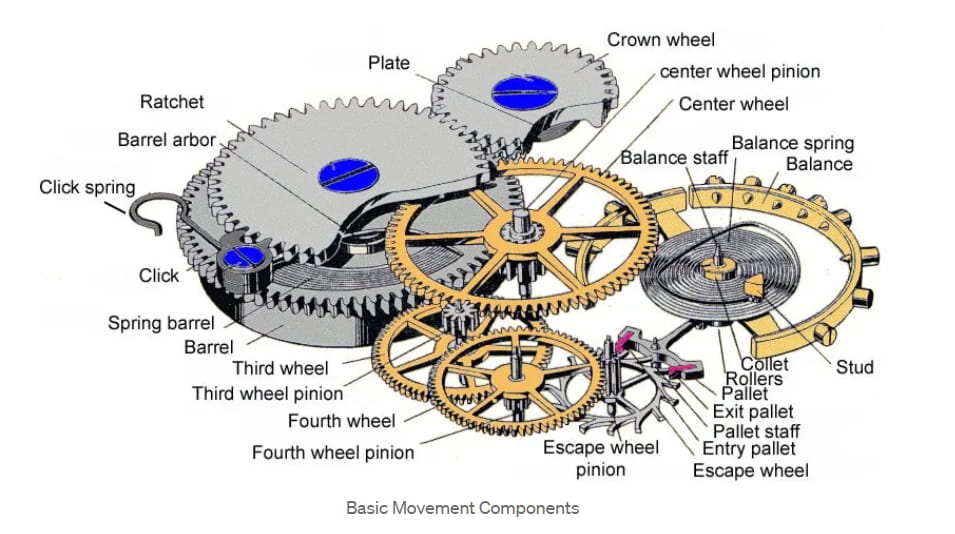
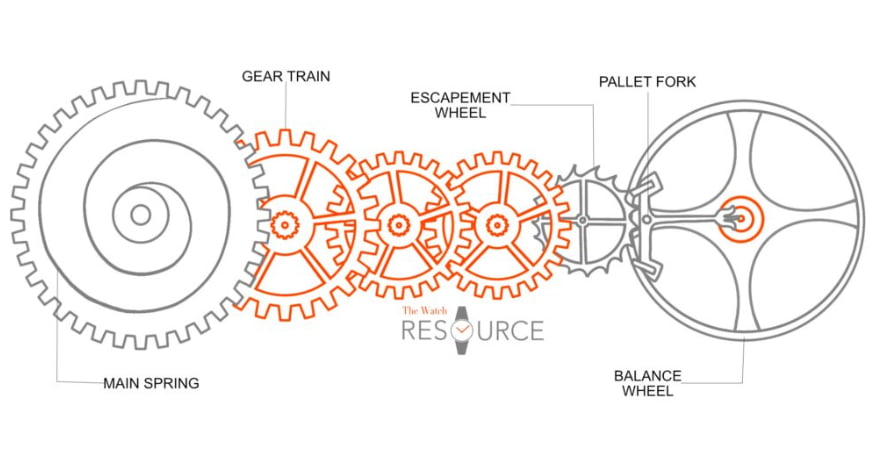
The mainspring is a coiled flat spring that stores energy when wound. This stored energy is slowly released to power the watch, much like winding a toy car. It is housed in a barrel and can store enough energy to keep the watch running for about 36 to 40 hours to several days, depending on its design.

Gear Train
The gear train is a series of interlocking gears that transmit energy from the mainspring to the escapement. These gears slow down the unwinding of the mainspring, which allows the watch to keep accurate time. The gear ratios are carefully calculated to ensure precision. In some high-end watches, the gear train is visible through a transparent case back that showcases the intricate craftsmanship.
Escapement
The escapement regulates the release of energy from the mainspring in precise intervals. It allows the gear train to move forward in controlled steps and produces the ticking sound characteristic of mechanical watches. The escapement typically includes the escape wheel and the pallet fork, working together to control the release of energy. This mechanism ensures that the watch runs at a consistent rate, with many watches having a frequency of 28,800 beats per hour.
Balance Wheel
The balance wheel oscillates back and forth, working with the hairspring to regulate the timekeeping. It acts like the heart of the watch that helps it maintain a steady rhythm. The balance wheel's constant motion is crucial for accuracy, typically oscillating at a rate of 4 to 10 times per second. This precision helps the watch keep time to within a few seconds per day .
Hairspring
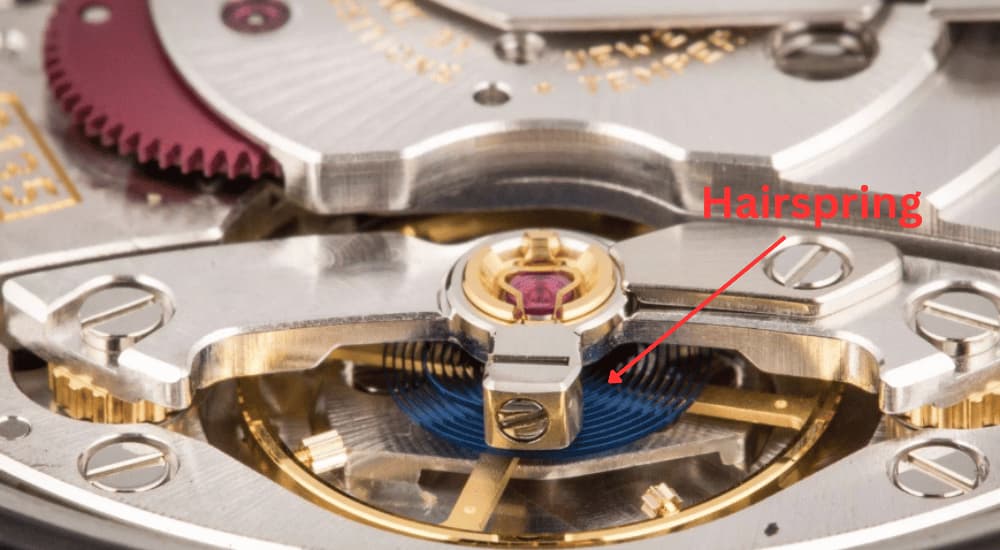
The hairspring is also known as balance spring. It is a tiny coiled metal strip attached to the balance wheel. It expands and contracts with the balance wheel's oscillations that help it return to its central position. The hairspring's quality and construction are vital for the watch's accuracy. Advances in materials, such as silicon hairsprings, have improved resistance to temperature changes and magnetic fields.
Dial and Hands
The dial displays the time and various complications (additional features like date or chronographs). The hands attached to the dial point to the current hour, minute, and sometimes second. The design of the dial and hands can vary greatly, but their primary function is to make it easy to read the time at a glance. High-end watches often feature luminous hands and markers for visibility in low light.
Casing
The casing protects all the delicate internal components of the watch and shields the movement from dust, moisture, and physical shocks. Cases are typically made from materials like stainless steel, gold, or titanium and often include a transparent back to showcase the movement. The casing's water resistance can range from minimal splash protection to professional-grade diving capabilities.
Complications
Complications are additional features beyond standard timekeeping. Common complications include subdials, which can display different time zones or act as stopwatches (chronographs); day/date displays, which show the current day and date; and moon phase indicators, which track the lunar cycle. High-end watches can have multiple complications, each adding to the watch's complexity and value.
Understanding these components helps us appreciate the craftsmanship and engineering that goes into making a mechanical watch. Each part works harmoniously to keep time accurately and reliably that showcases centuries of horological innovation and artistry.
Types of Mechanical Watch Movements
Manual Movement
Manual-movement watches require regular hand winding. This involves turning the crown to tighten the mainspring, which stores the energy needed to power the watch. This movement offers a tactile connection to the timepiece and a sense of tradition and craftsmanship. Many enthusiasts enjoy the ritual of daily winding and appreciate the watch's intricate mechanics.
Automatic Movement
Automatic movement watches are self-winding, powered by the wearer's wrist movements. Inside the watch, a small rotor spins as you move, winding the mainspring automatically. This provides the convenience of not needing daily winding. For more details on how automatic watch movements work, read the blog.
How Does a Mechanical Watch Work?
Understanding how a mechanical watch works can be fascinating. Let's break down the process into simple steps:
Energy Generation
A mechanical watch generates energy by winding the mainspring. This can be done manually by turning the crown or automatically through the natural movement of the wearer's wrist. The wound mainspring stores energy that powers the watch.
Energy Transfer
The energy from the mainspring is transferred through the gear train. This series of interlocking gears regulates the release of energy, ensuring it moves steadily and smoothly through the watch mechanism.
Regulation
The escapement and balance wheel work together to regulate the release of energy. The escapement controls the energy flow in precise intervals, making the balance wheel oscillate back and forth. This regulation ensures the watch keeps accurate time
Time Display
The controlled energy moves the hands on the dial to display the time. The gears connected to the hands rotate consistently, allowing the watch to show hours, minutes, and seconds accurately.
To gain a precise understanding of how mechanical watches function, explore the detailed breakdown in the video below.
Buying Guide for Mechanical Watches
Understanding your needs and preferences can help you make the best choice when buying a mechanical watch.
Here's a simple guide to help you navigate the options:
Purpose and Use
First, determine the specific need for your watch. Are you looking for a dress watch for formal occasions, a dive watch for underwater activities, or an aviation watch with additional functionalities? Knowing the primary purpose will help you narrow down your options.
Movement Choice
Next, decide between an automatic or a manual movement. Automatic watches wind themselves using the motion of your wrist and offer convenience as they don't need daily winding. On the other hand, manual watches require regular winding, which can be a satisfying ritual for many watch enthusiasts.
Complications
Consider the necessary functions, also known as complications, in your watch. Common complications include chronographs for stopwatch functionality, GMT for tracking multiple time zones, and moon phase indicators. Choose the complications that fit your lifestyle and preferences.
Size and Comfort
Select the appropriate case dimensions for your wrist. The watch size should be comfortable and proportionate to your wrist size. Trying on different sizes can help you find the perfect fit.
Budget Considerations
Finally, balance quality and cost. Mechanical watches come at various prices, influenced by the brand, materials, and craftsmanship. Set a budget that allows you to invest in a quality timepiece without overstretching your finances.
By considering these factors, you can choose a mechanical watch that perfectly fits your needs and style. Enjoy the process of finding a timepiece that reflects your personality and meets your functional requirements.
Shop Mechanical Watches at Jewels By Love (An Authorized Retailer of Mechanical Watches)
At Jewels By Love, located in the vibrant heart of St. Maarten, we take pride in being a trusted source of genuine luxury watches. With a legacy that dates back to the 1800s, we are recognized as an authorized retailer by the world's most revered watchmakers, including Patek Philippe, Cartier, Nomos, and Breguet.
This endorsement ensures that each timepiece we offer is an authentic symbol of craftsmanship and heritage.
Whether you want to invest in a classic or find a modern statement piece, our knowledgeable team guides you through our meticulously curated collection.
Contact us to discover the perfect watch that resonates with your style. Start your journey into the world of luxury timekeeping with Jewels By Love.