

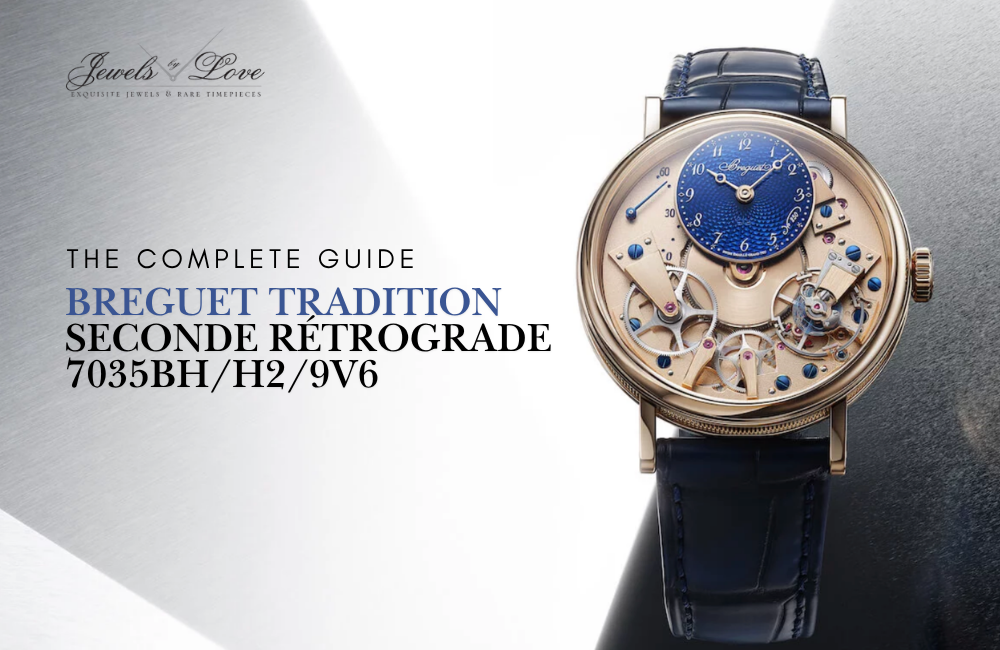
The Breguet Tradition Seconde Rétrograde 7035BH/H2/9V6 launched as part of the brand’s 250th year, limited to just 250 pieces.
For the first time in the Tradition line, there’s a flinqué enamel dial. Sounds like a small detail, but the deep blue enamel sitting against the warm gold case grabs attention immediately.
And as you start noticing more, the dial will mesmerize you with its exposed gears, balance, and architecture.
What defines this reference, then, is not just its visual appeal, but the way it presents its mechanics. The movement isn’t tucked away. It’s laid bare, structured, and intentional, turning the watch into a masterpiece of both form and function.
In this guide, we’ll break down everything you need to know.
Let’s get started.
The Design Architecture That Makes It Stand Out
If there’s one part of this watch that deserves closer attention. It's way everything has been structured. Every element, from the dial layout to the case proportions, works together to create a watch that reveals itself gradually rather than all at once.
The Flinqué Enamel Dial
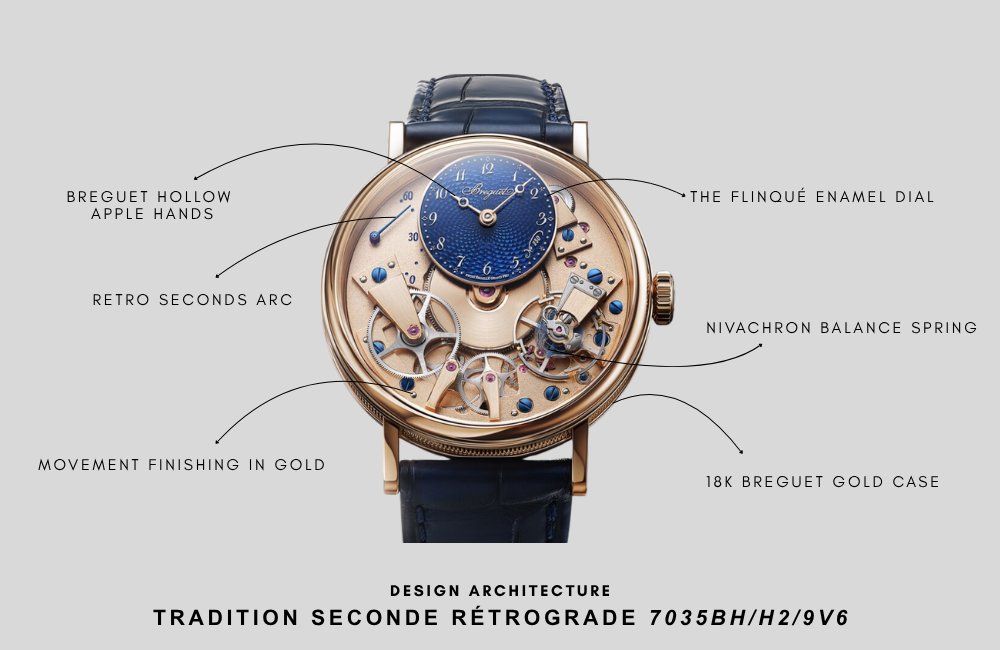
For the first time, Breguet introduces a flinqué enamel dial into the lineup, and the execution immediately sets it apart from previous models.
The dial begins with a solid gold base, engraved with a guilloché pattern before being coated with translucent enamel. What’s notable here is the method of application.
Instead of using a wet enamel mixture, the enamel is applied in powdered form through a sieve. This allows it to settle evenly into the engraved grooves, which helps in preserving the clarity and depth of the underlying pattern once it is fired. The result is a surface that feels both precise and layered, with the guilloché still clearly visible beneath the enamel.
The motif itself carries historical weight. It traces the curves of the Seine as it flows around the Île de la Cité and Île Saint-Louis, referencing the location of Abraham-Louis Breguet’s original workshop. The design is based on the Turgot map of 18th-century Paris, which means the dial is not merely decorative but rooted in a specific geographical and historical reference. The engraving becomes a quiet nod to place and is translated into a visual language that sits beneath the enamel.
The printed elements remain restrained and well-balanced. Breguet numerals, a finely executed minute track with fleurs-de-lis, and a discreet serial number at four o’clock are rendered in silver. Their tone provides a clear contrast against the blued steel retrograde seconds hand and screws.
It is creating a cohesive palette that contrasts effectively with the gold movement beneath.
The Retrograde Seconds Repositioned
One of the more subtle yet impactful changes in this reference lies in the placement of the retrograde seconds display. In earlier models such as the Ref. 7097, the seconds scale cut directly into the dial, which created a layered composition where the complication visually intersected with the dial surface.
In this iteration, that approach has been reworked. The retrograde seconds scale has been moved outward, positioned along the periphery between 10 and 11 o’clock. Rather than cutting across the dial, it now sits at its edge, leaving the enamel surface uninterrupted.
This adjustment alters the watch's overall balance. The emphasis shifts slightly away from the complication itself and toward the dial and its detailing.
Breguet Gold and the 38mm Case
The case introduces a new material direction while maintaining familiar proportions. Breguet gold is a proprietary alloy composed of gold, silver, copper, and palladium. The inclusion of palladium softens the overall tone, placing it between traditional yellow and rose gold without leaning too strongly toward either. The result is a more neutral, balanced appearance that complements both the dial and the movement.
At 38mm in diameter, the case is slightly smaller than previous automatic Tradition models, which makes it more adaptable across a wider range of wrist sizes. The thickness, however, increases to 12.6mm, up from 11.8mm in the Ref. 7097. This added height is directly linked to the flinqué enamel dial, which requires additional space. While the difference is noticeable on paper, in practice, it feels proportionate to the overall design.
The defining characteristics of a Breguet case remain present. The fluted caseband, welded lugs, and screw bars are aligned with the brand’s established identity. The extended profile created by the lugs, along with its smaller diameter, gives it a more balanced presence on the wrist.
Movement Finishing in Gold
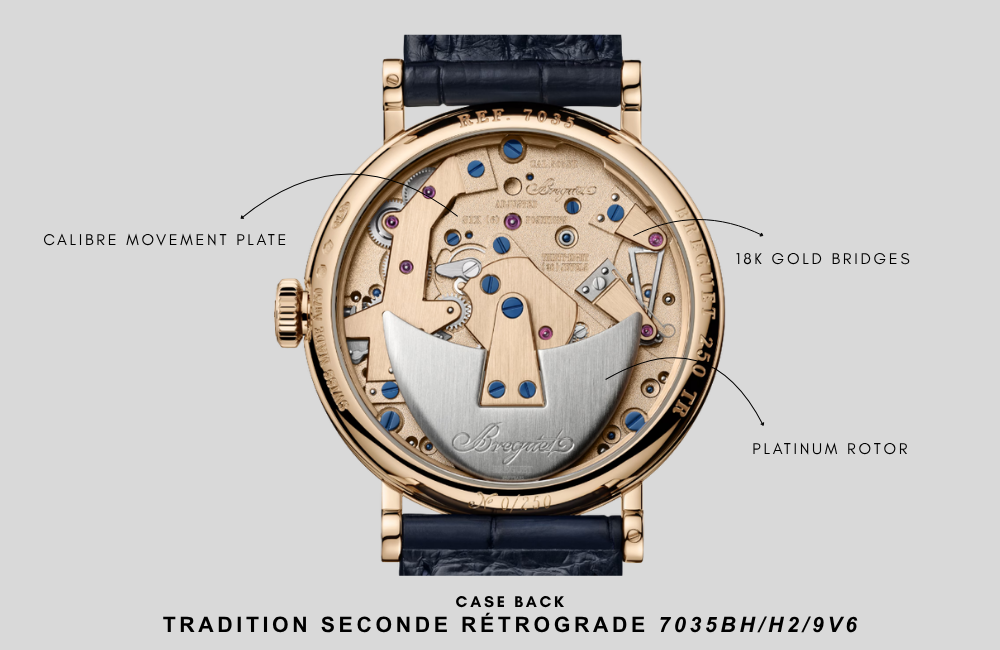
The movement is treated with the same level of attention as the dial and case, both in structure and finishing. A dedicated plating process brings the mainplate and bridges into alignment with the tone of the case, creating a consistent golden surface across the visible components.
What prevents this from feeling uniform is the variation in finishing techniques. The mainplate is bead-blasted, giving it a soft, matte texture. Plus, the bridges are finished with a hand-applied satin treatment on their upper surfaces, while the barrel features circular brushing. Every element interacts with light differently, which creates depth and contrast across the movement.
This layered approach is further emphasized by the contrasting elements within the movement. Silver-toned gears, blued screws, and ruby jewels introduce variation in both color and texture. Rather than competing with the gold base, these details provide definition, allowing individual components to stand out without disrupting the overall cohesion.
The Platinum Rotor
On the reverse side, the rotor introduces both functional and historical significance. It takes the form of a half-moon-shaped mass in platinum, referencing Breguet’s early use of heavy oscillating weights in his self-winding systems.
The choice of platinum is not purely aesthetic. Its density provides the rotor with the necessary mass to improve winding efficiency, thereby maintaining consistent performance. The movement itself contains approximately 52 grams of gold, complemented by an additional 2.2 grams of platinum in the rotor. This combination reflects a careful balance between material choice and mechanical function.
Visually, the rotor stands out against the surrounding components. Satin-brushed bridges and a shot-blasted mainplate create a subdued backdrop, allowing the platinum element to remain clearly defined without overwhelming the composition. The result is a movement that feels considered from every angle, with each element contributing to both performance and visual clarity.
The Mechanics That Power It
The calibre 505SR doesn’t try to reinvent automatic winding. What it does instead is stay loyal to a layout that Abraham-Louis Breguet established centuries ago, then updates it with modern materials that quietly improve performance. At its core, this is a movement built around visibility and logic. Let’s get into it.
Inverted Movement Architecture
The movement measures 32.8mm in diameter with a thickness of 6.31mm, housing 245 components and 38 jewels. Its layout is immediately recognizable. The barrel sits centrally, driving the gear train directly, while the balance is positioned at 3 o’clock and the centre wheel at 9 o’clock.
What makes it distinct is the inversion. The movement is effectively turned inside out, so the side that would typically face the caseback is brought to the dial. The result is a fully exposed mechanical layout where the going train, escapement, and balance are all visible in operation.
The escapement itself uses an in-line lever with silicon pallets. These components sit on the same plane as the rest of the movement but introduce reduced friction and improved longevity compared to traditional materials.
The Nivachron Balance Spring
The regulating organ is equipped with a blue Nivachron balance spring, a titanium-based alloy developed within the Swatch Group. Unlike silicon, Nivachron can be formed and adjusted using traditional methods, which allows it to retain the familiar characteristics of a conventional balance spring while offering modern resistance.
Its main advantage lies in its stability. It significantly reduces the effect of magnetic fields, while also performing consistently across temperature variations and daily wear conditions.
The spring is shaped with a Breguet overcoil, where the outer curve rises above the rest of the spiral. This geometry allows the spring to expand and contract concentrically, which plays a direct role in maintaining a stable rate regardless of position.
Pare-Chute Shock Protection
A historical detail that remains fully functional is the pare-chute system. Originally developed by Breguet in the late 18th century, it was one of the earliest forms of shock protection in watchmaking.
The system protects the balance pivots using a spring-mounted construction. In the event of an impact, the pivots are allowed to move slightly within their setting before returning to position. This reduces the risk of damage without interrupting the movement’s operation.
On the 7035, the pare-chute is visible on the dial side at 3 o'clock, sitting just beneath the enamel sub-dial where the balance wheel is positioned. It appears as a small U-shaped spring above the balance, a subtle but meaningful nod to Breguet’s early innovations.
Power Reserve and Frequency
The movement operates at 3 Hz, or 21,600 vibrations per hour, delivering a power reserve of approximately 50 hours from a single barrel. The barrel is centrally positioned and wound by the platinum rotor on the reverse, which rotates fully on a ceramic bearing.
This frequency is a deliberate choice. It strikes a balance between energy consumption and timekeeping stability, avoiding unnecessary strain on the power reserve while maintaining consistent performance over extended wear.
Retrograde Seconds Mechanism
The retrograde seconds display is driven by a cam and spring system. As the hand progresses along its arc between 10 and 11 o’clock, a follower tracks the contour of a kidney-shaped cam. Once it reaches the end of its path, the mechanism releases. The hand snaps back instantly, creating a sharp, precise motion that contrasts with the otherwise continuous flow of the movement.
The hand itself is rendered in blued steel, standing out clearly against the gold-toned architecture. The scale is engraved directly onto the movement plate, positioned neatly between the barrel and the enamel sub-dial, reinforcing the integrated nature of the design.
More from Breguet's 250th Anniversary Collection
Explore the 250th Anniversary Breguet Collection at Jewels by Love
At Jewels by Love, watchmaking isn’t something we stepped into recently. Our family has been part of this space since the 1800s, and now in its sixth generation, that history continues to shape our passion for fine watchmaking and the way we serve every client.
We’re an authorized retailer for brands like Breguet, and our approach is simple. If you care about the details, so do we. Whether it’s the flinqué enamel work, the movement architecture, or the smaller elements most people overlook, our team takes the time to walk you through what actually matters in a watch like this.
Our boutique in St. Maarten also offers a practical advantage. Being a duty-free destination, it allows collectors to explore pieces like the Tradition 7035 in a setting where value and experience come together naturally.
Beyond Breguet, we carry names such as Patek Philippe, Cartier, and Nomos Glashütte, each chosen for its distinct approach to watchmaking and long-standing credibility.
Feel free to reach out to us. Our team is ready to assist with availability, pricing, or any specific questions you may have.