

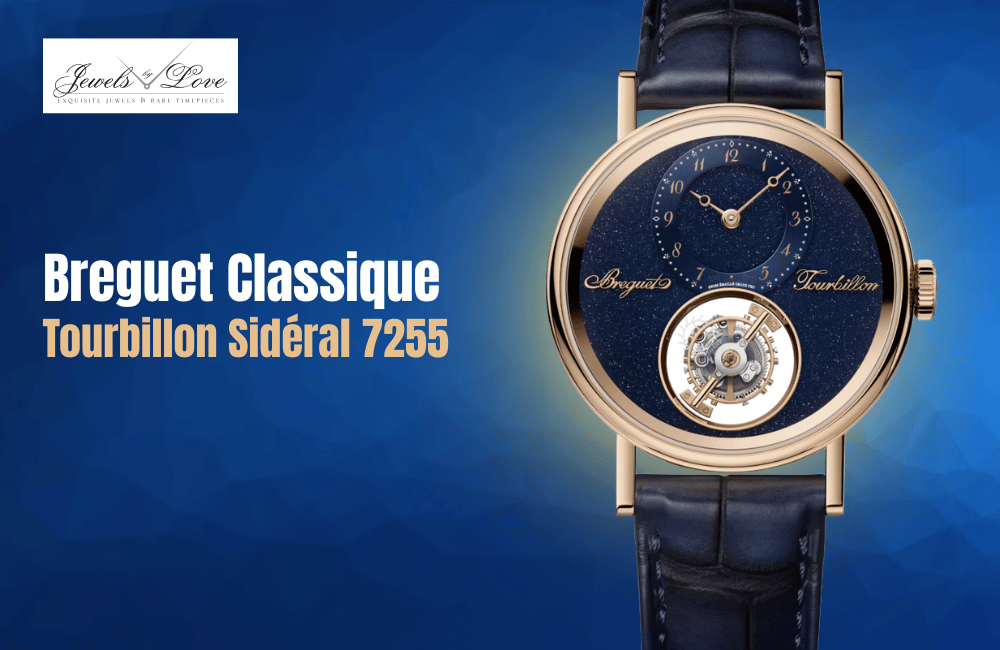
Introduced in 2025 to mark Breguet’s 250th anniversary, the Classique Tourbillon Sidéral 7255 has drawn attention for a clear technical shift within the maison’s tourbillon history. It is the first time Breguet has executed a flying tourbillon, paired with an aventurine enamel dial that evokes the night sky.
Collectors and historians focus on this reference because it revisits the tourbillon as a mechanical concept rather than a display of visual dominance. By removing the upper bridge, the tourbillon is supported solely from beneath, creating a flying construction that leaves the cage fully visible from the dial side. The dial is kept deliberately restrained, allowing the mechanism to be viewed without visual interference.
Even within Breguet’s extensive tourbillon lineage, the Sidéral 7255 occupies a distinct position. Its design choices feel deliberate and measured, reflecting a broader intent to examine how one of watchmaking’s most important inventions can be interpreted today.
This article explores the watch in detail. From the origins of the Sidéral concept, to the engineering decisions behind the movement, to the technical constraints and challenges involved in its execution.
The focus remains on the mechanics, the thinking, and the reasons this reference continues to be discussed beyond its anniversary release.
Let’s get started.
How the Sidéral 7255 Reframes the Tourbillon
Classique Tourbillon Sidéral 7255 addresses the tourbillon from its original problem and was conceived around the same question Abraham-Louis Breguet originally faced - how gravity affects a regulating organ held predominantly in vertical positions. While modern wristwatches no longer suffer from the same positional constraints as pocket watches, Breguet chose to revisit the mechanism as an engineering principle rather than a decorative signature.
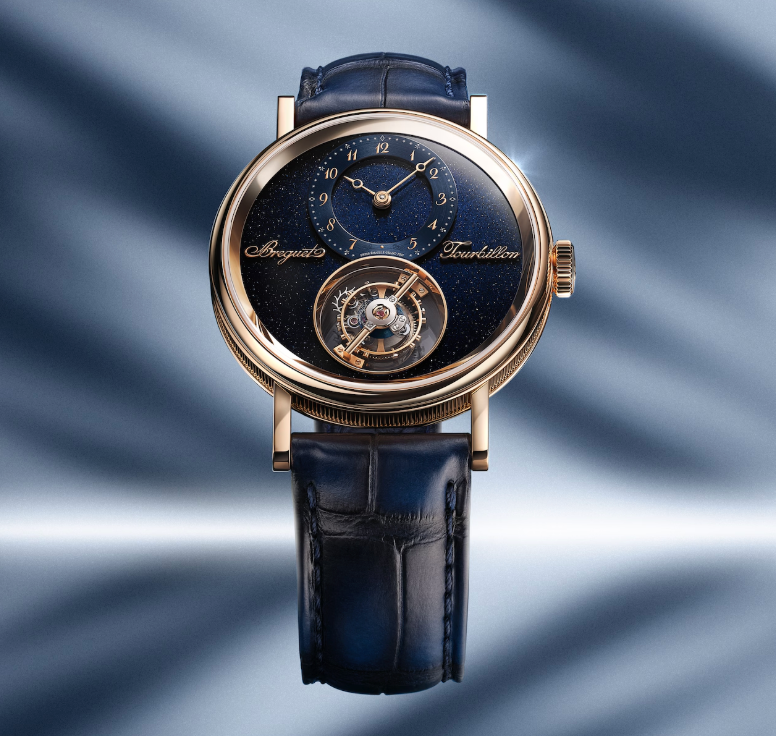
In the Sidéral 7255, that thinking materializes through the maison’s first flying tourbillon. By eliminating the upper bridge, the regulating organ is supported entirely from below, exposing the full geometry of the cage without altering its function. The choice is not made for visual drama. It is made to clarify the mechanism and reduce structural interference around it.
The “Sidéral” designation further grounds this reference in a scientific context. Historically, the term “tourbillon” predates watchmaking and originates in astronomy, where it described rotational motion within the cosmos. Breguet’s use of the word here is deliberate. The rotating carriage becomes a mechanical echo of planetary movement, a concept reinforced by the aventurine enamel dial, which serves as a visual reference to the night sky rather than an ornamental surface.
“Sidéral” places the watch in an astronomical and scientific context, emphasizing motion, rotation, and observation. It reflects how Breguet positions the tourbillon in this model, as a regulator informed by observation, physics, and motion, not as a spectacle.
This approach aligns precisely with the Classique collection’s philosophy. Proportions remain controlled. Decoration is restrained. The focus stays on structure, balance, and mechanical intent. The Sidéral 7255 does not attempt to modernize the tourbillon through complexity. It refines its presentation while remaining faithful to the original engineering problem that gave the mechanism meaning.
If you're curious about the fascinating history of the tourbillon, you'll find a more in-depth discussion in our separate piece, Evolution of the Breguet Tourbillon.
The Appearance of the Classique Tourbillon Sidéral 7255
Every visible element of the Classique Tourbillon Sidéral 7255 is shaped by intent, balancing technical clarity with restrained visual expression.
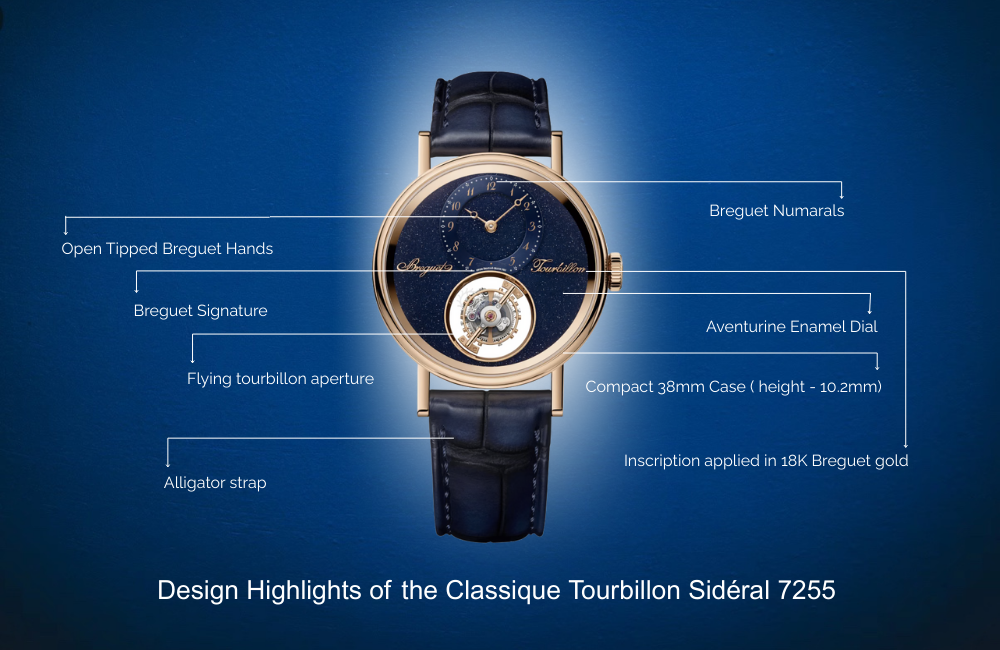
The Aventurine Enamel Dial
The dial is the first clear signal that this reference is not a conventional Classique. For the first time in its history, Breguet uses aventurine enamel, produced through a Grand Feu process. Crushed aventurine glass is incorporated into multiple layers of enamel, each fired at temperatures exceeding 800°C. The process allows little margin for error. Any imbalance in heat or timing can compromise the dial entirely.
Because the distribution of copper inclusions cannot be controlled, no two dials are identical. The surface reads as a deep, luminous blue scattered with metallic points, referencing a star-filled night sky rather than serving as a decorative flourish. The effect is visual, but restrained, intended to support the concept behind the watch rather than dominate it.

Image caption - Applying crushed aventurine particles to the dial base during the Grand Feu enameling process.
Dial Layout and Visual Balance
The time display is deliberately offset, with hours and minutes positioned away from the tourbillon aperture. This asymmetry is a familiar Breguet trait, allowing each element space to exist without visual congestion. Applied Breguet numerals and open-tipped hands maintain legibility against the textured dial surface.
The inscriptions are executed in 18K Breguet gold and kept to a minimum. As with other Classique references, secret signatures are discreetly engraved into the dial, remaining visible only under magnification. The overall composition prioritizes balance and clarity, avoiding visual competition between display and mechanism.
The Floating Tourbillon
At six o’clock sits the defining feature of the reference. The Sidéral 7255 introduces Breguet’s first flying tourbillon, rotating once per minute and serving as the small-seconds indicator. The absence of an upper bridge allows a clear view of the cage and its motion.
The construction goes further through the use of sapphire components. Both the lower bridge and the support of the tourbillon carriage are made from sapphire with anti-reflective treatment, rendering them visually imperceptible. The point of contact between the gear train and the carriage is deliberately offset and concealed beneath the dial. This creates the impression that the tourbillon operates without visible support, while remaining mechanically grounded.
Case Design and Proportions
The case measures 38mm in diameter with a thickness of 10.2mm, dimensions dictated largely by the height of the tourbillon construction. It is crafted in 18K Breguet gold, a proprietary alloy developed for the 250th anniversary, characterised by a subtle, warm tone.
Traditional Classique details are preserved. The caseband is finely fluted. The lugs are straight and welded. Proportions remain compact and controlled, reinforcing the collection’s historical continuity. Water resistance is rated at 30 metres, consistent with the watch’s intended use.
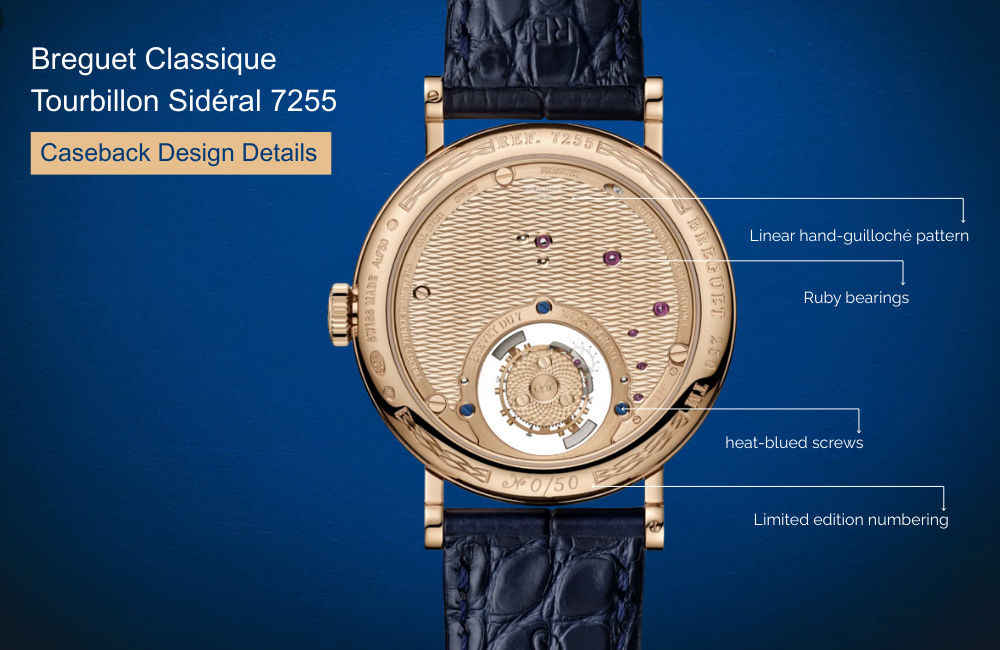
The Classique Tourbillon Sidéral 7255 is limited to 50 numbered pieces and is delivered on a navy blue alligator strap with an 18K Breguet three-blade folding buckle.
Caliber 187M1: Architecture, Restraint, and Mechanical Intent
The mechanical character of the Classique Tourbillon Sidéral 7255 is shaped by a movement conceived to prioritise structure, clarity, and controlled execution. Read further to explore more.
Manual-Winding Architecture and Flying Mystery Tourbillon
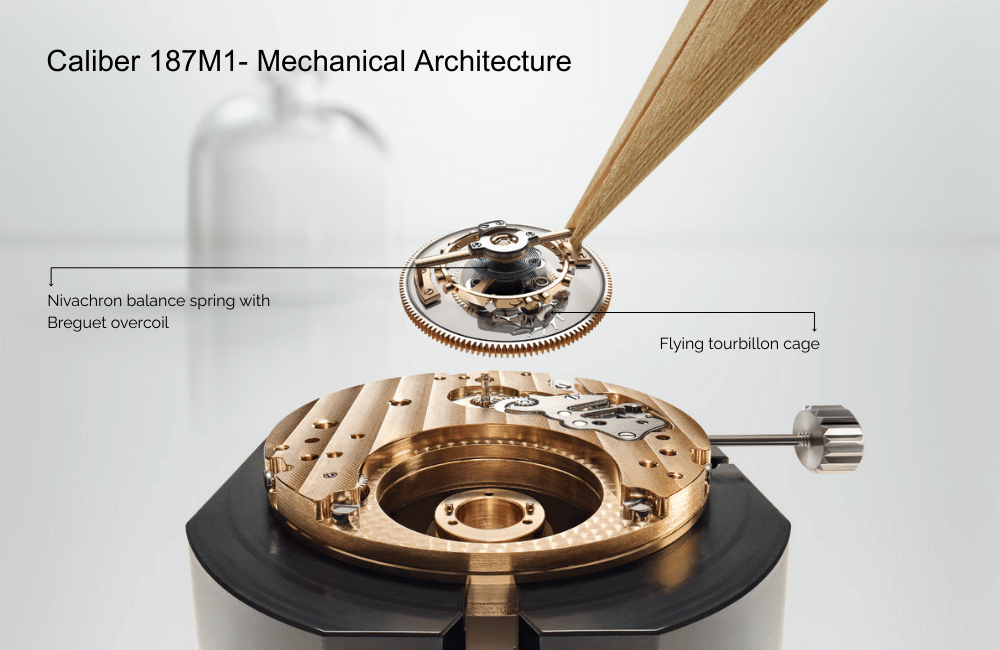
At the center of the Classique Tourbillon Sidéral 7255 is the Caliber 187M1, a manually wound movement developed specifically for this reference. Its design represents a significant break with Breguet’s conventional tourbillon construction by introducing a flying configuration, with the cage supported solely from beneath.
The movement also applies a mysterious construction in order to decrease the visibility of mechanical connections. Sapphire elements replace traditional metal supports at the lower bridge and carriage bearing, treated with anti-reflective coatings to render them visually imperceptible. Power transmission to the tourbillon is deliberately offset and concealed beneath the dial plane, so the one-minute rotating cage looks mechanically isolated but is fully functional.
The tourbillon itself is also the small-seconds indicator, rotating one turn every 60 seconds. Inside the cage resides a free-sprung, screw-poised balance that preserves traditional regulation principles despite contemporary architecture.
Beat Rate, Power Reserve, and Visual Tempo
The Caliber 187M1 works at 2.5 Hz rate, or 18,000 vibrations per hour and 50 hours of power reserve. For sure, this frequency is purposeful. Taking its cues and reducing velocity while attempting to maintain lower frequencies for visual clarity and mechanical calm, Breguet has a slower tempo.
The minimal beat rate enables observation of the escapement and equilibrium without visual agitation. Within the context of the Sidéral 7255, this bolsters the watch’s focus on measured progression, not performance-driven display.
Materials, Regulation, and Long-Term Stability
For the balance spring, Breguet chose Nivachron, a titanium-based alloy resistant to magnetic fields and temperature variation. Nivachron, unlike silicon, may be constructed with a conventional Breguet overcoil, thus preserving its traditional regulating geometry while also improving the stability in the real-world.
The spring is blued to reflect historical aesthetics without relying on legacy materials. The movement plates and bridges are machined from solid 18K Breguet gold, not plated brass. This proprietary alloy is enriched with silver, copper, and palladium that provide improved chemical stability over time, lessening the risk of discoloration whilst maintaining consistent behaviour in finishing and assembly.
Caseback Decoration and Parisian Reference
The case back is transparent, allowing for a direct view of the caliber inside. The Caliber 187M1 features the Quai de l’Horloge guilloché, a pattern made exclusively for the 250th-anniversary collection.
Applying linearly to the movement’s mainplate, this treatment is distinct from typical circular guilloché and requires a sustained level of precision across a broad surface. The motif borrows from the River Seine’s path around the Île de la Cité, which is where Breguet’s historic workshop was located in Paris.
More than decoration, this detail anchors the movement geographically and historically, grounding modern-day execution in the maison’s origins without altering the movement’s mechanical priorities.
Explore Breguet References at Jewels By Love
Jewels By Love is an authorized retailer of Breguet, offering access to the maison’s most respected references through direct brand relationships. Every Breguet timepiece available through us is sourced with authenticity, provenance, and proper manufacturer support.
Our boutique is located in Philipsburg, St. Maarten, a destination known worldwide for duty-free luxury shopping. Collectors and travellers visit us not only for favourable pricing, but for informed guidance and a carefully curated selection of fine watches.
Our team has deep experience with Breguet references, complications, and historical models. Whether you are exploring Classique Tourbillon Sidéral 7255 or any specific tourbillon, comparing collections, or seeking clarity on a particular reference, we are here to assist.
To explore Breguet watches or discuss availability, feel free to contact our team directly. We are always happy to help you make an informed decision.