

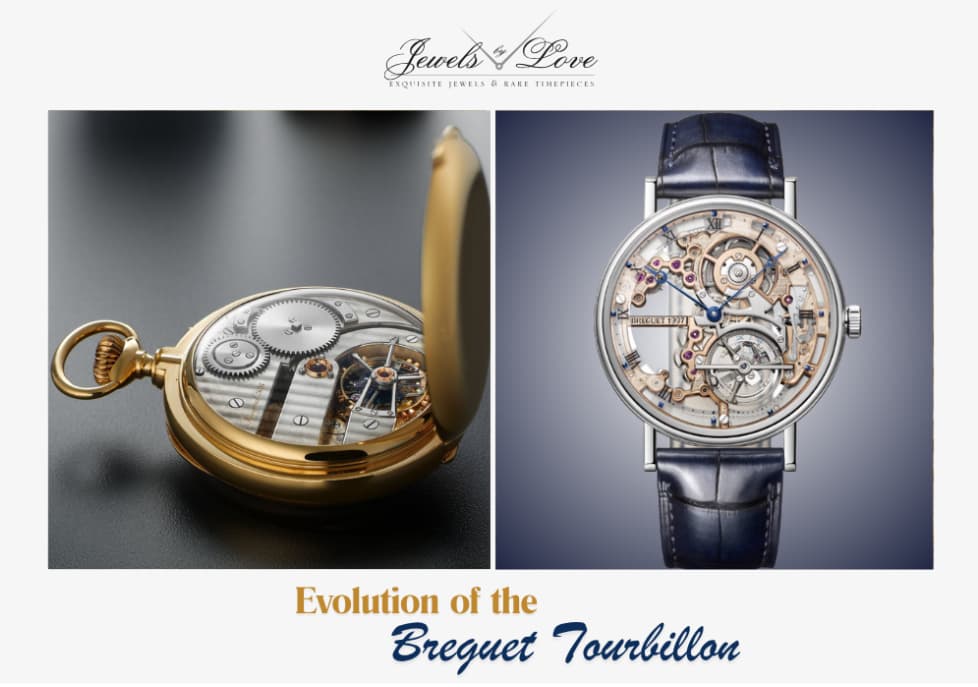
2025 marks 250 years since Abraham‑Louis Breguet opened his Paris workshop “Quai de l'Horloge” in 1775. Few names in watchmaking carry this kind of weight.
In 1801, Breguet changed the course of horology by patenting the tourbillon. This rotating mechanism offsets the effects of gravity on a watch’s movement, improving accuracy. It wasn’t just a technical fix but a bold rethink of how time could be measured more precisely.
Breguet's legacy doesn’t stop there. He introduced self-winding movements, shock protection, overcoil balance springs, and even what many call the first wristwatch, made in 1810 for the Queen of Naples.
This article traces the full arc of the Breguet tourbillon. From that 1801 patent to today’s ultra-slim designs, the story blends invention, refinement, and quiet obsession with precision.
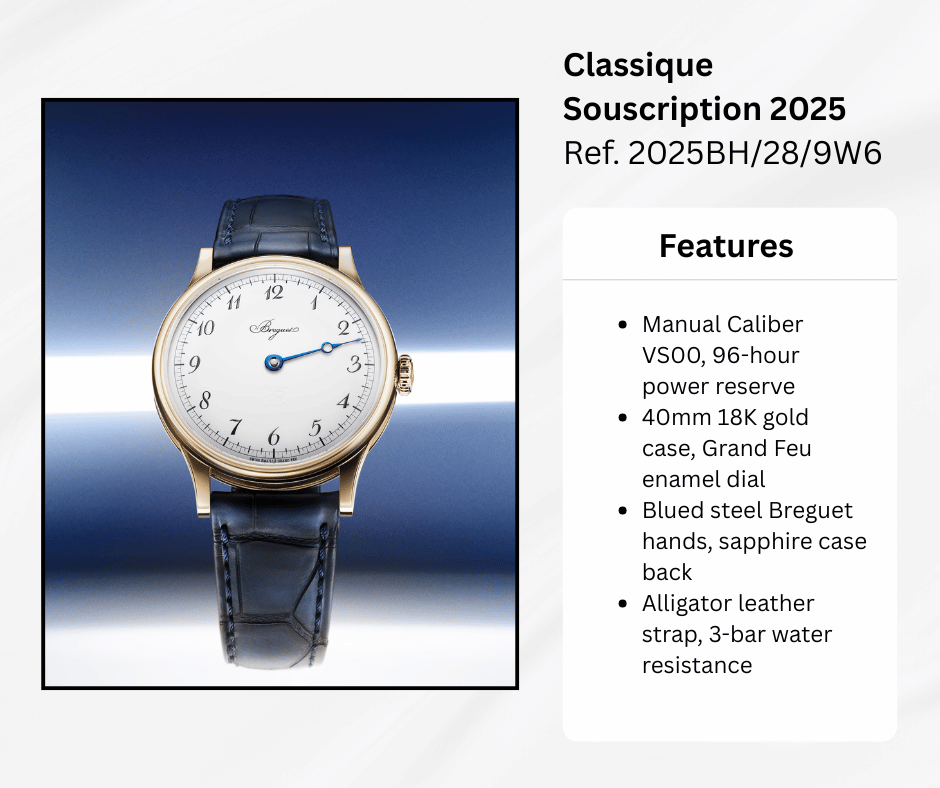
To mark the 250th anniversary, Breguet recently unveiled the Classique Souscription 2025, a clean, single-hand watch modeled after their early subscription pieces, to know more click here. At the other end of the spectrum sits the Classique Tourbillon Extra‑Plat 5367, a mechanical marvel just 7.45 mm thick.
Tourbillons stand out. Not because they shout, but because they show. That spinning cage under the dial is proof of effort, detail, and restraint. In a sea of smartwatches, that still means something.
Let’s get into it.
The Invention of the Tourbillon (1795–1801)
Abraham-Louis Breguet had a problem to solve. Pocket watches in the 18th century didn’t keep consistent time. Gravity pulled differently depending on whether the watch sat upright, flat, or at an angle. For a man obsessed with accuracy, that wasn’t acceptable.
Rather than try to defy gravity, Breguet found a way to work with it.
Between 1793 and 1795, while living in Switzerland during his exile from revolutionary France, Breguet began designing a rotating mechanism that would hold both the escapement and balance wheel. By turning continuously, this cage would average out positional errors caused by gravity. He called the invention the Tourbillon. The word Tourbilion was borrowed from astronomical language that described orderly planetary motion.
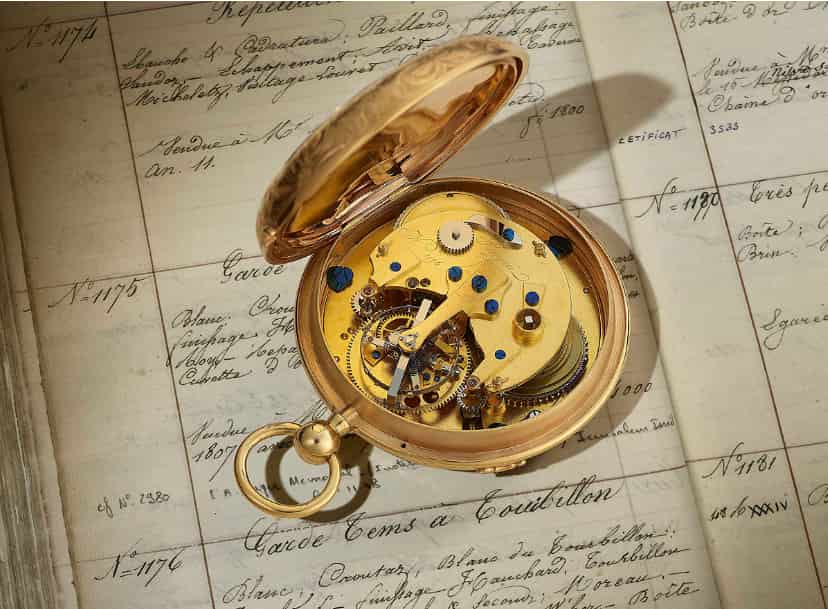
(The Early Tourbillon Developed By Abraham-Louis Breguet)
After returning to Paris, he spent years perfecting the design. On June 26, 1801—7 Messidor An IX in the Revolutionary calendar, he secured a patent for what he called a Tourbillon Regulator.
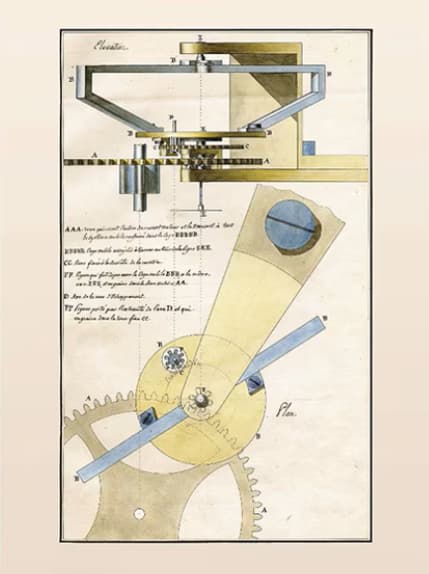
(The patent for the Tourbillon regulator, dated 1801)
In his application to the Minister of the Interior, he explained how it corrected timekeeping anomalies caused by shifting centers of gravity and uneven wear on the escapement. He also noted how the rotating cage helped keep oil evenly distributed and improved long-term performance.
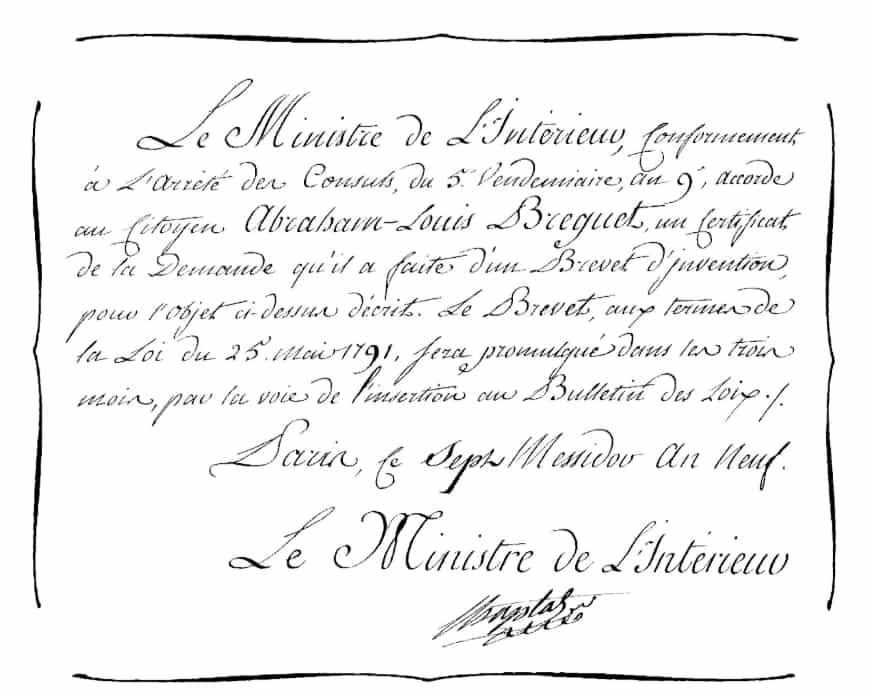
(In this Above Image: Two lines above the signature of Le Ministre de l’Intérieur, the following statement is inserted: ‘Approved and signed by the Minister of the Interior, Chaptal.)
Development didn’t stop with the patent. Between 1796 and 1829, Breguet and his workshop built 40 tourbillon timepieces, plus nine others that were never finished and were recorded in the company’s ledgers as scrapped, lost, or written off.
Out of the 40, 35 were completed and sold. Most did not follow the original patent’s design of a one-minute rotation. Instead, their cages rotated once every four or six minutes. No two were exactly alike. Some featured constant seconds, power reserve indicators, or even built-in thermometers. They weren’t mass-produced but were technical masterpieces, each custom-built.
Some watches were even used for scientific and navigational purposes. A number were carried on ships to calculate longitude at sea. One was taken to Australia by Thomas Brisbane. Another accompanied an explorer into Africa. At least a quarter of the 40 tourbillons were used for marine navigation.
Five additional one-off creations were also made, including a Sympathique clock, a clock and watch set, a large demonstration model, a marine chronometer, and a travel clock.
These early tourbillons weren’t just about precision. They were about proving what was possible. And for Breguet, they represented the fusion of scientific thinking with mechanical skill. The mechanism took more than a decade to perfect and wasn’t a commercial hit at the time. But the fact that nearly 30 of the original 40 are still accounted for today tells you everything about their lasting value.
Tourbillon in the 19th Century
Though revolutionary in concept, the tourbillon saw limited adoption throughout the 19th century, primarily due to its construction difficulty and high cost. It remained an elite complication, reserved for technical chronometers, competition pieces, or specialised applications.
The level of skill required to produce a tourbillon even with advances in watchmaking meant it was still beyond the reach of most workshops. As a result, it continued to represent the pinnacle of horological craftsmanship rather than a commercial success.
Scientific Use and Marine Chronometry
Many of Breguet’s original tourbillons, as well as later examples were used in scientific contexts, particularly for marine navigation. At least a quarter of the original 40 were carried aboard ships to help calculate longitude, where reliability across different positions was critical.
One tourbillon was taken to Australia by Thomas Brisbane, a colonial governor and respected astronomer. Another supported an African expedition. These were not simply luxury watches, they were serious instruments.
Patrons of Precision
Throughout the 19th century, the tourbillon remained a symbol of distinction. It was favoured by monarchs, scientists, aristocrats, and explorers. Breguet’s client list continued to grow, with his tourbillons being commissioned by:
- George III and George IV of England
- Ferdinand VII of Spain
- Princes Yermoloff, Gagarin, Repnin, Demidoff (Russia)
- Count Potocki (Poland)
- Prince Hardenberg (Prussia)
- Baron Podmaniczky (Hungary)
- Chevalier de Brito (Portugal)
20th Century: Dormancy and Revival
After the death of Abraham-Louis Breguet, the tourbillon entered a prolonged period of rarity. From the early 19th century into the 20th, production remained extremely limited. The intricacy of the mechanism and the time required to manufacture it made it suitable only for specialised commissions and precision chronometry. Across more than a century, fewer than 900 tourbillons were made globally, most of them built for observatory competitions or scientific application. The complication survived quietly in the hands of a few master craftsmen, never intended for broader production.
By the 1970s, the Swiss watch industry faced an existential challenge. The introduction of battery-powered quartz watches, offering unprecedented accuracy at a fraction of the cost, disrupted nearly every established manufacturer. Mechanical watchmaking declined sharply. Complications like the tourbillon, once held as technical pinnacles, were risked becoming museum pieces rather than meaningful engineering achievements.
In the years that followed, mechanical horology slowly began to recover. This resurgence wasn’t driven by volume or affordability but by a renewed appreciation for heritage and human ingenuity. In this context, the tourbillon returned not as a relic but as a symbol of continuity, a mechanical idea that still had relevance, not in competition with quartz but in contrast to it.
During this period of revival, Breguet gradually reasserted its role as the originator of the tourbillon. The brand returned to the complication it had introduced in 1801, refining its execution and integrating it into new wristwatches that respected the principles laid down by its founder. These modern interpretations did not aim to replicate the past but rather to advance it with thinner profiles, improved materials, and enhanced precision, always built around the original concept of regulating time through motion.
Rather than fade, the tourbillon evolved and Breguet remained at the heart of that evolution, bridging the invention of the 18th century with the demands and expectations of the modern era.
Breguet’s Modern Tourbillons (1990s–2000s)
Following its acquisition by the Swatch Group in 1999, Breguet began reasserting its identity as the original creator of the tourbillon. The revival was not simply nostalgic. It was technical, architectural, and deeply intentional. Modern tourbillon models were developed to push boundaries in both innovation and aesthetics, without losing sight of the brand’s classical DNA.
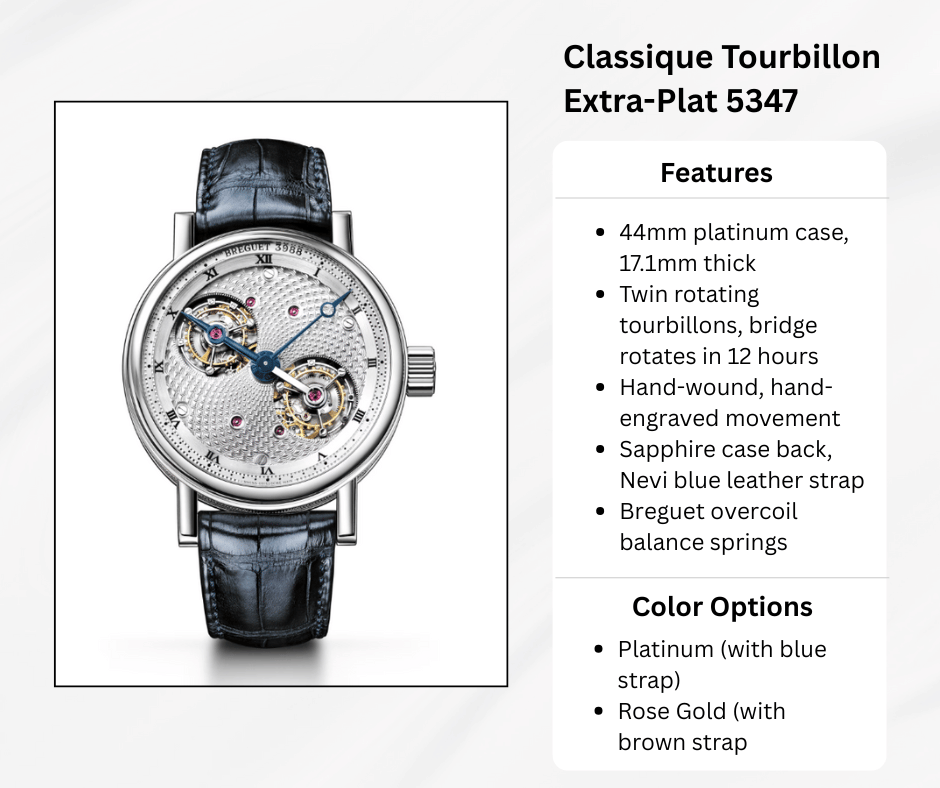
Classique Complications 5347
Released in 2006, the Classique Complications 5347 stands out for its double tourbillon mechanism. Two independent one-minute tourbillons are connected by a central differential and mounted on a rotating plate that completes a full revolution every 12 hours. The bridge connecting the two tourbillons serves as the hour hand, while a traditional minute hand completes the display. The result is kinetic, balanced, and deeply rooted in Breguet’s technical tradition.
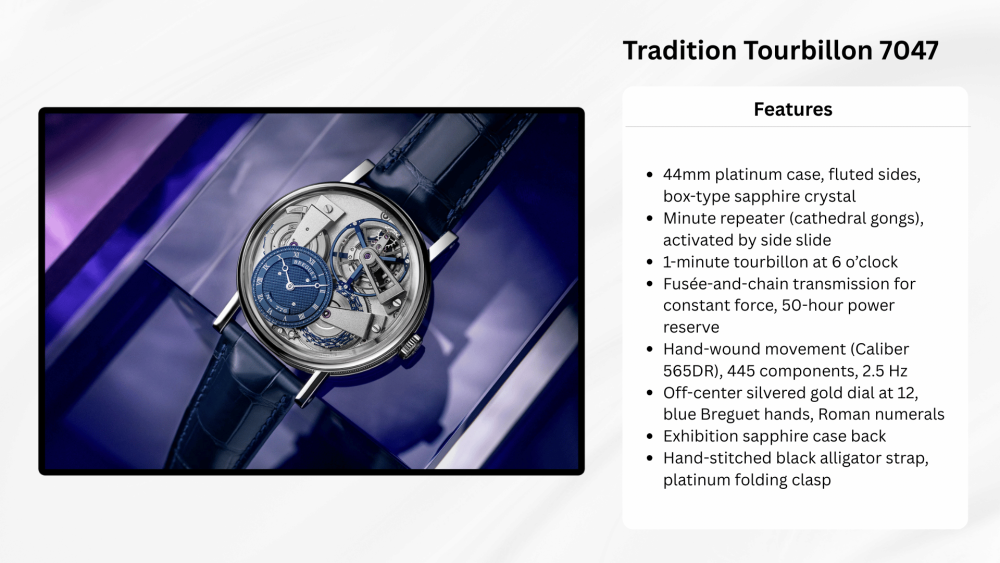
Tradition 7047
Introduced in 2012, the Tradition 7047 reinterprets historic techniques with modern execution. It features a fusée-and-chain constant force mechanism paired with a one-minute tourbillon, designed to deliver consistent energy as the mainspring unwinds. The addition of a silicon balance spring ensures greater resistance to temperature variation and magnetic fields, marking a clear step forward in long-term precision. Watch this youtube video to know more about Breguet Tradition 7047.
References 5377 and 5395
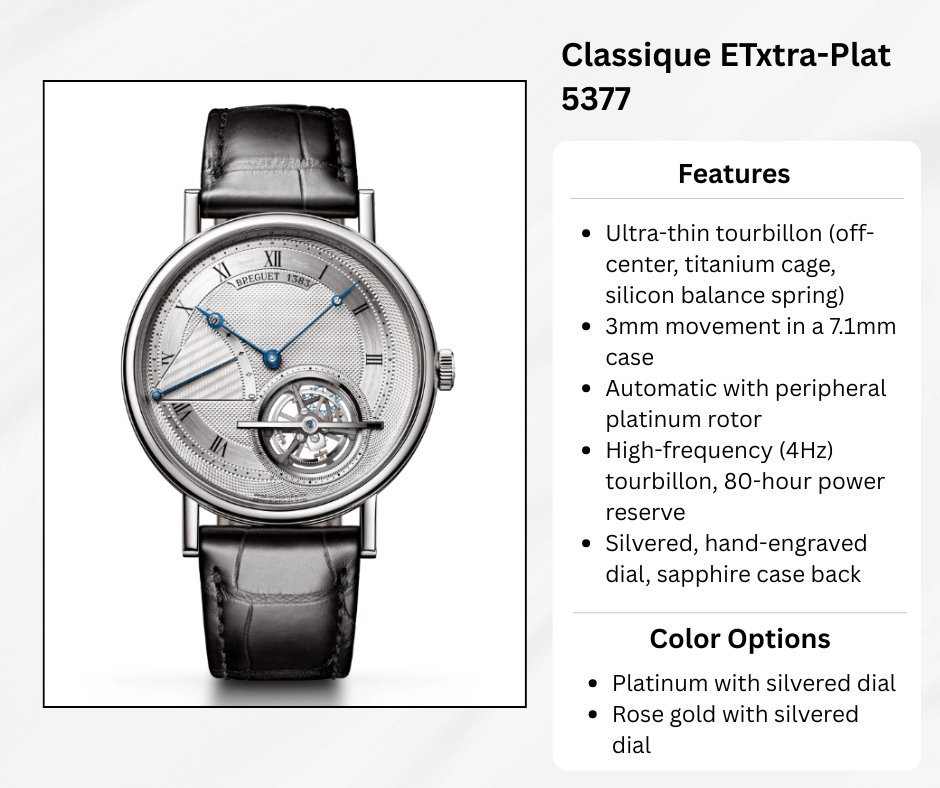
Breguet’s pursuit of mechanical elegance led to two standout models: the Classique ETxtra-Plat 5377 and the Classique Squelette 5395. Watch this video for the indepth visual walk through about classique Squelette 5395. The 5377, released in the mid-2010s, incorporates a self-winding tourbillon movement just 3mm thick. Its high-beat silicon escapement and peripheral rotor deliver an 80-hour power reserve without sacrificing slimness.
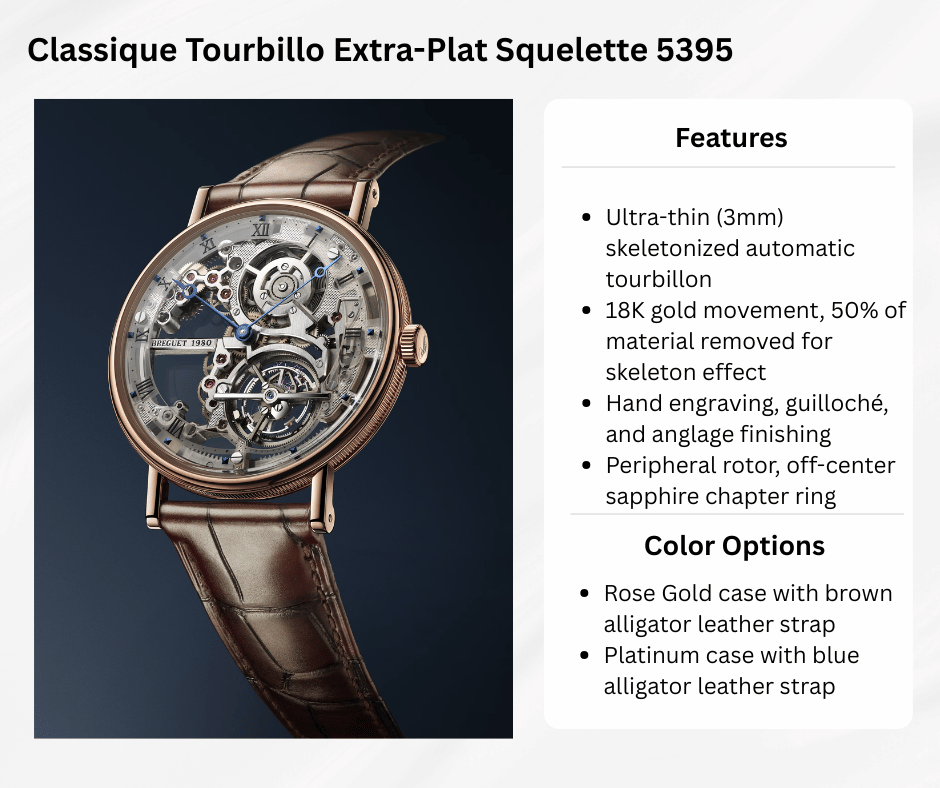
Taking that even further, the 5395 reveals the entire movement through meticulous skeletonization. Almost nothing is hidden, the bridges, gears, tourbillon, and rotor are fully exposed through both sides of the sapphire case. The skeletonized gold movement is hand-finished and suspended inside a 41mm case, merging openwork artistry with compact engineering.
Evolution of Mechanics and Design
While these models are technically advanced, they are equally committed to visual impact. Breguet’s use of engine-turned (guilloché) dials, layered bridges, and blued hands preserves the visual codes established in the 18th century. Sapphire casebacks and dial apertures allow the tourbillon to be admired from all angles. Whether fully skeletonized or subtly integrated, the cage is never hidden, it is the centrepiece.
The result is a modern tourbillon collection that respects the original 1801 concept while clearly expressing 21st-century watchmaking values.
Technical Evolution and Innovations
Originally designed to counteract gravity in vertical pocket watches of the early 19th century, the tourbillon underwent a transformation with the rise of wristwatches. This shift became prominent in the late 20th century, when the complication moved from being hidden under the dial to being fully visible on the dial side. This choice marked a philosophical pivot. The tourbillon was now both a tool and a spectacle, an exposed display of mechanical finesse.
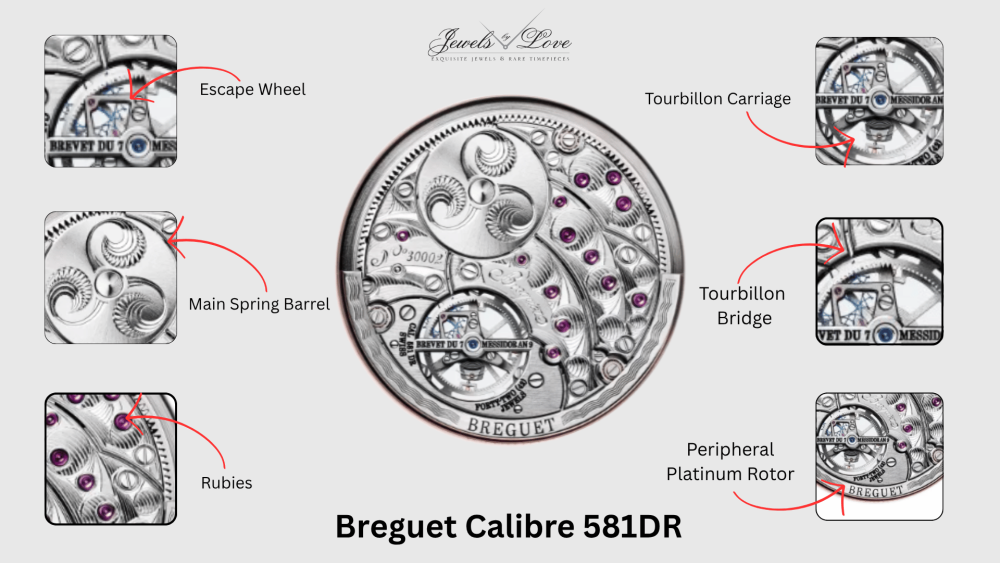
In 2013, Breguet introduced Calibre 581DR, one of the slimmest self-winding tourbillon movements ever made, measuring just 3 mm thick. It features a titanium tourbillon cage, a silicon balance spring and escapement, and operates at 4 Hz, offering an impressive 80-hour power reserve. Its peripheral rotor keeps the mechanism slim, while its structure allows full visibility of the movement through the dial.
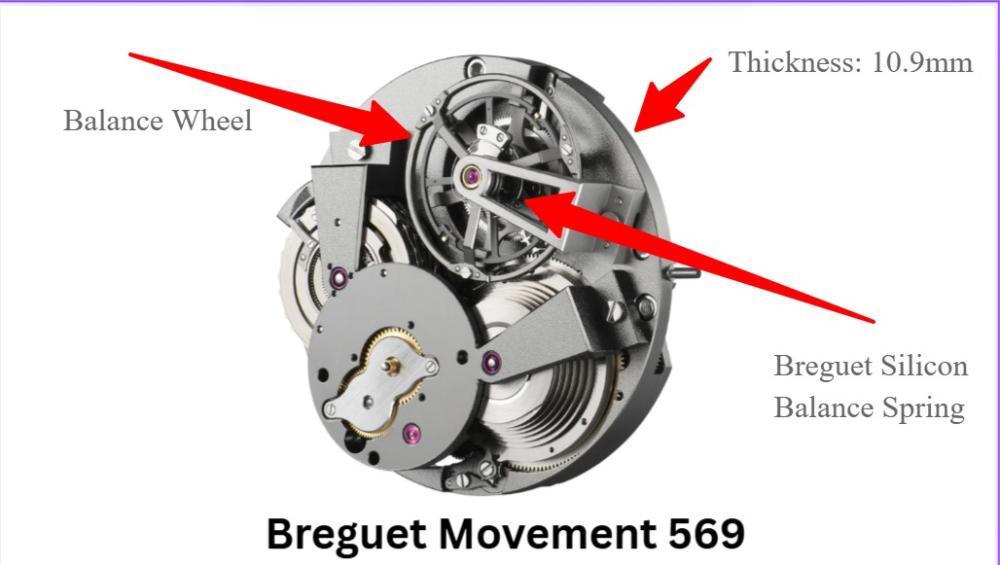
The Tradition 7047 (launched in 2012) has Movement 569 which marked another technical step forward. It combined a fusée-and-chain transmission for consistent torque delivery with a silicon balance spring, a combination designed to optimise isochronism, even as the mainspring unwinds. These developments reflected Breguet’s historical values brought into a contemporary framework.
Advancements in materials played a central role in modern tourbillon innovation. Titanium cages reduced weight and inertia, enhancing efficiency and durability. Silicon, first used by Breguet in the early 2000s and increasingly adopted across collections, offered unmatched resistance to magnetism and temperature shifts. Gold remained in use, particularly for bridges and decorative finishing, preserving visual warmth and traditional prestige.
In today’s context, the tourbillon walks a line between chronometric function and artistic expression. Its mechanical benefit, averaging positional error, still holds value. But its visible placement, guilloché finishing, openworked bridges, and sapphire architecture elevate it beyond mere accuracy. It has become a statement of legacy, complexity, and craft, all measured in slow, deliberate rotation.
Explore Breguet Models at Jewels by love (an authorized breguet retailer)
With six generations of expertise in fine watchmaking, Jewels by Love is far more than a luxury boutique, it's a trusted name handpicked by the world’s most revered watchmakers. Among them stands Breguet, a house synonymous with horological innovation since 1775. The partnership between Breguet and Jewels by Love is built on deep-rooted heritage, technical mastery, and a mutual commitment to excellence.
As an official retailer of Breguet, Jewels by Love brings the brand’s legacy to life located in one of the most iconic destinations for luxury shopping: St. Maarten which is internationally celebrated for its duty-free status.
Explore Breguet timepieces with us from tourbillon masterpieces and the Tradition series that reveals the brand’s mechanical roots, to the elegant Classique collection and the contemporary sophistication of Marine chronometers. Whether you're drawn to heritage-inspired design or innovative engineering, each piece speaks to centuries of uncompromised watchmaking.
Visit Breguet, Patek Philippe, Cartier and Nomos collection on our website and contact us directly for any enquiry. We're here to assist with expert guidance and personal attention.