

There are few things in watchmaking that can still make people pause. The minute repeater does. At a press of a slide, the watch begins to sing a rhythm of notes counting out the hours, quarters, and minutes.
Originally, it solved a simple problem: telling time in the dark. Centuries later, that same idea still feels magical. Today, a minute repeater isn’t about need. It’s about fascination that makes a collector lean in just to hear how each note hangs in the air. Building one takes months of patient assembly, endless adjustments, and a tolerance for frustration that borders on obsession. It’s less a feature and more a statement of what’s still possible when watchmaking borders on art.
In this detailed exploration, we’ll journey through the rich history of the minute repeater, examine the craftsmanship that goes into each piece, and explain exactly how this complex mechanism works
A Brief History of the Minute Repeater
Long before glowing dials and streetlights, people told time by ear. Church bells marked the hours, echoing across towns. The next leap came when watchmakers wondered: could a pocket watch do the same on demand?
The 1600s: Sparks of Invention
Around 1676, Reverend Edward Barlow was said to have created a mechanism that allowed a clock to chime whenever requested. While many credit him with this early idea, there’s little concrete evidence to prove it. What’s known is that his supposed system , a rack and snail arrangement, became the foundation on which later repeating mechanisms were built.
The earliest known example of this mechanism in action was built by Joseph Knibb, a gifted English clockmaker whose work gave Barlow’s idea a tangible form.
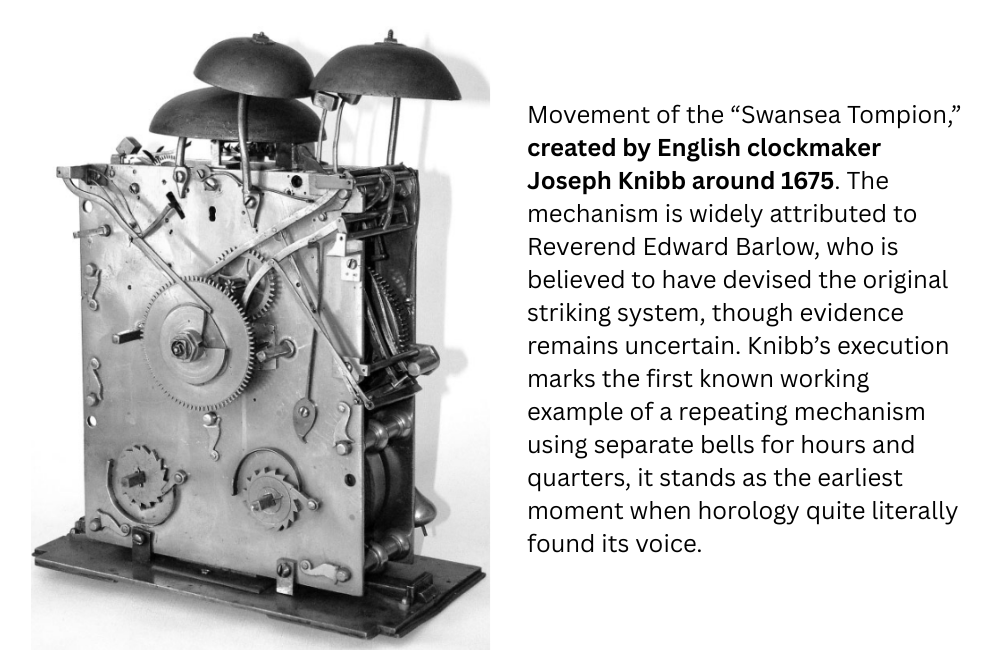
At the same time, London craftsman Daniel Quare was developing his own interpretation of the concept. Both men claimed the invention, prompting King James II to intervene. The King’s council examined their prototypes Barlow and Knibb’s two-button design versus Quare’s single-trigger solution and ultimately sided with Quare for its simplicity and elegance. That decision effectively established him as the father of the repeating watch.
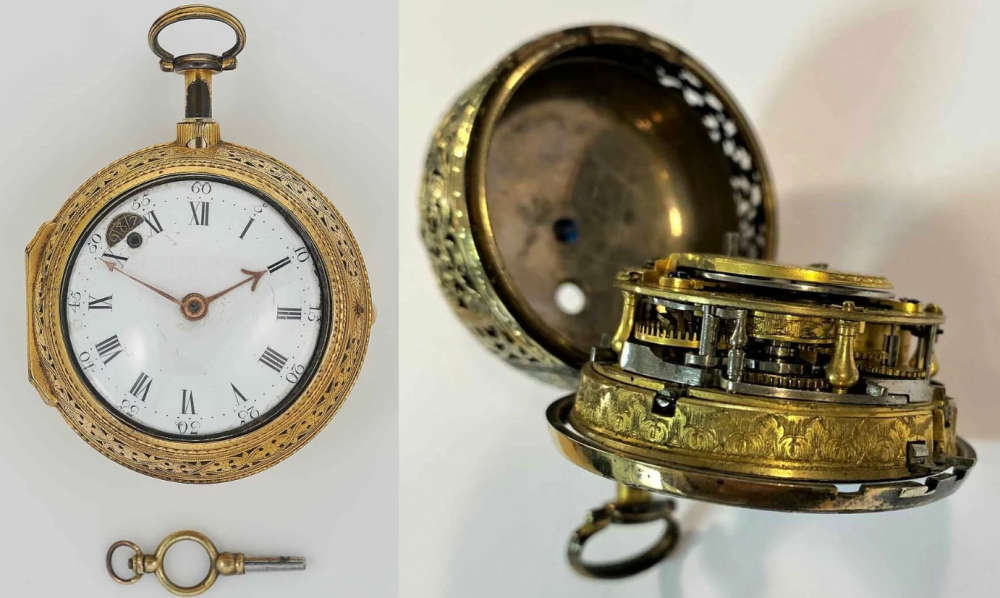
Image Caption: A repeating watch by Daniel Quare c.1700.
From Quarters to Minutes
Early repeaters could only strike the hours and quarter-hours. By the early 1700s, watchmakers pushed the concept further.
Thomas Mudge, a brilliant English horologist, advanced the design around 1750, enabling it to count the individual minutes past the quarter. For the first time, a watch could sound five-fifty-three with distinct low, double, and high tones. A mechanical melody that truly told time.
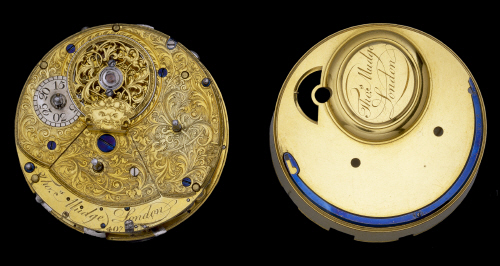
Image Caption: Minute repeating clock created by Thomas Mudge in | Source: The British Museum
The Silent Touch
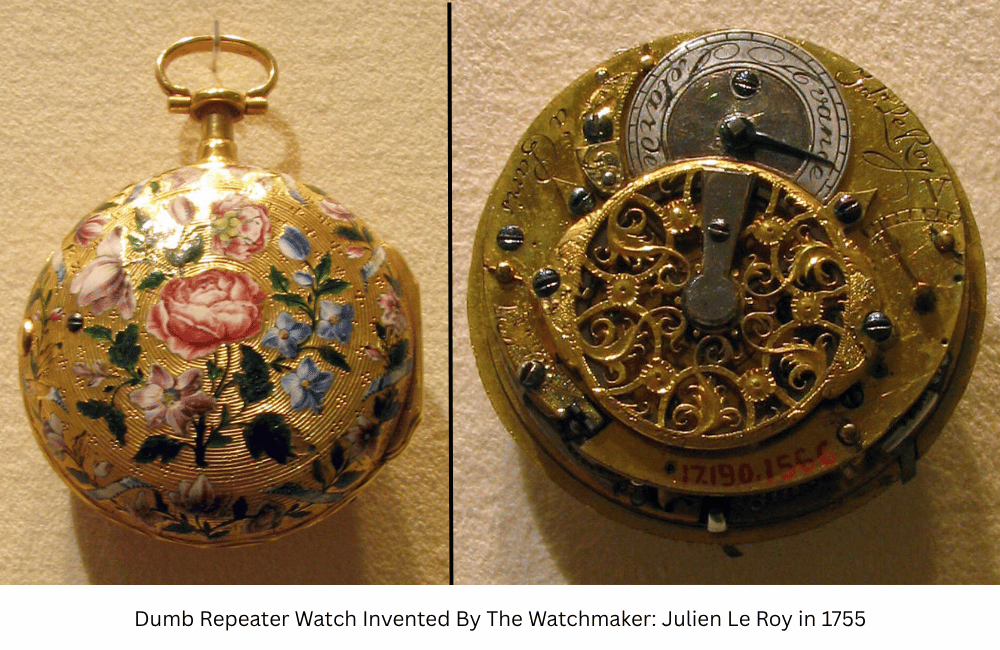
Not everyone wanted to broadcast the hour. Around the mid-18th century, French watchmaker Julien Le Roy introduced the “dumb repeater,” which replaced chimes with soft vibrations felt through the pocket or wrist. It allowed aristocrats to check the time silently during court sessions or private meetings without drawing attention. Functionally quiet, yet culturally unmistakable.
Breguet’s Revolution
Then came Abraham-Louis Breguet, whose name still carries weight in any serious watch conversation. In 1783, he replaced bulky bells with slender steel gongs coiled around the movement. The result: slimmer watches with clearer tone.
He also developed the “all-or-nothing” safety system, which prevented half-pulled slides from misfiring, a small change that made a big difference in reliability. Breguet’s repeaters, like his No. 1790 and the legendary “Marie Antoinette” pocket watch, became blueprints for everything that followed.
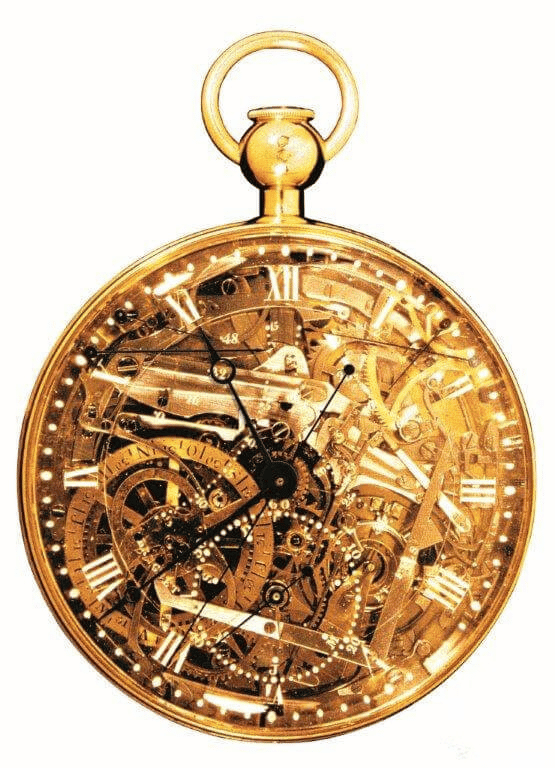
Image Caption: Abraham-Louis Breguet’s pocket watch No. 160, commissioned in 1783 for Queen Marie Antoinette of France, was conceived as a showcase of every advanced horological feature of its time.
If you’re interested in knowing how Breguet’s creative vision later evolved particularly through his Reine de Naples collection, you can explore its fascinating history in detail.
19th-Century Refinement
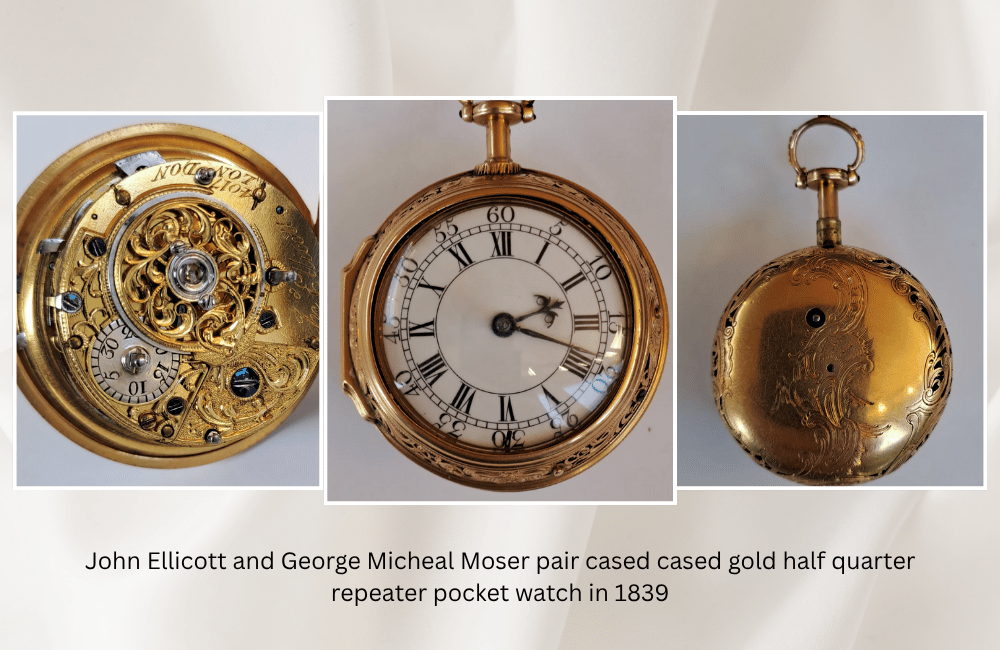
By the 1800s, repeaters had evolved from rare curiosities to prized possessions of the wealthy. London’s John Ellicott helped move them from one-off commissions to limited production runs.
Swiss workshops quickly joined in. Patek Philippe, founded in 1839, completed its first chiming pocket watch by 1845.
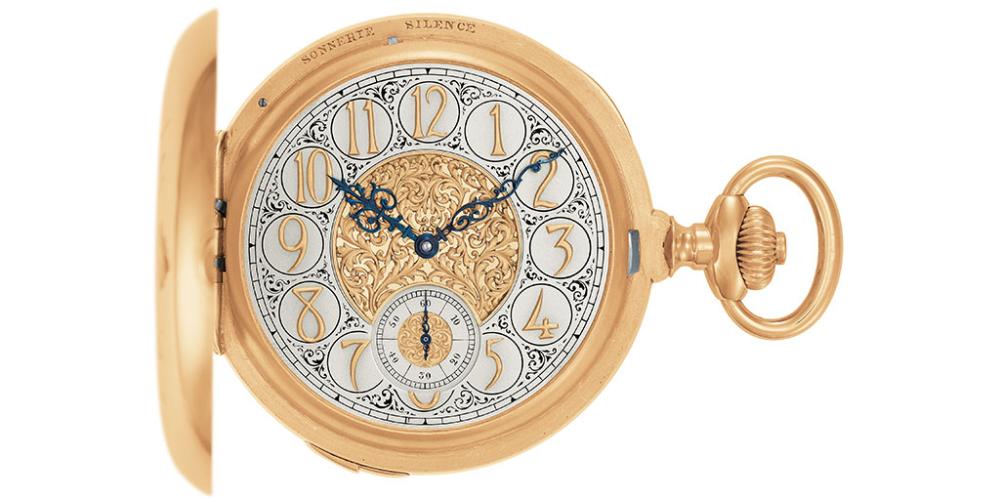
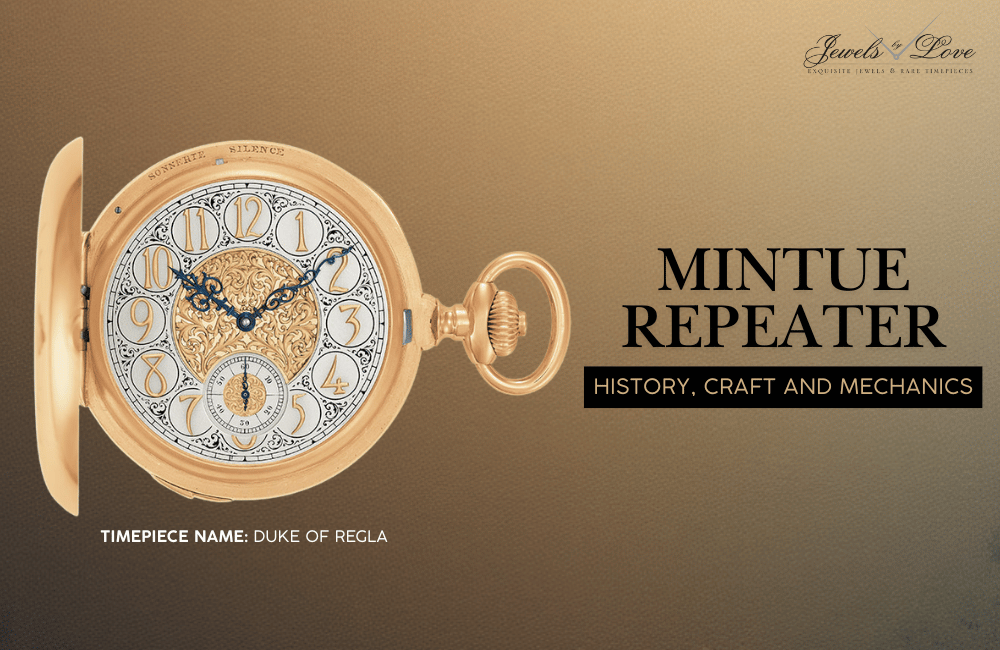
Image Caption: Patek Philippe minute repeater with grand and petite sonnerie and the highly complicated Westminster chime made for the Duke of Regla in 1909. Image credit: Patek Philippe
Soon after, brands like Vacheron Constantin and Audemars Piguet followed suit. Bells were out, gongs were in, and the minute repeater became the ultimate showcase of mechanical artistry.
Onto the Wrist
Shrinking that complexity into a wristwatch was another matter. In 1892, Audemars Piguet created the first known wrist-worn repeater at the request of Louis Brandt, founder of Omega.
It was more experiment than revolution, essentially a small pocket movement on straps but it proved possible.
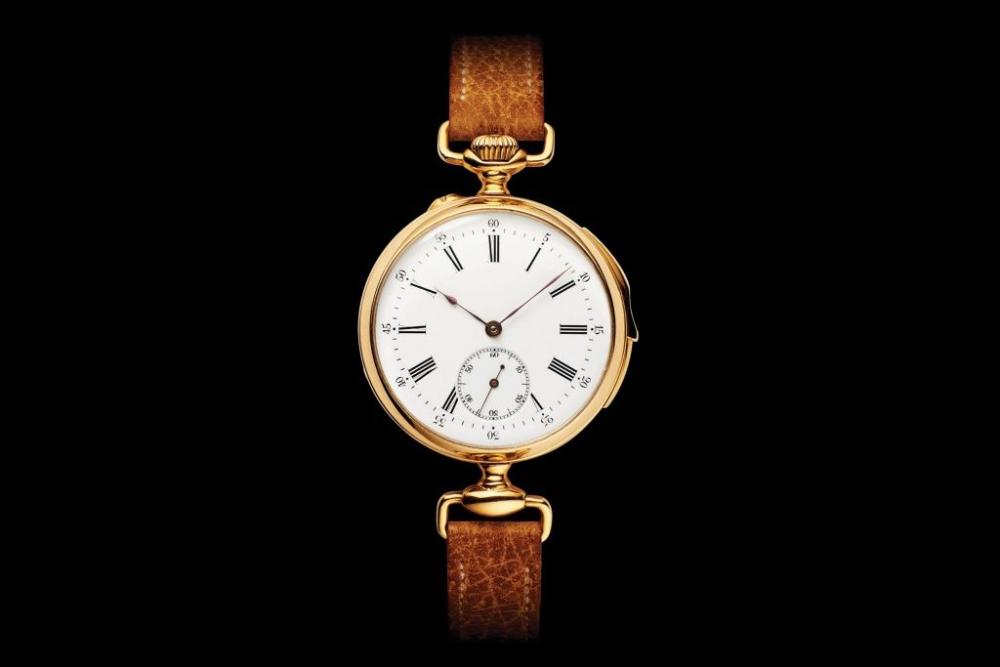
Image Caption - In 1892, Audemars Piguet built the first wrist repeater for Omega founder Louis Brandt.
A few decades later, Patek Philippe refined the concept. By the 1920s, the brand was producing minute repeater wristwatches in tiny numbers, often made to order for well-known patrons such as American engineer Ralph Teetor.
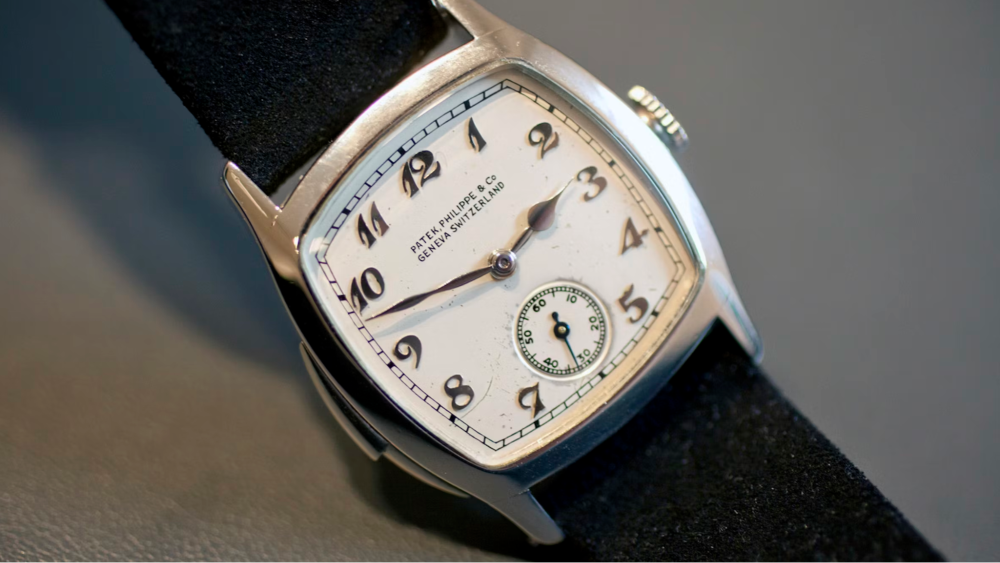
Image Caption: Patek Philippe’s platinum tonneau minute repeater, made for famed collector Henry Graves Jr. in 1928.
These early Patek repeaters were showcases of hand-finishing and acoustic tuning, built case by case rather than for catalogues. Each one reflected the client’s taste from dial layout to case metal which is why surviving examples are so fiercely collected today.
Decline and Revival
World War II and the Quartz era nearly silenced repeaters altogether. Mechanical extravagance fell out of favour, and only a few master watchmakers kept the know-how alive.
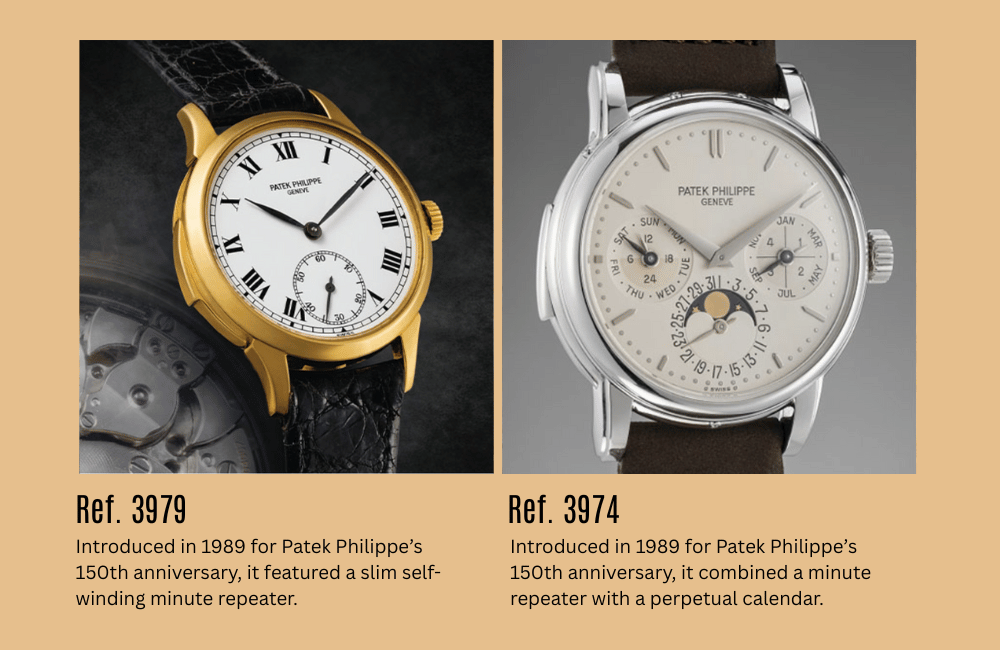
Then, in the late 1980s, the chime returned. Patek Philippe’s 150th-anniversary collection reintroduced new repeater calibres like the Ref. 3979 and Ref. 3974, reigniting interest across the industry.
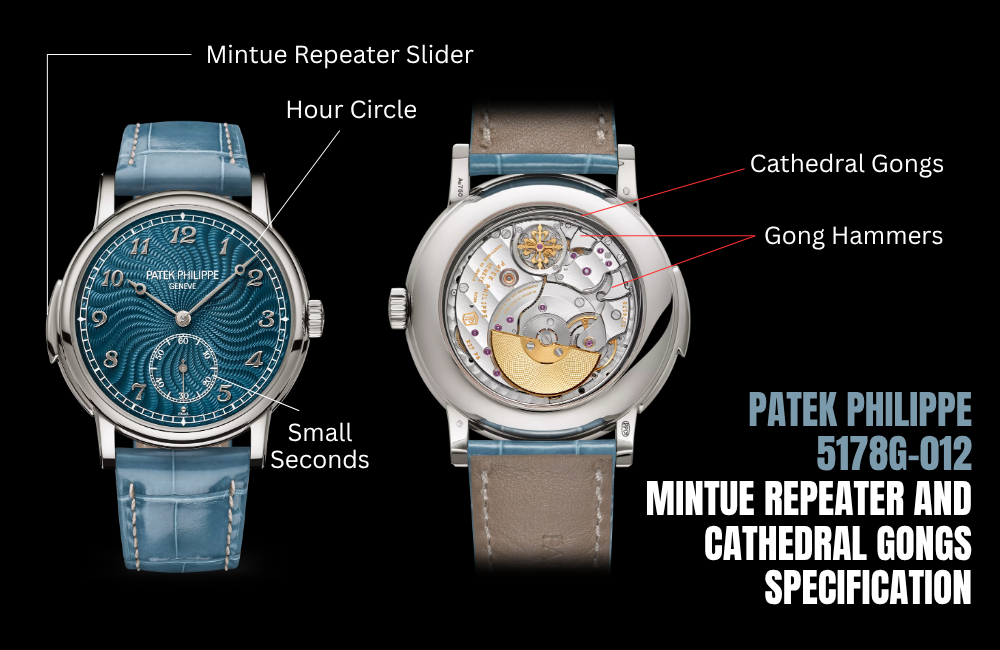
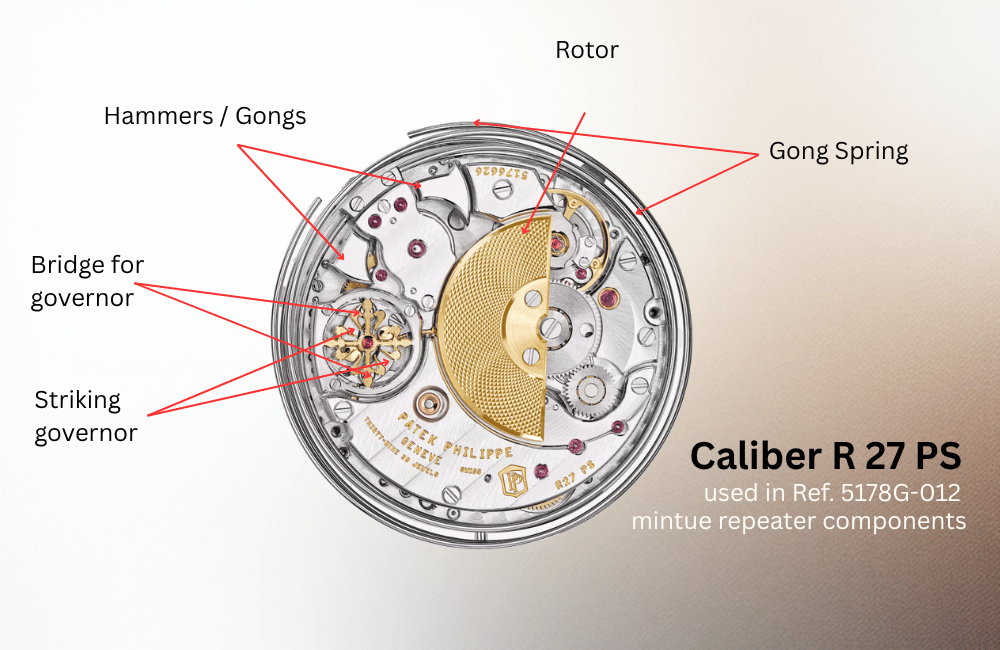
The revival reached its peak with the Patek Philippe Ref. 5178G, powered by the Caliber R 27 PS with twin cathedral gongs that deliver its unmistakable tone. To discover how this masterpiece brings sound and precision together, read the full story here: Patek Philippe 5178G-012 Minute Repeater Explained
Vacheron Constantin, Audemars Piguet, and Breguet soon followed. Later, A. Lange & Söhne brought its German precision to the stage, while modern creations like the Zeitwerk Minute Repeater proved that innovation and tradition could still coexist.
Today’s Meaning
Modern repeaters serve no practical purpose. And that’s exactly the point. They exist for the same reason a Stradivarius still captivates musicians because sound, when shaped by human hands, can still move us.
Each chime is a reminder of how far watchmaking has come and how much of it still depends on patience, intuition, and touch.
The Craft and Artistry Behind Minute Repeaters
Inside the Most Demanding Watch Mechanism
At its core, a minute repeater is a mechanical timekeeper that can chime the exact time on demand. When the slide on the case is activated, it winds a separate spring that powers a sequence of gears and levers. These components translate the time shown on the dial into sound hours, quarters, and minutes. Each represented by a distinct tone. The system works entirely mechanically, without electronics or amplification, relying only on the precision of its parts and the sensitivity of its tuning.
A typical repeater movement contains 300 to 400 individual components, some so small they can be mistaken for dust. These include racks that “read” the position of the hands, snails that define how many strikes are needed, hammers that create the sound, and gongs that act as the instrument’s strings. Every piece must be hand-fitted under a microscope, because even a fraction of a millimetre in misalignment can throw the entire sequence off.
From Metal to Melody
The gong's thin steel wires shaped into coils are the soul of a repeater. They’re carefully hardened, filed, and tuned by ear, often taking days to reach the correct pitch and harmony. When the hammers strike them, one delivers a low tone for hours and another a higher tone for minutes. Quarters are represented by a double chime both hammers hitting in sequence. The challenge is achieving a balance between clarity and warmth; too tight a gong can sound sharp, while too loose can blur the rhythm.
Hammers are equally important. Each must hit with consistent force, then rebound instantly to avoid muting the next note. The tiniest misalignment changes the sound. Watchmakers adjust these by hand using a loupe and listening repeatedly. It's as much about intuition as it is about engineering.
Finishing and Adjustment
Before assembly, every part is finished by hand. Bridges are beveled, screws polished, and surfaces decorated with patterns such as Geneva stripes or perlage. These finishes don’t just serve aesthetics; they also reduce friction and protect against oxidation. Even hidden components receive the same attention because in haute horlogerie, craftsmanship isn’t only what you see; it’s what you know is there.
Once assembled, the watchmaker spends weeks tuning the mechanism. They test the rhythm, adjust hammer strength, regulate gong length, and listen for imperfections in resonance. Each repeater must strike at a consistent tempo with clean transitions between tones; the “voice” of the watch is entirely unique to the person who built it.
The Case: Where Sound Comes to Life
The case isn’t just decoration; it’s the resonator. Its metal, thickness, and shape dictate how the sound travels. Gold tends to produce a richer tone, while platinum, being denser, dampens it. Some watchmakers subtly thin the case walls or mount the gongs directly onto the movement to enhance vibration. Even the crystal above the dial and the openings around the slide influence the acoustics.
To preserve resonance, most repeaters aren’t designed for deep water resistance. A tightly sealed case would trap the sound inside. Instead, they’re constructed like musical instruments open enough to let the chime breathe naturally.
Tradition in Motion: How Modern Watchmakers Keep the Repeater Alive
Even with advanced tools and computer-assisted design, the minute repeater remains a creation of human hands and ears. The process hasn’t changed much in centuries; every part is still adjusted, assembled, and tuned by a single craftsman.
At Patek Philippe, repeaters spend weeks in acoustic testing. Each chime is listened to, refined, and approved by Thierry Stern, whose ear ultimately decides whether the sound meets the brand’s standard.
Breguet continues to mount its gongs directly on the movement for stronger resonance, tuning each pair by hand for harmony. A. Lange & Söhne takes a more technical route assembling its repeaters twice to perfect alignment and precision, while models like the Zeitwerk Minute Repeater modernize the idea with a decimal striking system.
Other maisons such as Vacheron Constantin, Audemars Piguet, and Cartier experiment with new materials and sound chambers, blending innovation with tradition. Yet despite these advances, the final judgment always comes from the ear, not the machine.
The minute repeater endures because it connects modern engineering with the oldest form of craftsmanship sound shaped by skill, patience, and instinct.
The Mechanics: How a Minute Repeater Works
A minute repeater converts the time shown on its hands into a precise sequence of sounds. Everything happens mechanically, powered by its own spring and controlled by a chain of cams, racks, levers, and hammers that work in perfect rhythm.
Step 1 - Activation
Sliding the lever on the side of the case winds a small, dedicated spring. This spring powers the repeater independently of the main timekeeping system. An all-or-nothing mechanism ensures that unless the lever is fully pushed, the process won’t begin avoiding any partial or mistimed chimes.
Step 2 - Reading the Time
Inside the movement, three cams (snails) constantly rotate with the watch’s gears: one for hours, one for quarters, one for minutes. Each has stepped surfaces that represent numerical intervals.
When the repeater is activated:
Three racks, each with a tiny “beak,” drop onto the snails.
The beaks rest at different depths depending on the time, determining how many strikes are needed.
A small spring-loaded surprise piece ensures the racks align perfectly at quarter times, preventing errors.
These cam snails sit beneath the dial, moving in sync with the hands. When the racks drop, they trace each snail’s steps to “read” the time mechanically. The hour snail sets the low tones, the quarter snail defines the double chimes, and the minute snail controls the final high notes that turning motion into music with flawless precision.
Step 3 - Relaying the Chime
Each rack is toothed like a gear. As it rotates, its teeth sequentially trigger hammer trips that pull back and release the striking hammers.
The sequence always plays in three parts:
Hours: Low tones, one per hour.
Quarters: High-low pairs (“ding-dong”) for each 15-minute interval.
Minutes: High tones, one per minute past the last quarter.
Step 4 - Regulation
A small spinning governor controls the pace of the chime. In modern repeaters, it’s usually centrifugal, two weighted arms extend as they spin, creating air resistance that slows and evens out the rhythm. This ensures the chime flows musically instead of rattling too quickly.
Step 5 - Refinements
Modern repeaters refine this same 18th-century logic with a few key upgrades:
Cathedral gongs for longer resonance.
Silent governors to eliminate audible whirring.
Decimal systems that chime in tens instead of quarters.
Despite these advances, the principle hasn’t changed: a purely mechanical logic system that “reads” time and translates it into sound with absolute precision.
Explore Minute Repeaters at Jewels By Love
Jewels By Love is a sixth-generation family-run jeweller and an authorized retailer for some of the world’s most respected watch brands, including Patek Philippe, Breguet, Cartier, and NOMOS.
As an authorized dealer, every timepiece comes directly from the manufacturer with full authenticity, warranty, and after-sales support.
If you’re considering a minute repeater or have questions about one, this is the place to ask. Our experienced team can answer technical queries, guide you through models, or help you purchase with complete confidence.
Contact our team - we’re always ready to help you find or understand your perfect timepiece.