

Patek Philippe has long stood at the top of Swiss watchmaking, a name associated with refinement and prestige. Yet in 1976, the brand surprised the industry with something few expected: the Nautilus, a stainless-steel sports watch. For a company best known for its elegant gold dress pieces, this was a bold move.
At the time, the quartz crisis was in full swing. Japanese affordable watches, crafted with inexpensive materials that gave a luxurious feel, were beginning to erode the very foundations of traditional watchmaking and distribution. Instead of retreating, Patek Philippe, a manufacturer with grand history and heritage, took the plunge. Designer Gérald Genta created a beautiful new concept, inspired visually by the shape of a ship's porthole, to create a watch that exuded strength and style.
Today, nearly fifty years later, the Nautilus is undeniably the most recognizable luxury sports watch ever made. Its journey through history tells a story of transformation, resilience, and most of all, how one design decision changed the fate of a legendary brand and the entire category of what we know as a sports watch.
Join us as we trace the remarkable journey of the Nautilus and discover how it became a defining chapter in Patek Philippe’s history.
The 1970s Backdrop & Gérald Genta’s Vision
In the 1970s, Swiss watchmakers were in the midst of a major crisis. Japanese quartz technology was flooding retailers across the globe with affordable watches with impressive designs that left the centuries-old tradition of mechanical watches eroding. For a legendary company like Patek Philippe, renowned for delicate gold dress watches, this was an extreme crisis. And, they knew that something had to change.
That change began with Gérald Genta, a visionary designer already gaining recognition for his daring approach to watchmaking. In 1974, during a watch fair in Basel, he was sitting in a restaurant when inspiration struck. He noticed Patek Philippe executives across the room, picked up a napkin, and in just a few minutes sketched out a design that would rewrite the brand’s future. His idea was a case shaped like a ship’s porthole, complete with a rounded octagonal bezel and side “ears” that echoed watertight hinges. The name Nautilus was no accident either; it was a deliberate nod to Jules Verne’s submarine in Twenty Thousand Leagues Under the Sea.

(Gérald Genta — the visionary designer behind the Nautilus, sketched its iconic form in 1974.)
His concept borrowed heavily from shapes and forms related to a ship's porthole, including a rounded octagonal bezel and ears protruding from the case that resembled watertight hinges. He even named the piece Nautilus, after Jules Verne’s submarine from 20,000 Leagues Under the Sea.
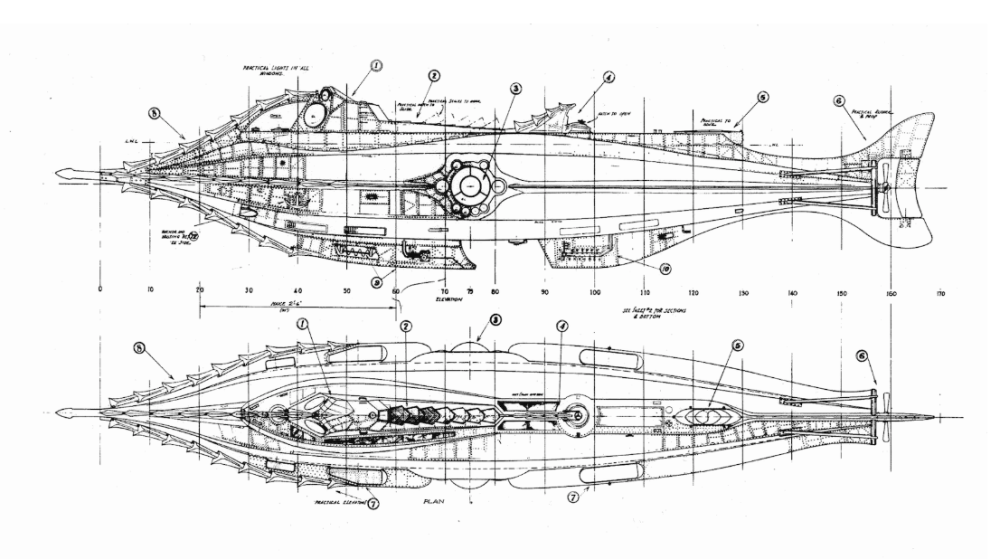
(Inspired by the sea - the Nautilus design echoes a ship’s porthole with its rounded octagonal bezel and hinge-like lugs.)
The concept was radical for Patek. Instead of another precious metal dress piece, this would be a stainless-steel sports watch with a bold, angular shape and an integrated bracelet. When it launched in 1976 as the Reference 3700/1, it was unlike anything the brand had attempted before. Large at 42mm, distinctive in style, and unapologetically modern, the Nautilus signalled that Patek Philippe wasn’t retreating from the crisis. It was daring to redefine luxury on its own terms.
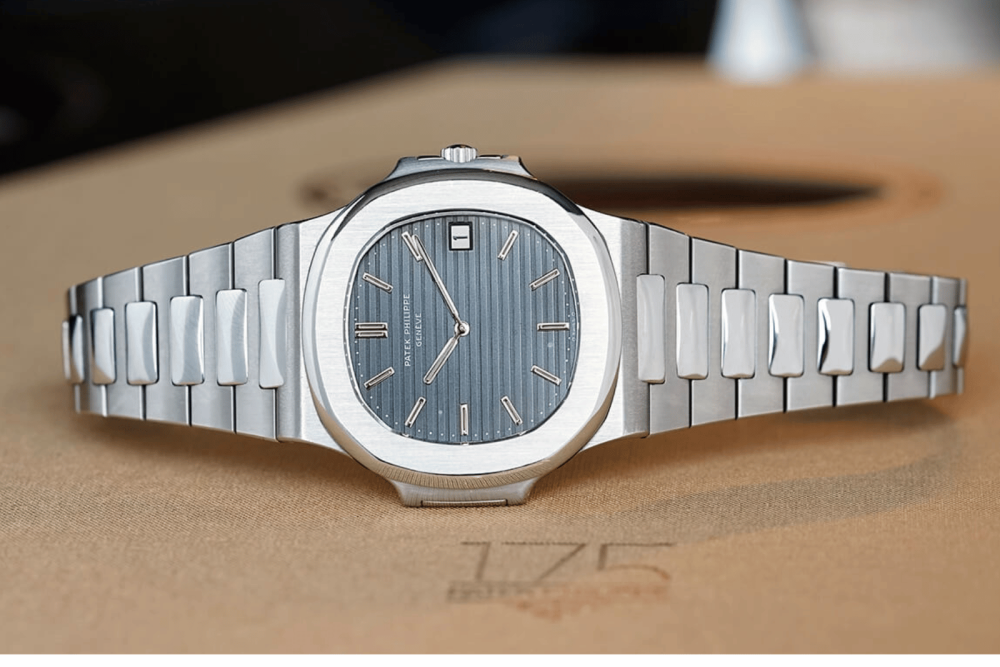 (Patek Philippe Reference 3700 Nautilus from 1976)
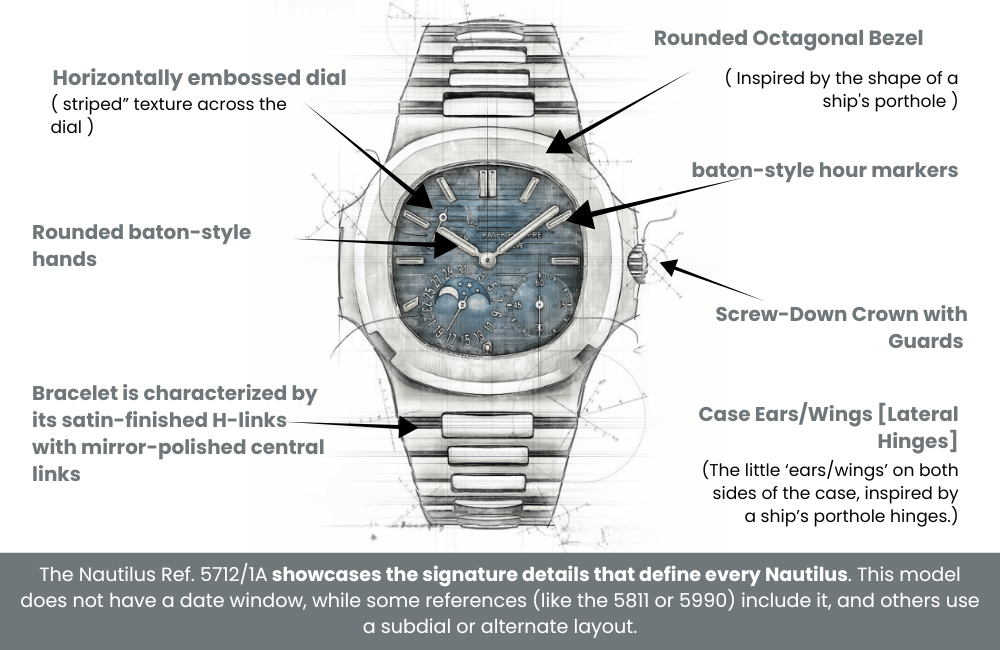
Before we dive into the references, here’s a quick visual guide to the Nautilus design DNA—shown on Ref. 5712/1A so you can spot the signature details across the line (with the date display varying by reference).”
The Birth of the Nautilus: Ref. 3700 "Jumbo" (1976)
Patek Philippe's Nautilus Ref. 3700/1A, which was launched in 1976, rocked the industry. "One of the world's most costly watches is made of steel," read the ad copy from the brand. A stainless-steel watch priced at $3,100 was audacious in an age of precious metals.
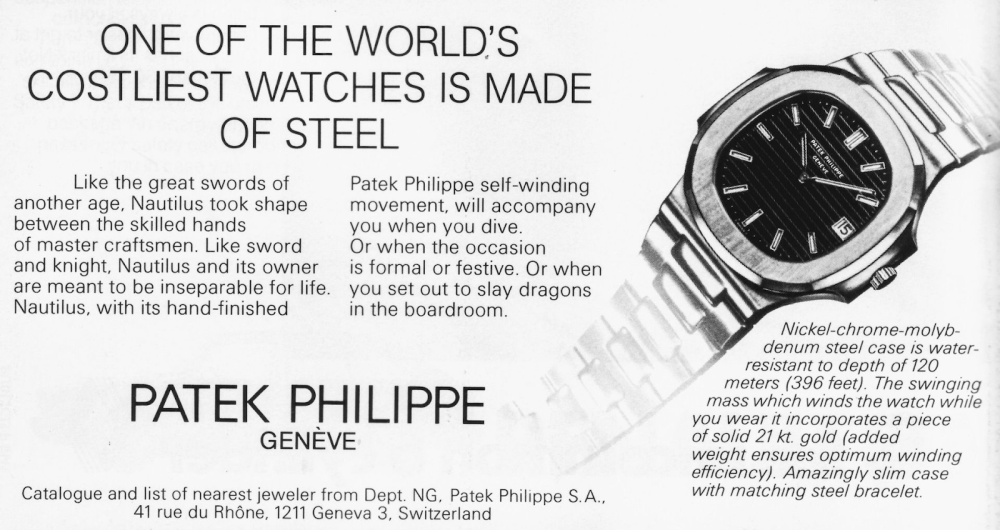
(An early advertisement for the original Ref. 3700 Patek Philippe Nautilus featured the daring concept of creating a luxury sports watch in stainless steel. Photo credit: Patek Philippe.)
The design corresponded to the claim. With a case measuring 42 mm across, it was quite oversized for the time, and thus dubbed the "Jumbo." Despite that, it was incredibly slim at only 7.6 mm due to its ultra-thin automatic caliber 28-255 C. The structure itself was inspired by the porthole of a ship: a monobloc base secured the hinged bezel, which clamped down on the crystal and gasket to ensure a water-resistance rating of 120 meters. With its octagonal bezel rounded at the corners and distinctive side "ears," the Nautilus offered a profile no other Patek Philippe had produced before.
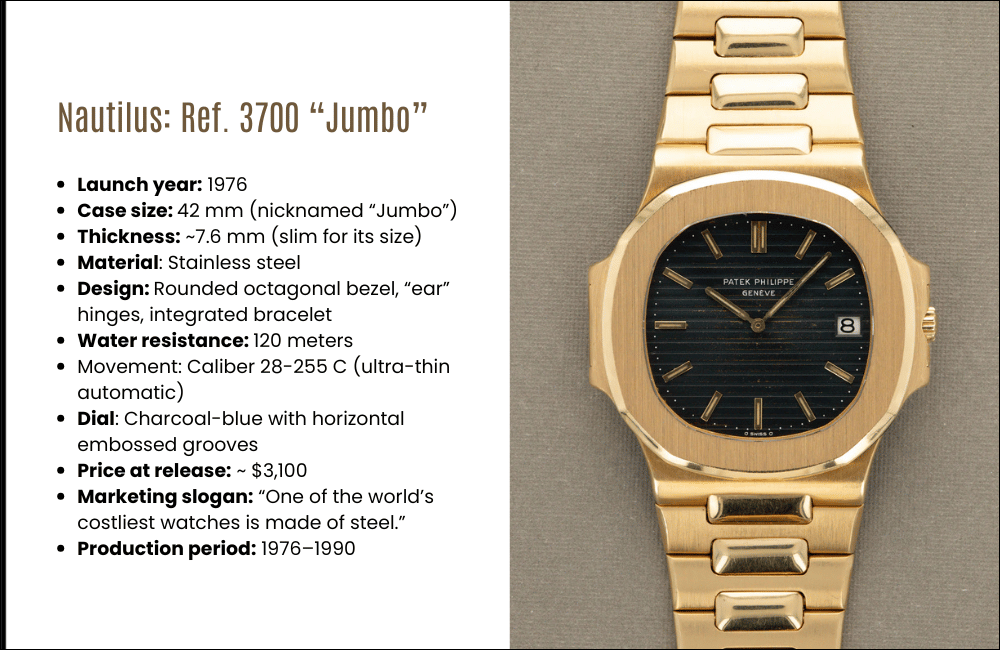
The bracelet was flawlessly fitted into the case, with alternating brushed and polished surfaces. As such, the bracelet was a truly seamless connection between the case and bracelet, giving the watch a cohesive quality that made it seem more like a single piece of block steel than a case connected to a strap. The dial completed the whole interpretation: the dial is deep charcoal blue colored with horizontal grooving effects that resemble the surface of the sea, plus thin luminous-filled hands, baton hour markers, and a small date window at 3 o'clock.
Upon its launch, the reaction to the watch was mixed. Traditionalists found the idea of paying more for steel than gold was difficult to comprehend, while the new audience appreciated the bold nature of the watch. For those admirers, the Nautilus represented confidence and modernity without losing its iconic identity.
Ref. 3700 continued to be produced until 1990. It was not just a new watch. It marked the beginning of a very new chapter for Patek Philippe.
Expansion and Evolution (1980s–2000s)
Smaller Sizes and New Audiences
By the early 1980s, it became apparent that not every wrist would look good at substantial 42 mm "Jumbo." Patek Philippe reacted by producing two new references. The first was the Ladies' Nautilus in 1980, Ref. 4700, a quartz watch furnished in a slimmer profile.
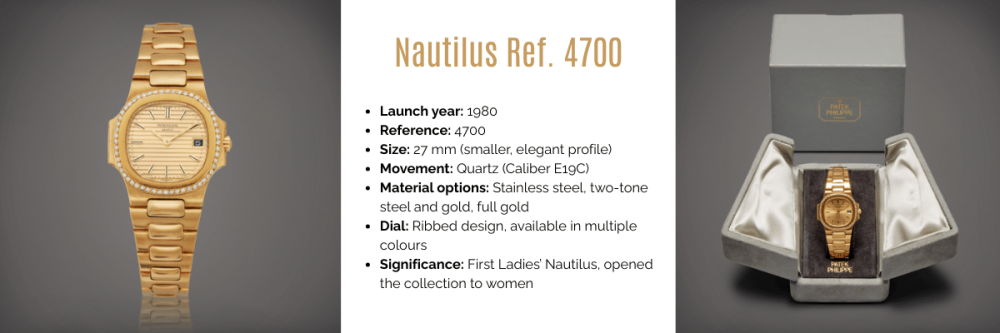
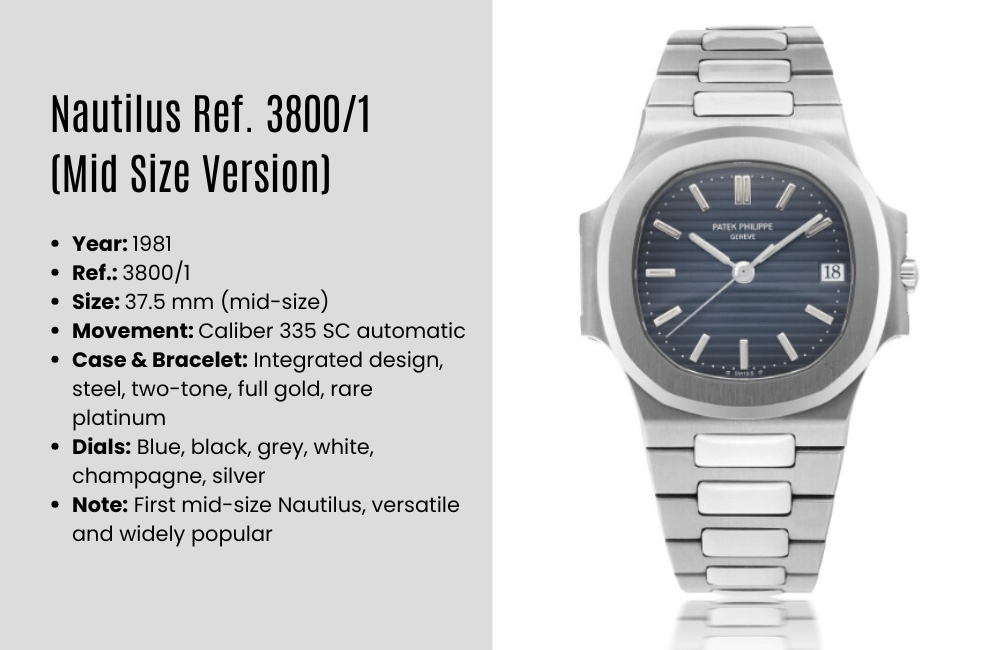
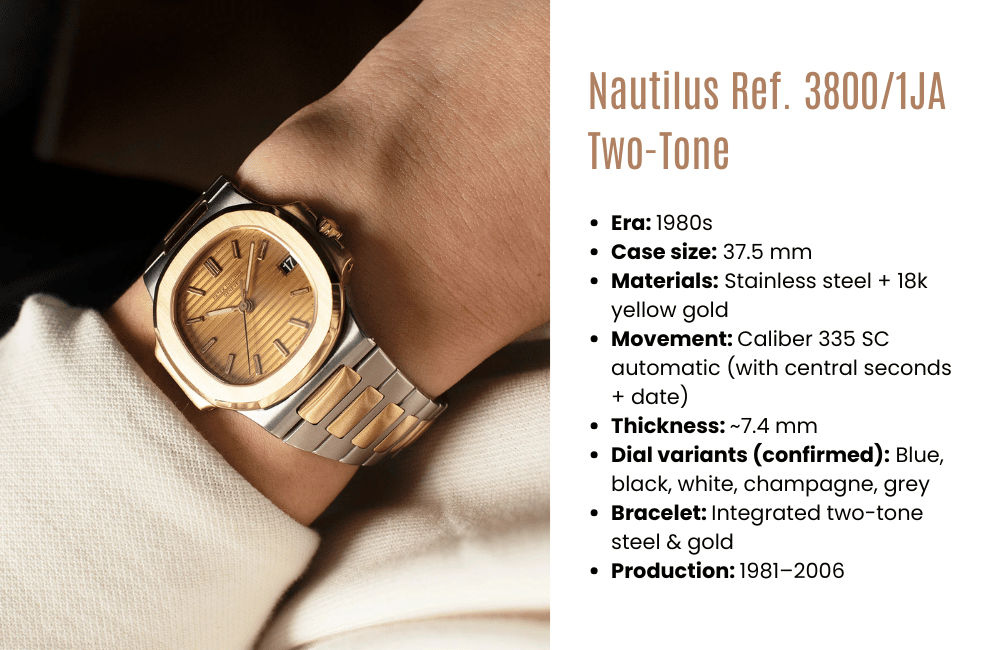
Just a year later, the Ref. 3800 followed, a mid-size version measuring about 37.5 mm. Both watches kept the signature porthole case and grooved dial, but their more manageable sizes opened the Nautilus to a broader audience.
Variations in Style and Material
The Nautilus soon transcended its all-steel origins. Beginning in the 1980s, Patek experimented with a variety of case variations: two-tone steel and gold cases, full 18k gold versions, and even some prototype models in platinum. While the key elements, including the rounded octagonal bezel, integrated bracelet, and embossed dial and case remained the same, variations allowed collectors to experience the Nautilus in exciting new ways without losing the unique aspects of each Nautilus in newer "versions."
Campaigns That Defined the Era
Patek introduced nostalgic advertisements with its new models. Patek presented as a timepiece equally at home with a wetsuit or a tuxedo. The gist of the message was clear - it was not merely a sporty watch but a luxury watch that could be worn on a variety of occasions. The advertising, carefully crafted campaigns, helped ease any initial doubts and engender admiration before gradually building a legacy of the Nautilus.
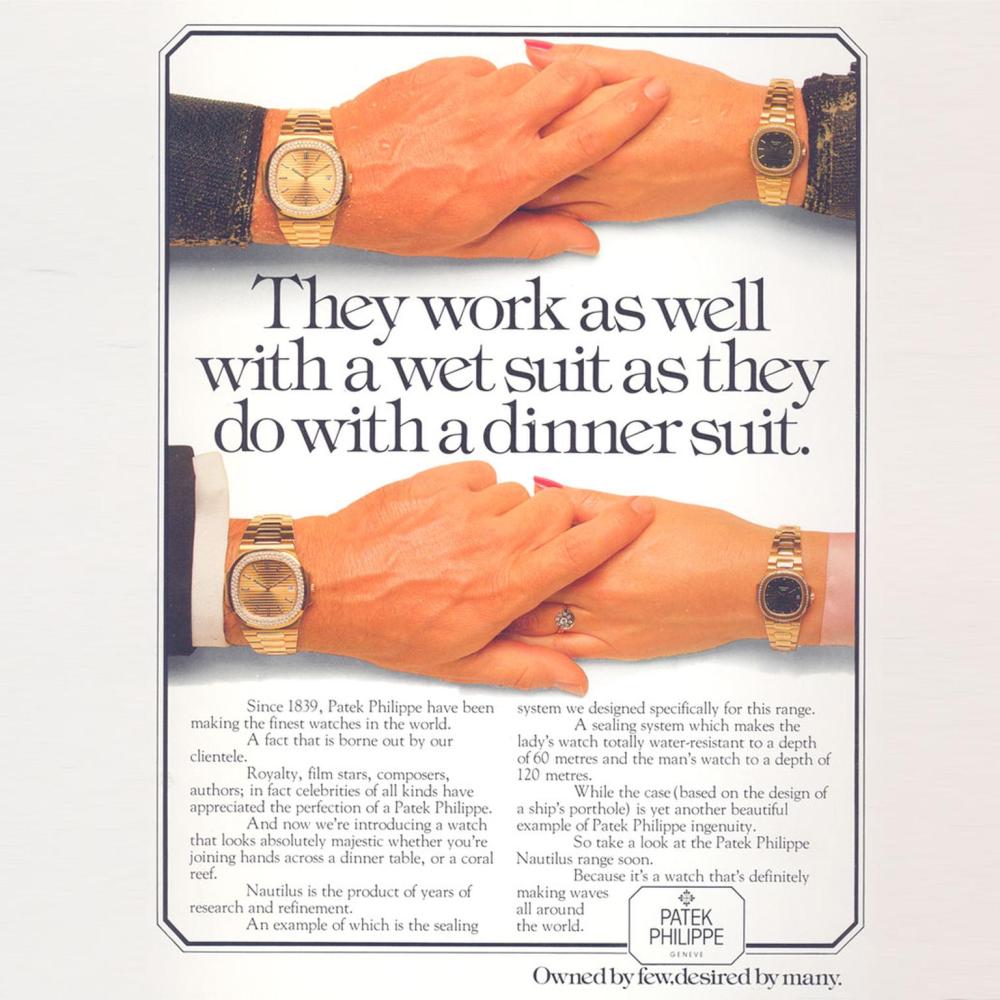
(“An iconic Patek Philippe Nautilus ad from the 1970s - blending lifestyle and luxury with the line, ‘They work as well with a wet suit as they do with a dinner suit.’”)
The Arrival of Complications
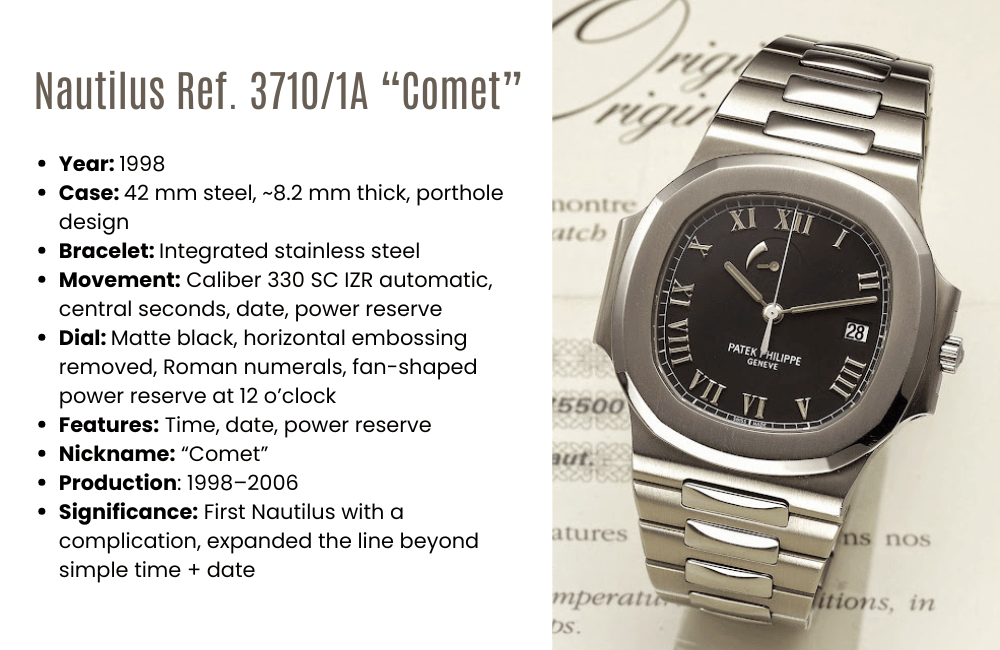
The Nautilus remained a purely time-and-date watch until the late 1990s. However, this changed in 1998 with the Ref. 3710/1A, the first model to incorporate a complication, a power reserve indicator at 12 o'clock on a black dial with Roman numerals. It was the signal that the Nautilus could progress beyond simplicity without sacrificing its audacity.
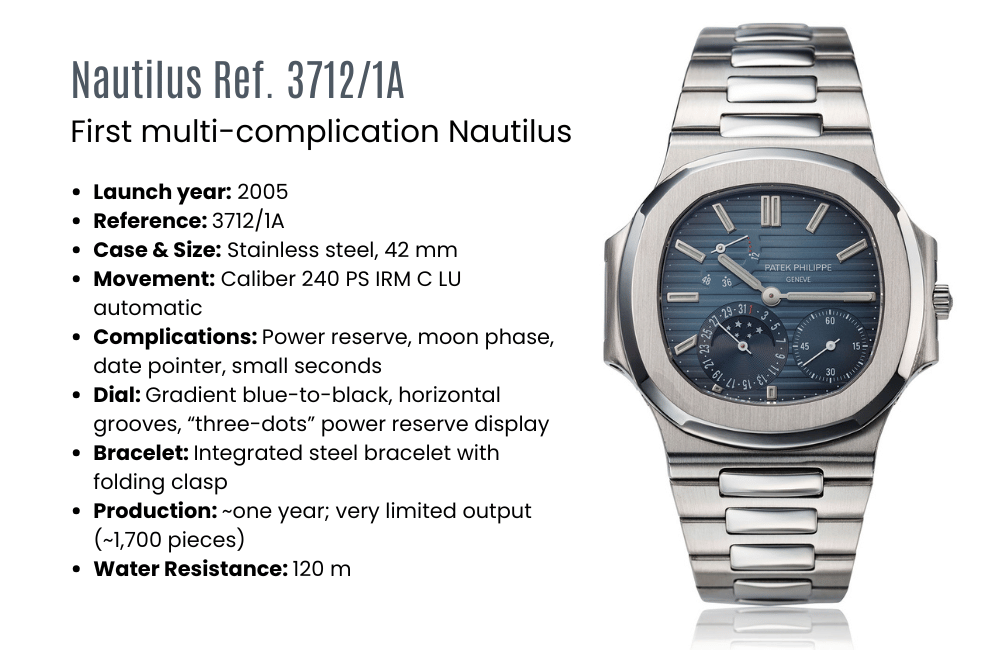
The Ref. 3712 expanded the Nautilus’ functionality by adding a moonphase, a date sub-dial, and a power reserve indicator in 2005. Although the Ref. 3712 was short-lived, it marked the beginning of a new era in which complications would form an integral part of the Nautilus story.
Setting the Stage for the Future
By the early 2000s, the Nautilus had grown from a single daring steel watch into a diverse collection. With different sizes, materials, and now complications, it has proven its staying power. What began as a radical experiment in 1976 had, by the turn of the millennium, become a permanent pillar of Patek Philippe’s catalogue, ready to take on the 21st century.
Modern Icons & Key References
Ref. 5711 (2006–2021) – The Modern Successor
For the Nautilus’s 30th anniversary in 2006, Patek Philippe introduced the Ref. 5711/1A. It echoed the original Jumbo but with updates for a new era: a slightly larger 40 mm case (about 43 mm including the “ears”), the in-house Caliber 324 automatic, and a sapphire crystal caseback. The construction was revised into three parts, which made servicing easier while keeping 120 m water resistance intact.
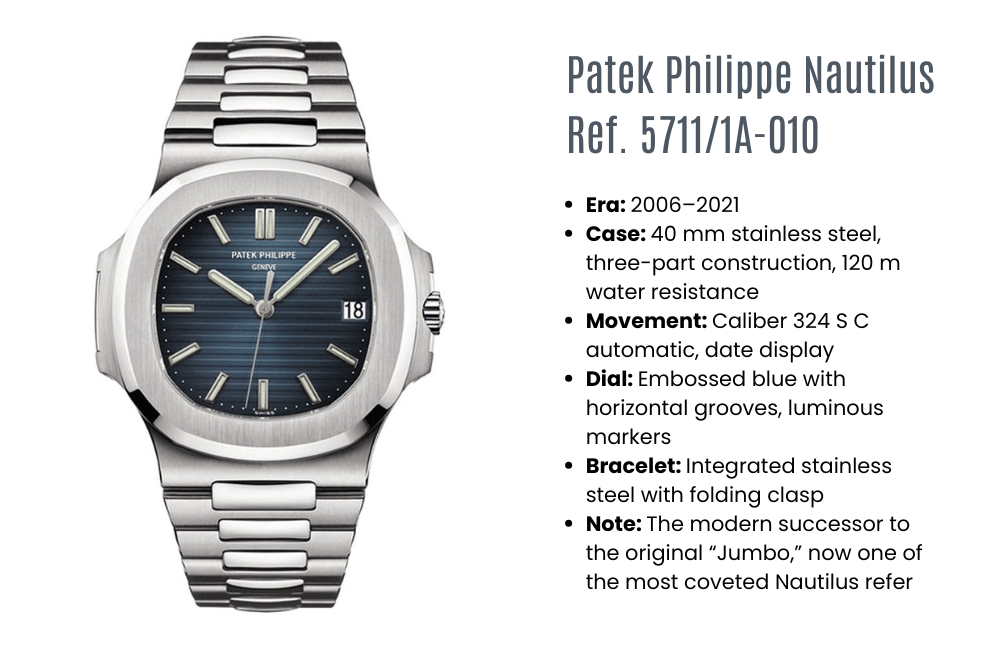
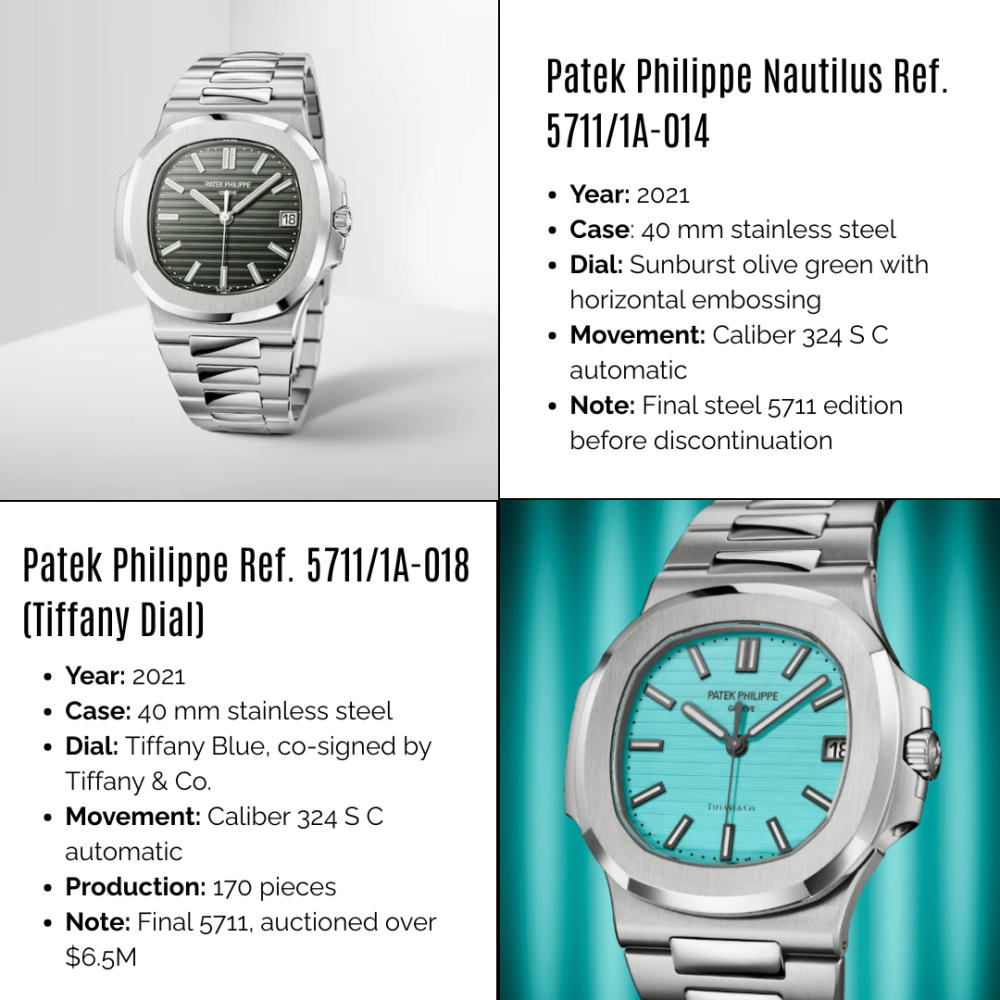
The 5711 quickly became the most iconic modern Nautilus. With its blue embossed dial and clean three-hand layout, the 5711 became the epitome of the 'must-have' watch. Demand surged, second-hand prices skyrocketed, and wait-lists grew over the years. Finally, in 2021, Patek announced the watch’s discontinuation, but not before making two incredibly elegant (and limited) final editions: the olive green dial Ref. 5711/1A-014 and the ultra-rare Tiffany Blue dial ref. 5711/1A-018 with a Tiffany & Co. signed dial, as one could only be found in hype watches. One Tiffany example sold for over $6.5 million at auction, cementing the 5711’s place in modern watch history.
Ref. 5712 (2006–present) – Complications with Asymmetry
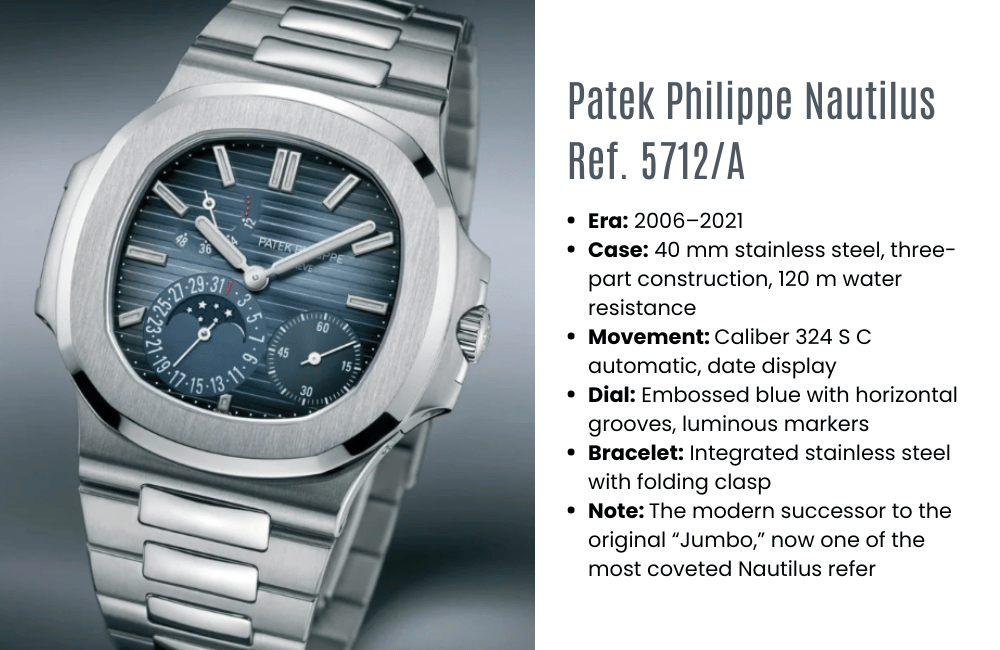
Released alongside the 5711, the Ref. 5712/A brought complications into the mix. Its off-centre dial features a power reserve indicator, a moonphase, and a pointer date, creating an asymmetrical look that gives it real character. The design divided opinions but also attracted collectors who wanted a Nautilus with a little more complexity.
Ref. 5990 (2014–present) – Travel Time Chronograph
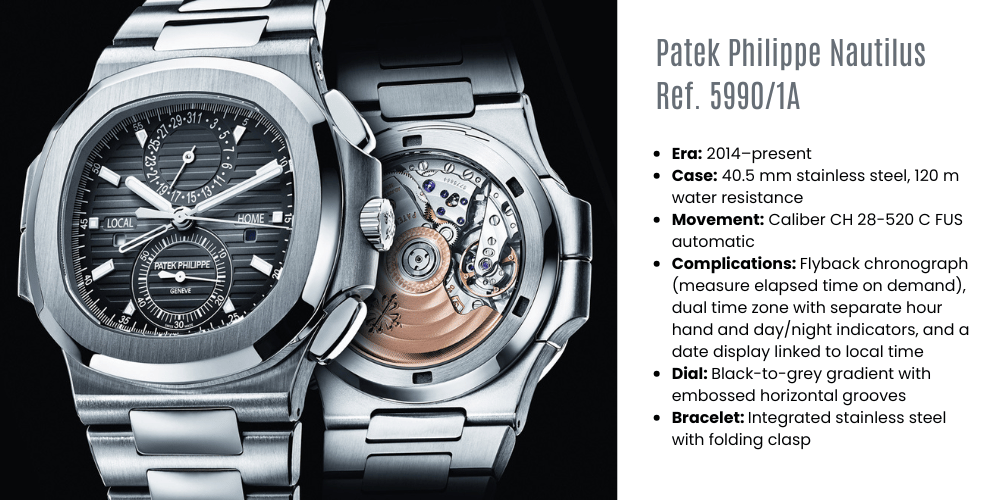
Patek introduced the Ref. 5990/1A to market in 2014, introduced the Ref. 5990/1A . This watch featured two prestigious complications, while remaining slim and sporty as desired in the Nautilus collection. The dual function of the 5990 satisfied any collector's requirements for functionality and style.
Ref. 5740 (2018–present) – The First Perpetual Calendar
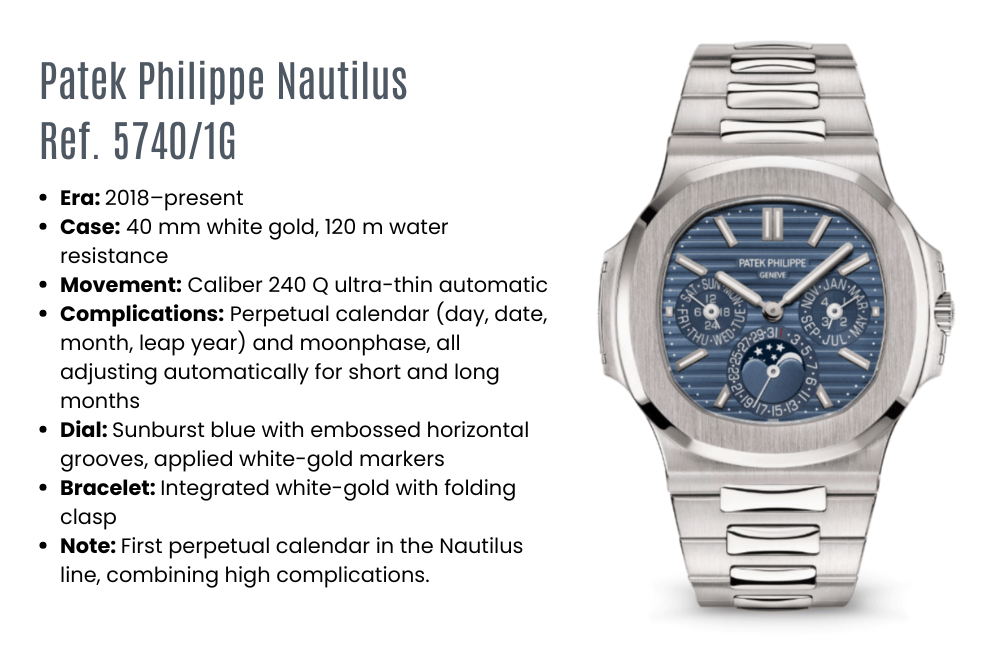
The Ref. 5740/1G debuted in 2018 as the first perpetual calendar in the Nautilus line. Crafted in white gold and powered by Patek Philippe’s ultra-thin Caliber 240 Q, it exemplified the brand’s mastery of high complications within a Nautilus case. The Ref. 5740/1G also highlighted just how far the design had evolved since the original 1976 model.
Women’s Nautilus (2000s–present) – Expansion of the Line
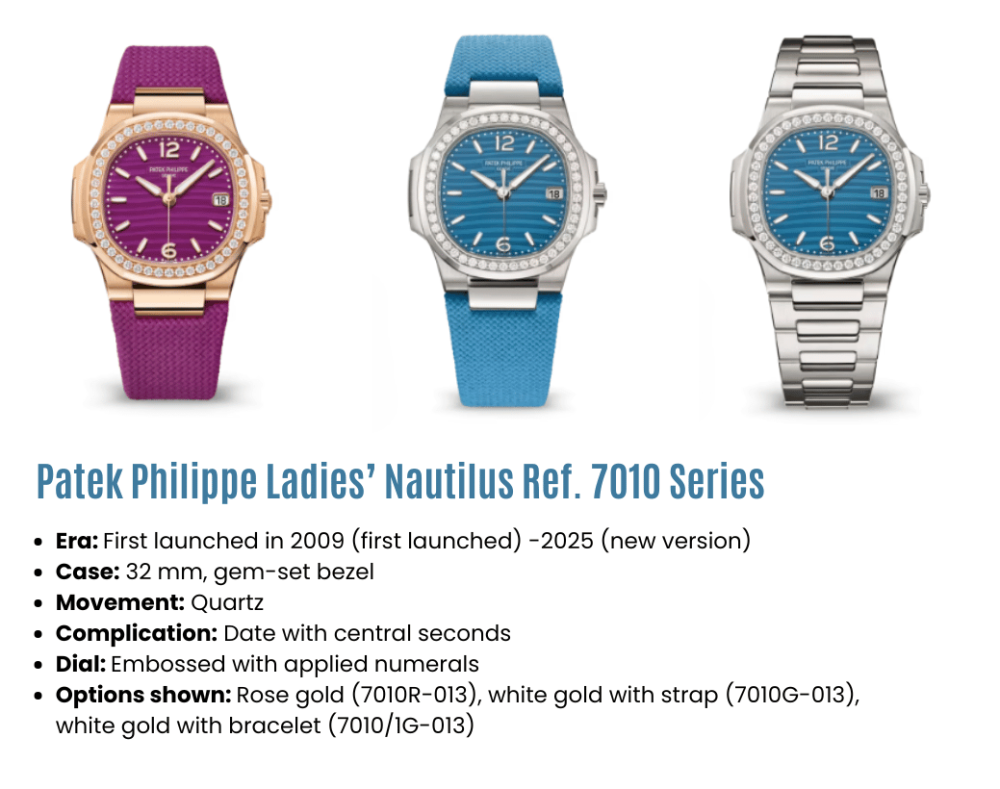
Interest in women’s Nautilus models was renewed with the introduction of the Ref. 7010 in 2009. With a 32 mm size, a quartz movement, a gem-set bezel, and several case metals, it is an elegant option for women seeking the Nautilus style in its most refined, jewelled form. Then in 2025, Ref. 7010G-013, Ref. 7010R-013 and Ref. 7010/1G-013 debuted even more options with all-white gold cases with various coloured dials and a few different straps or full bracelets.
In 2015, Patek Philippe introduced the Ref. 7118/1R-001, an automatic option for women seeking a mechanical movement. Measuring 35.2 mm, it retained the signature porthole case and integrated bracelet of previous women’s Nautilus models, but featured softer, wave-style embossing for a distinctly feminine aesthetic. Available in stainless steel, rose gold, and diamond-set versions, the Ref. 7118/1200R-010 quickly became the flagship of the women’s Nautilus collection.
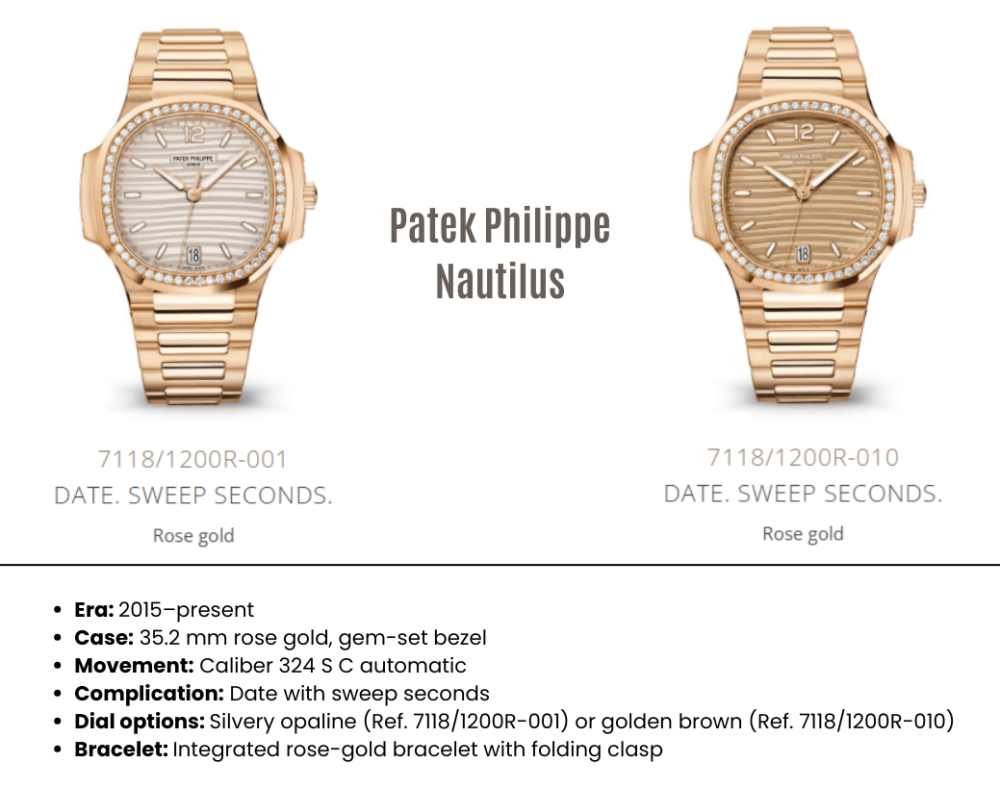
Together, the 7010 and 7118 gave the Nautilus family a strong presence in women’s watchmaking, from accessible quartz pieces to refined mechanical models to ensure the design’s appeal reached beyond its original roots.
Ref. 5980/60G (2024 – present) – White Gold Chronograph with a Modern Spirit
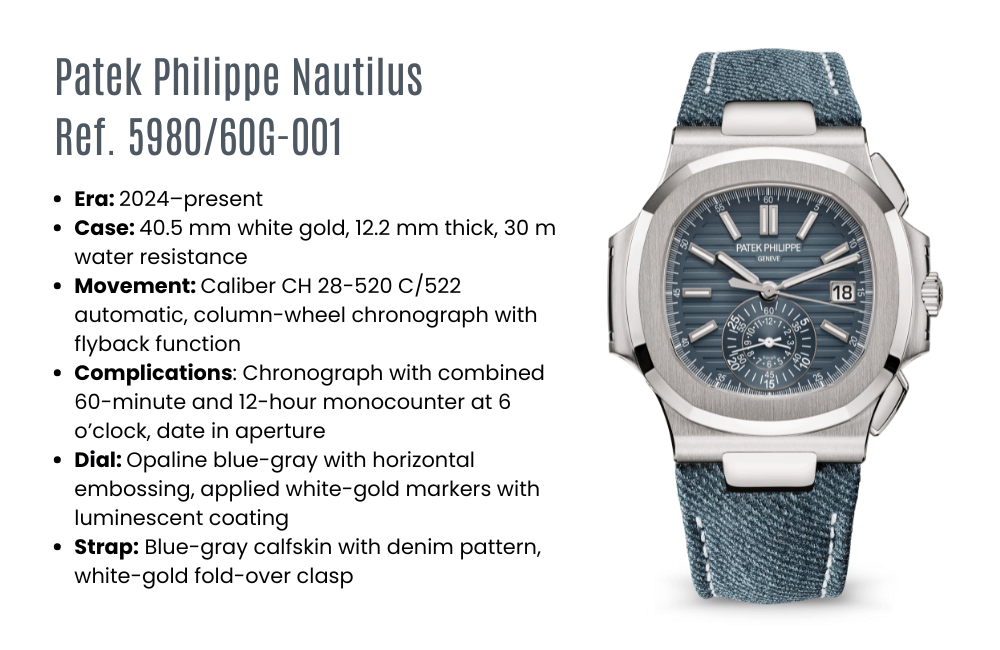
A contemporary and casual take, Ref. 5980/60G comes with a case paired with a blue-grey opaline dial and a denim-patterned calfskin strap. This styling makes the watch more relaxed and fashion-forward, contrasting with the traditional bracelet look. It carries a distinctly sporty vibe within the Nautilus chronograph family.
Explore the Patek Philippe Nautilus Collection at Jewels by Love
Jewels by Love has been a family business for decades, built on knowledge, trust, and deep relationships with the most respected watchmakers in the world. We are an authorized Patek Philippe dealer, and we are privileged to present the Nautilus collection with the authenticity and care it deserves.
Although the Nautilus is the star, it is just one part of what we do. Our showcases offer exceptional timepieces also from Cartier, Nomos, Breguet and other maisons with similar heritage and attention to detail. We invite you to visit us at our St. Martin stores and see the watches for yourself in an environment dedicated to the art of fine watchmaking. Or contact our team, and we are delighted to assist you in finding the timepiece that is perfect for you.