

Enamelling on watch dials started in the 17th century on pocket watch dials. In the mid-twentieth century, enamel dials were the most popular among watch enthusiasts. From that time, the industrialisation of enamelling has been attempted but it has still not taken hold of the market. Enamelling is an art form which is being done on various surfaces from the 13th century BC till now. Even though it is an old art form, we see it on various day-to-day items. Enamelling is done for various reasons for example decoration, fine arts, metal coating, industrial use, etc. In the case of watch dials, the enamelling is done purely for decorative purposes. This art form is used by many well-established haute horology manufacturers today as well and is considered the highest form of art in haute horologerie.
How is Enamelling done?
It is basically a process of fusing powdered glass on a metallic surface with the help of exposure to high temperatures. Enamelling can be done on surfaces of glass, ceramic, and, of course, metals. It helps to add colour to the metal surfaces such as copper, silver, gold and many more. In the process of enamelling, the powdered glass is applied in dry form as well as wet form. Once it is applied on the surface, then the surface is exposed to a temperature range of 1400 to 1650 degrees Fahrenheit(760°C to 900°c) with the help of a torch or a kiln. At this high temperature, the powdered glass melts and gets fused on the metal surface developing a smooth coating on the surface. After it is cooled down, the enamel can be opaque, translucent, or transparent depending on the way the powdered glass (enamel powder) was exposed to the heat.
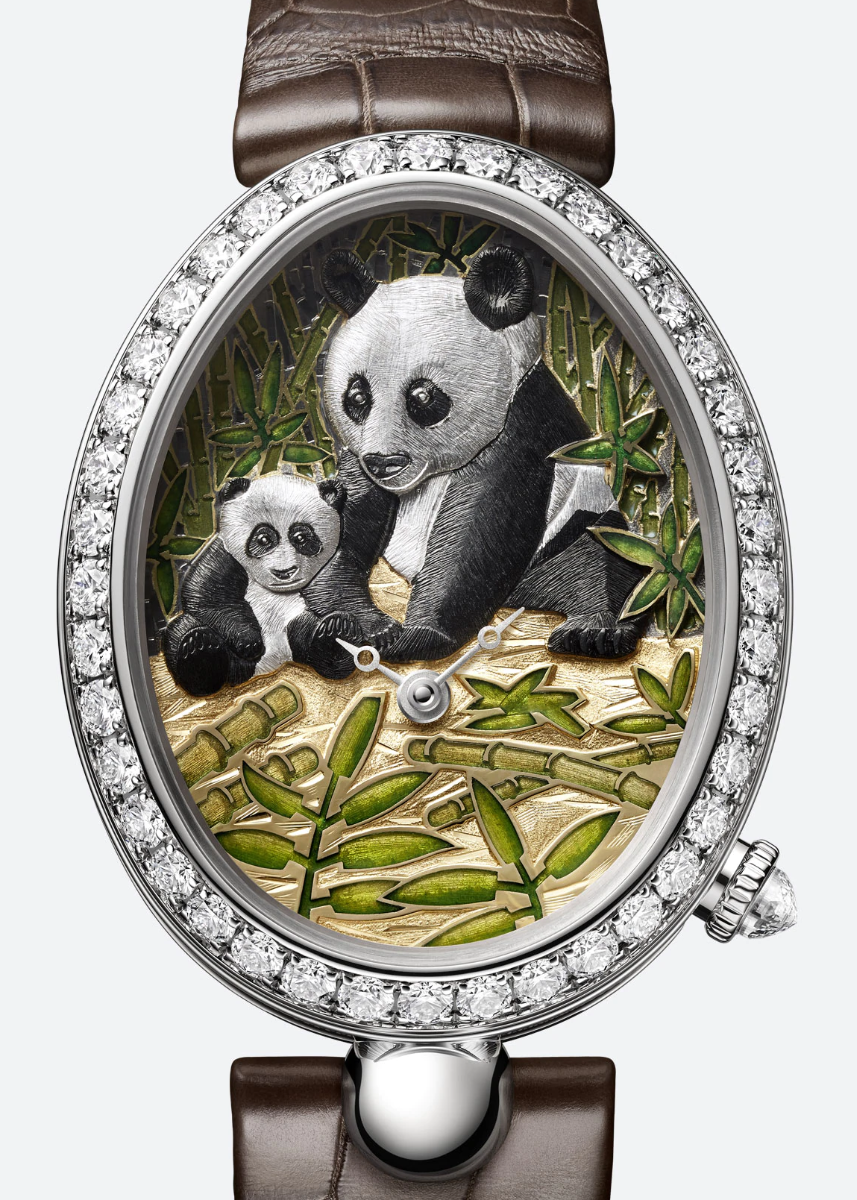
Breguet Reine de Naples reference 8958EB with grand fue enamelling and miniature hand-painting.
Enamel Dials
When the enamelling is done on a dial, a single layer is not sufficient. The specialist usually can go up to eight layers of enamelling on a dial. To enhance the details on the dials the enamelled surface is smoothed and then again sent for the next layer. The final enamel look depends on the exposure to heat at the time of enamelling each layer which was finely controlled by the enamelling specialists. The enamel dials are fragile by themselves whereas with the watch case they are as durable as to go till eternity.
Types of enamelling techniques
The art form of enamelling has been modified over a long period of time. Enamelling can be of many different styles. Some of the famous enamelling techniques in the watch world are:
Champlevé
Cloisonné
Plique-a-jour
Flinqué
Grand feu and vitreous
Grisaille
Champlevé
In this type of enamelling, the engravings are done on the dial providing a lowered surface which enamelers fill in with the enamel powders. The enamels in this type can be translucent to showcase the artwork of the engravers. The word “champlevé” has come from the French words “champ surélevé” where champ means background the areas where the enamelling is to be done are lowered rather than raising the rest of the surface.
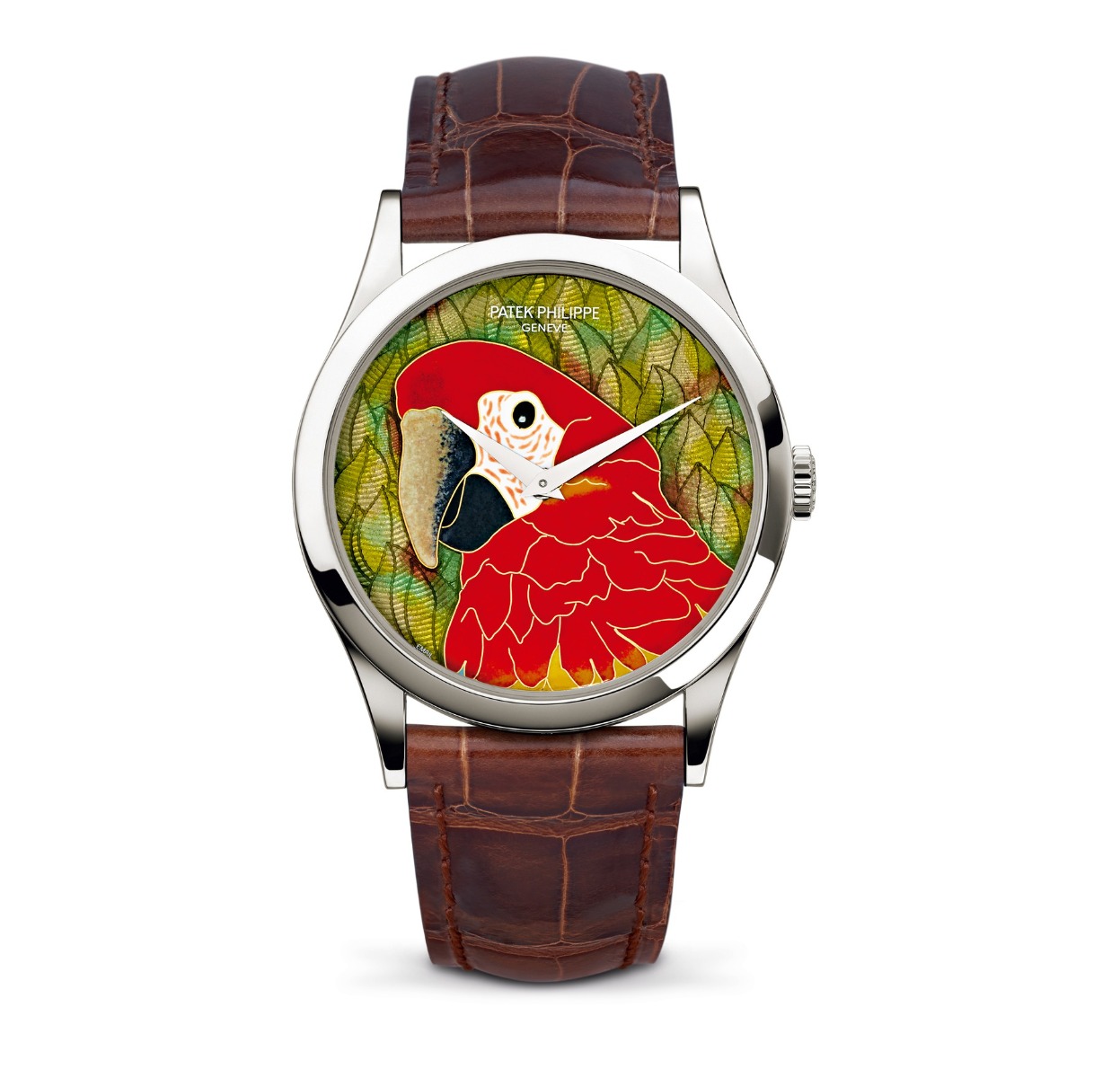
Patek Philippe Calatrava 5077 timepiece with champlevé enamelling
Cloisonné
The word “cloisonné” literally translates to “partitioned”. In this type of enamelling, a thin silver or gold wire or a very fine strip is applied on the surface to create patterns. In between these patterns, the enamelers apply the enamelling powders and liquids after which they are sent for high heat exposure. These fine wires work as barriers between two enamels. Different temperature gives enamel a different depth and translucent characteristics.
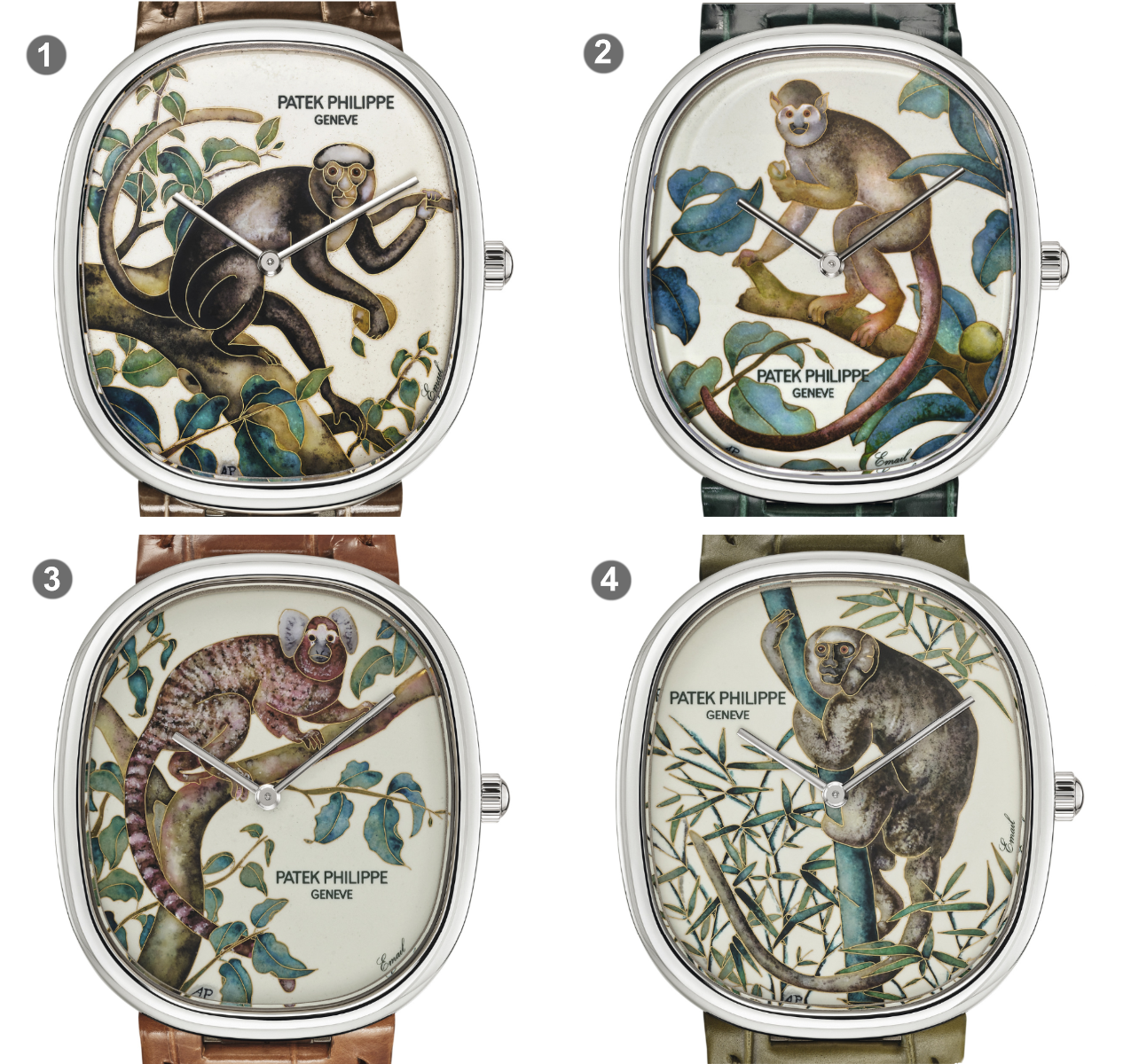
Patek Philippe Reference 5738 with cloisonné enamelling. Monkeys, “Cloisonné “ enamelling technique with miniature painting on Golden Ellipse wristwatches’ dials. Their reference numbers are listed as 1. 5738/50G-013, 2. 5738/50G-014, 3. 5738/50G-018, 4. 5738/50G-019
Plique-a-jour
Plique-a-jour is a technique similar to cloisonné. In this technique, the base, on which the enamel lies, is removed after cloisonné enamelling is done. The removal of the base is done either by scrubbing it off or by exposing the base to acid. This makes the style more delicate to execute. The final product looks similar to the stained glass window which has translucent characteristics to its glass, letting the light pass through it. Therefore, this method of enamelling is the most fragile.
Flinqué
This style is the most simplistic of them all. In this style of enamelling, a translucent layer of enamel is set on the guilloché work done on the watch dials giving a unique look to the guilloché pattern. Guilloché by itself is extremely appealing, adding enamel over it raises the decorative bar too high.
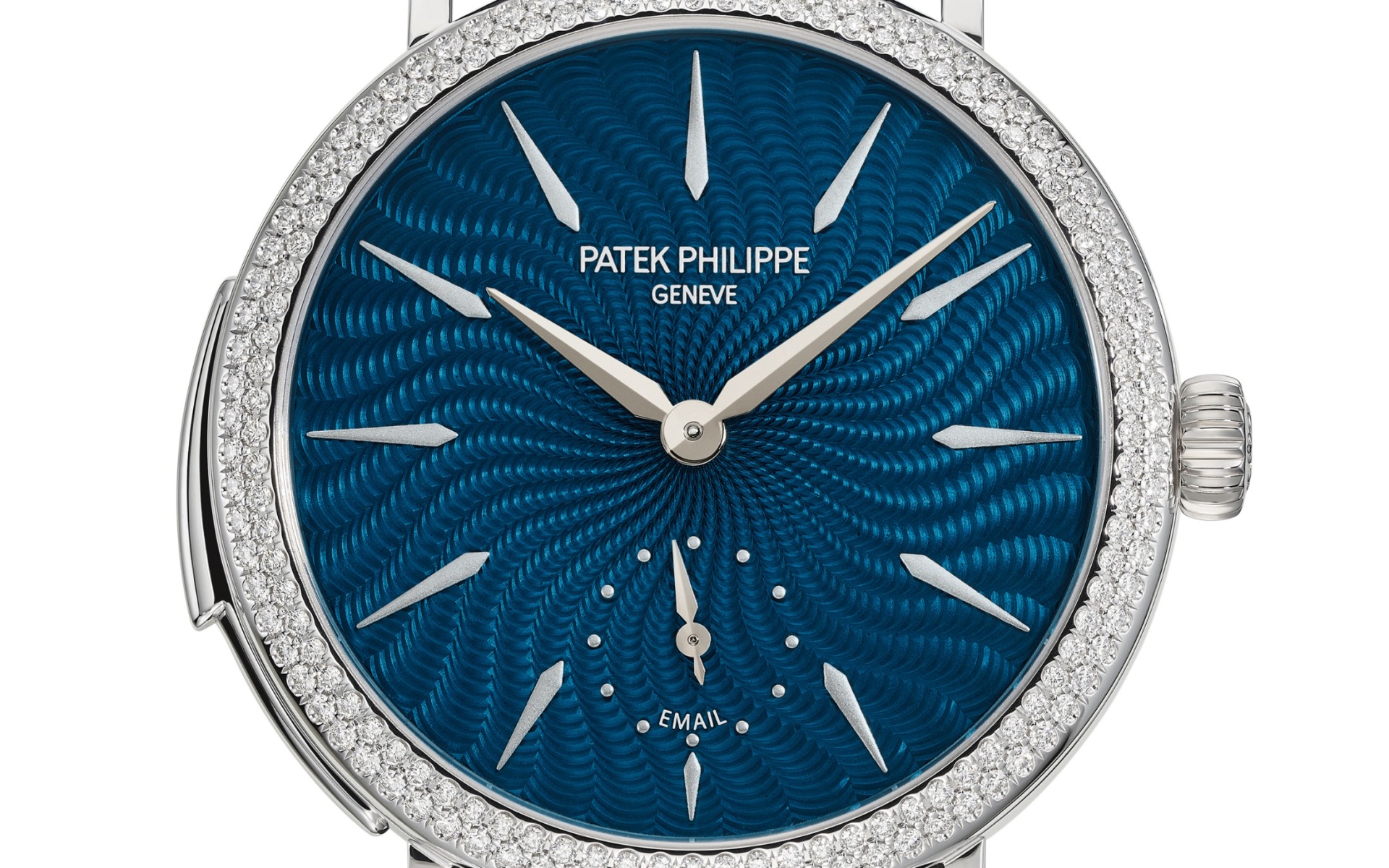
Patek Philippe reference 7040_250G with flinque enamelling.
Grand feu and vitreous
The name Grand feu translates from French as “big fire” and “vitreous” means glass. This type of enamelling is a very common technique used in the watch industry. In this technique, the enamel is exposed to high temperature making the enamel colour dark and vibrant. Even though this technique is simple, the process of executing it is quite difficult. To achieve the vibrant colour of this technique, the enamelers have to put multiple layers on the dial, apart from that when you are adding more layers, each time you have to expose the enamel powder or liquid to high temperature which causes bubbles and irregularities. Due to this reason, a majority of these dials, having Grand Feu enamelling, end up being discarded.
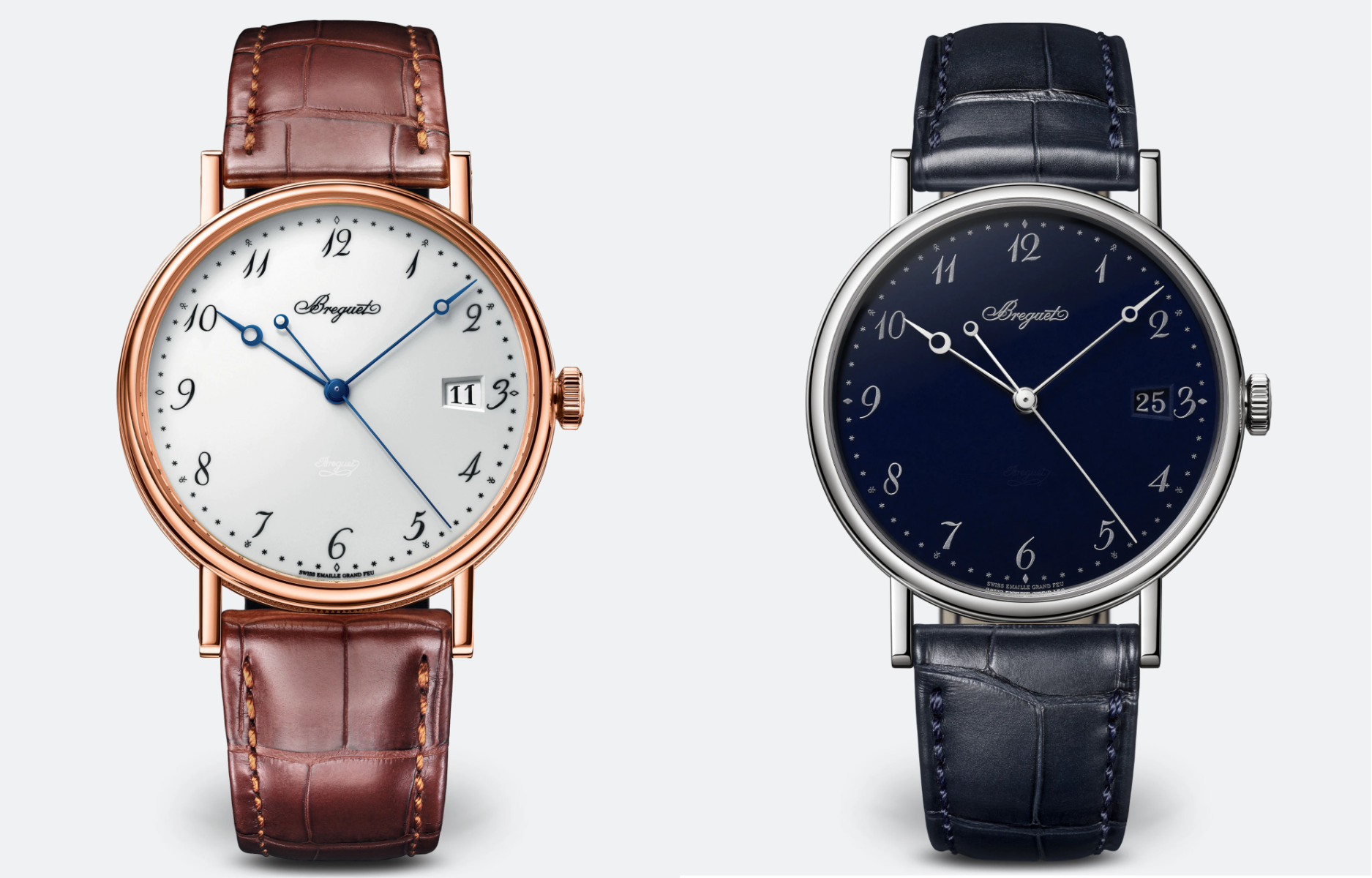
Breguet classique collection 5177BB and 5177BR with white and blue grand fue on the dial.
Grisaille
Grisaille is a form of enamel art having a monochromatic look where the base is of dark colour, usually black, which is then painted with white enamel. In this type of enamelling technique, the dark colour base is created with the Grand Feu enamelling technique. As the Grand Feu enamelling technique itself is so difficult to achieve, the white colour enamel paint makes it even more difficult to have on the watch dial. The white-coloured enamel used on the Grand Feu is Blanc de Limoges, this is a special type of enamel powder which is grounded finer than the usual enamelling powders. The white enamel powder is used to create different strokes on the dark base delivering a delicate design and images on the watch dial making them even more complicated than the Grand Feu enamelling technique
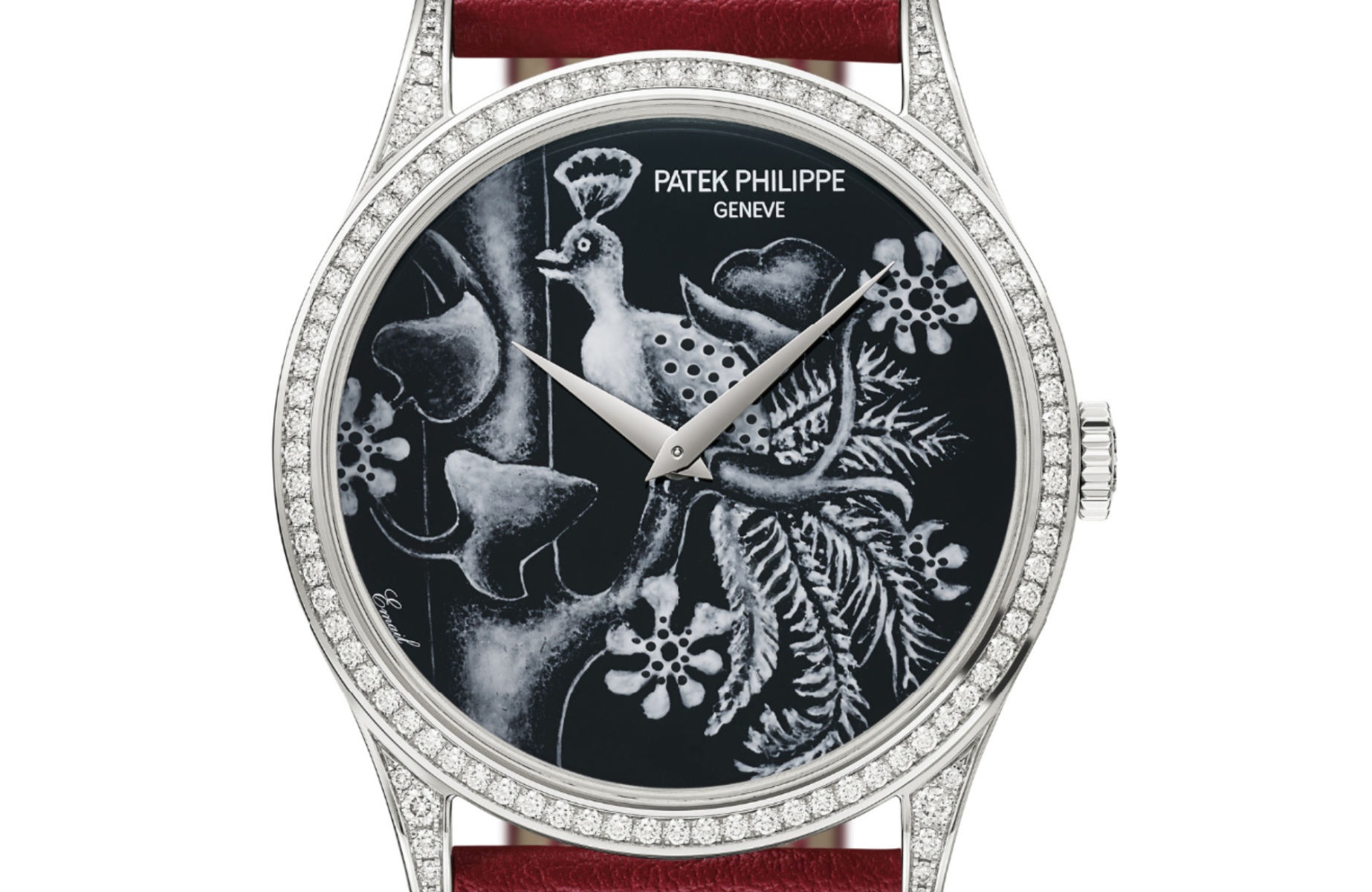
Patek Philippe Calatrava Collection reference 5077/100G-055 with grisaille enamelling on the dial decorated with "blanc de Limoges" enamelling powder over grand fue
Apart from these enamelling techniques, there are many more, used in different watch styles each one more beautiful and attractive than the other. In today's world, the number of talented enamelers has gone down and very few of them remain who keep the enamelling art alive for haute horologerie.