

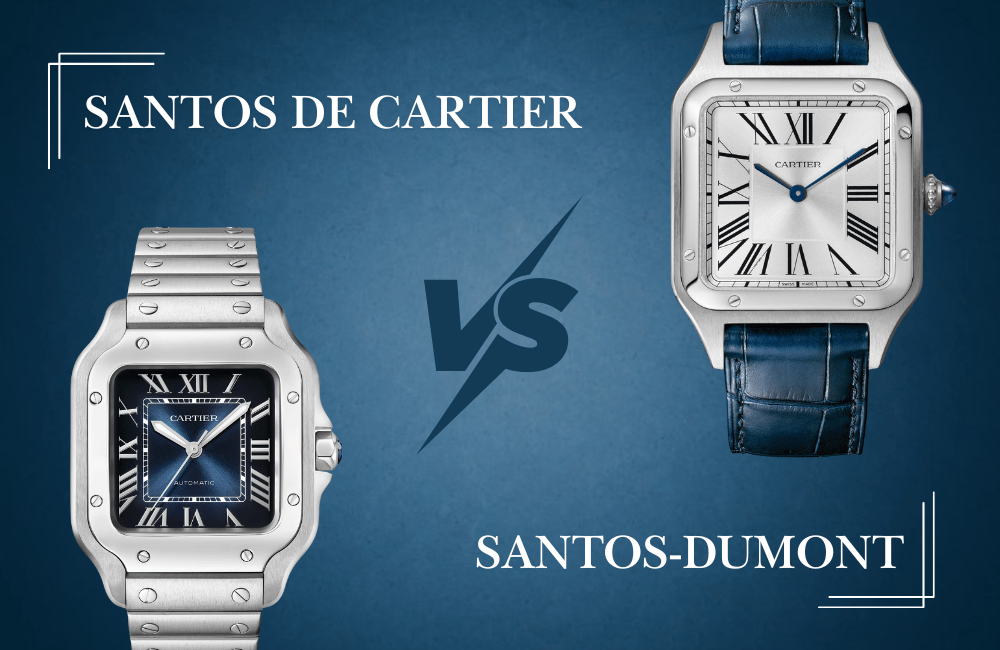
Cartier first launched the Santos in 1904 for Alberto Santos-Dumont, a pilot who wanted to read the time without taking his hands off the controls. What started as a tool quickly became a regular part of the catalogue, and later one of the brand’s most recognisable lines. Years later, Cartier used the Santos Dumont name for slimmer, lighter pieces shaped for formal wear and quiet daily use.
Here is where buyers pause. If both carry the Santos name, are they part of the same line, or are they two separate lines with different functionality and utility?
For the full backstory on how the Santos evolved, we've covered the entire journey in this blog.
In this piece, you’re going to get all of your answers about the differences Santos and the Santos Dumont differ in build, feel, and daily use, and why choosing between them often says more about your lifestyle than your wrist size.
Let’s take a closer look.
How the Santos and Santos-Dumont Actually Differ
At a glance, they look like close cousins. Both come with a square case, roman numerals, and blue hands and have the same brand and line name on the Dial. But when it comes to wearability, changes are visible. Here are those changes.
Case Shape and Wrist Fit
While both watches use a square case, their construction follows two different design approaches.
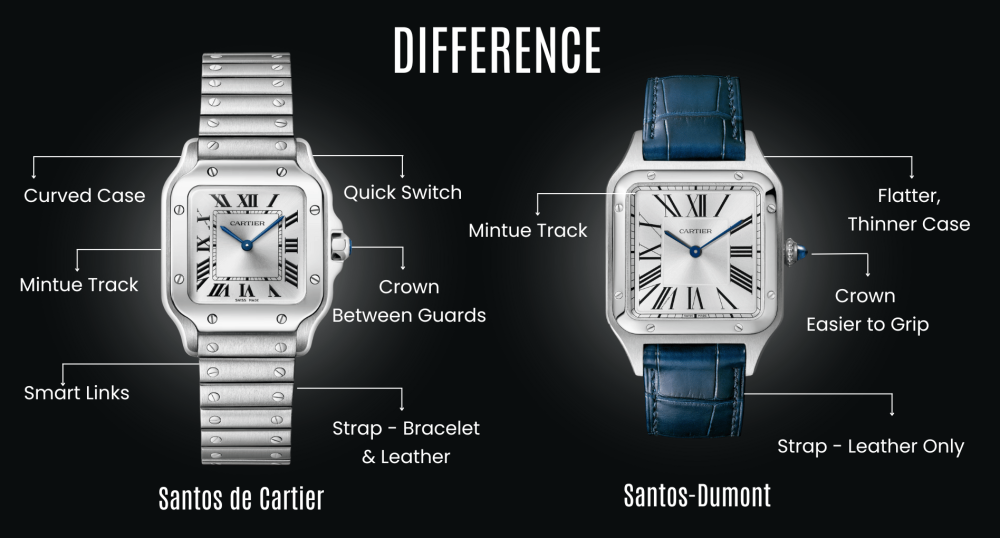
The Santos de Cartier uses a curved case profile that traces back to the Santos Galbée redesign introduced in the late 20th century. Modern versions retain this rounded mid-case shape, and since the 2018 update, the bezel extends into the lugs, creating a continuous case outline that visually links the watch head with the bracelet or strap.
The caseback is also shaped rather than flat, and the bracelet’s first links follow the same curve as the case, forming a continuous arc from case to wrist.
The Santos-Dumont follows a flatter, thinner case construction. The bezel sits distinctly on top of the case, and the lugs step down separately instead of flowing from the bezel. The case profile remains closer to early wristwatch layouts, with less vertical depth and simpler geometry.
The strap connects directly at the lugs, without integrated case-to-bracelet shaping.
Case construction comparison:
|
Feature |
Santos de Cartier |
Santos-Dumont |
|
Design lineage |
Galbée curved case evolution |
Early flat wristwatch proportions |
|
Mid-case profile |
Rounded and contoured |
Mostly flat |
|
Caseback shape |
Curved |
Flat |
|
Bezel design |
Extends into lugs |
Sits on top of the case |
|
Lug structure |
Integrated into the case shape |
Traditional strap lugs |
|
Bracelet integration |
Yes (on bracelet models) |
No (strap only) |
|
Typical thickness |
Thicker |
Thinner |
Size and Thickness Comparison
Cartier uses different sizing systems for each line, which adds to the confusion.
The Santos de Cartier comes mainly in Medium and Large. Both have noticeable wrist presence, with thicker cases and broader lug spans.
The Santos-Dumont is offered in Small, Large, and Extra Large, yet even the Extra Large version stays thinner and lighter than the Medium Santos de Cartier.
So yes, an Extra Large Dumont can still feel smaller on the wrist than a Medium Santos de Cartier. That surprises many buyers the first time they try them on.
|
Model |
Width (mm) |
Lug to Lug (mm) |
Thickness (mm) |
|
Santos de Cartier Medium |
35.1 |
41.9 |
8.83 |
|
Santos de Cartier Large |
39.8 |
47.5 |
9.1 to 9.4 |
|
Santos-Dumont Small |
27.5 |
38.5 |
~5.5 |
|
Santos-Dumont Large |
31.4 |
43.5 |
7.3 |
|
Santos-Dumont Extra Large |
33.9 |
46.6 |
7.5 to 8.0 |
Movements and Daily Use
Here is where the two lines fully separate.
The Santos de Cartier runs on Cartier’s in-house automatic Caliber 1847 MC. It beats at 4 Hz, offers roughly 42 hours of power reserve, and uses non-magnetic components in the escapement along with internal shielding. In plain terms, it stays stable around phones, laptops, tablet covers, and handbag clasps. The watch winds itself as you move, shows running seconds, and larger models add a date at six. It suits daily wear and long stretches between servicing.
The Santos-Dumont takes a different route in most sizes. Small and Large models use high-autonomy quartz movements built to run for about six years on one battery. There is no second hand, which keeps the dial visually calm and avoids the tick that many buyers notice on quartz watches. Even if you leave it in a drawer for months, pick it up, and the time will still be correct. For collectors who rotate watches, that convenience matters.
Extra Large Santos-Dumont models and selected editions switch to a manual movement, the Caliber 430 MC, based on the ultra-thin Piaget 430P. It offers around 38 to 43 hours of power reserve and keeps the case slim by skipping the automatic rotor. You wind it by hand every day or two, which some owners enjoy as part of the routine.
Movement overview:
|
Feature |
Santos de Cartier |
Santos-Dumont |
|
Main calibers |
1847 MC |
Quartz (Small, Large) / 430 MC (XL) |
|
Winding |
Automatic |
Battery or manual |
|
Power reserve |
~42 hours |
Battery ~6 years / Manual ~40 hours |
|
Seconds hand |
Yes |
No |
|
Date |
On Large models |
No |
|
Daily readiness |
Wear and go |
Always ready on quartz |
Bracelet, Straps, and Adjustment
The Santos de Cartier is designed around ease of wear and fast adjustments.
Its steel bracelet uses squared links that mirror the shape of the case, which keeps the visual flow tight from lug to clasp. The links taper slightly toward the clasp, so the bracelet feels solid near the case and lighter as it moves down the wrist. This helps balance weight and keeps the watch from shifting during long wear.
Cartier adds two practical mechanisms to the Santos de Cartier.
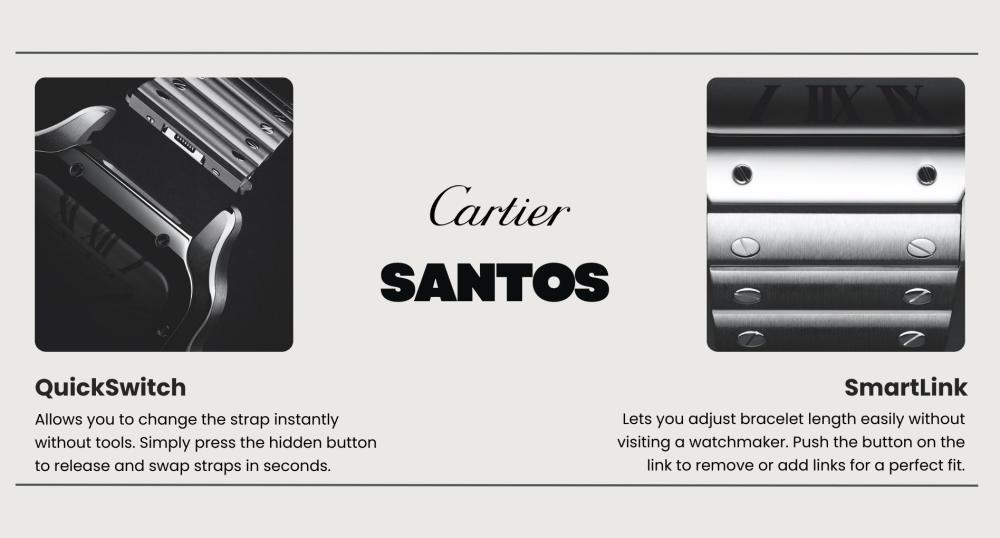
First is QuickSwitch, which lets you remove the bracelet and attach a strap by pressing a small release tab hidden under the lug. Without needing any tools, with no loose spring bars, and no risk of scratching the case. Most Santos de Cartier models ship with both a bracelet and a second strap, so switching from steel to leather takes seconds.
Second is SmartLink, built into the bracelet itself. Each removable link has a small push button on the underside. Press it with a fingernail, and the pin releases partway, allowing the link to slide out. This lets you resize the bracelet at home or even mid-day if your wrist swells in the heat or during travel. Few luxury bracelets allow this kind of adjustment without tools.
Together, these systems let the Santos de Cartier move from casual to formal without a trip to the jeweller.
The Santos-Dumont stays much more traditional.
It is sold only in leather, and the lugs are shaped to sit flush with a strap rather than support a metal bracelet. Many recent models use quick-release spring bars on the strap, which makes strap changes easier, but there is no integrated swap system and no bracelet option at all. Sizing still depends on strap holes, and there is no way to fine-tune fit during the day.
This keeps the watch lighter and slimmer, which suits its design, but it also fixes it in one mode of wear.
|
Feature |
Santos de Cartier |
Santos-Dumont |
|
Bracelet option |
Yes |
No |
|
Strap included |
Yes |
Yes |
|
Tool-free strap swap |
Yes, via QuickSwitch |
Yes, on many recent models |
|
Tool-free sizing |
Yes, via SmartLink |
No |
|
Fit adjustment during the day |
Possible |
Not possible |
Dial Layout and Visibility
Both watches share the same design language, but the details shift with purpose.
The Santos de Cartier often includes luminous material on hands and markers. You can read it in low light. The minute track sits inside the numerals. Larger models add a date at six.
On the other hand, the Santos-Dumont is not luminous. The minute track often sits closer to the edge of the dial, which makes the face feel more open. The layout looks clean and balanced.
|
Feature |
Santos de Cartier |
Santos-Dumont |
|
Hour markers |
Roman numerals |
Roman numerals |
|
Minute track placement |
Inside the numerals |
Near the outer edge of the dial |
|
Luminous material |
Present on hands and markers on many models |
Usually none |
|
Seconds hand |
Yes |
No |
|
Date display |
Present on larger models |
No |
|
Low-light readability |
Practical for evening or travel |
Limited to well-lit settings |
|
Overall dial feel |
Slightly busier, more functional |
Cleaner, more restrained |
Crown Design and Protection
On the Santos de Cartier, the crown sits between guards and uses a faceted stone. It is protected from knocks and easier to live with if the watch sees daily wear.
On the Santos-Dumont, the crown is more exposed and easier to grip, especially on manual models. It looks closer to early wristwatch designs and feels more delicate by comparison.
Water Resistance
This part matters more than most buyers expect.
The Santos de Cartier is rated for swimming and daily contact with water. Rain, hand washing, poolside weekends, no stress.
The Santos-Dumont is rated for light splashes only. It should stay dry. Add in the leather strap, and it becomes a watch for meetings, dinners, and quieter settings.
If you want one watch to cover everything, this difference carries weight.
|
Feature |
Santos de Cartier |
Santos-Dumont |
|
Water rating |
100 meters |
30 meters |
|
Swimming |
Fine |
Avoid |
|
Strap material |
Bracelet or leather |
Leather only |
Rain and daily splashes cause no worry for Santos de Cartier. Dumont prefers dry settings.
Materials and Recent Direction
Cartier has broadened the Santos de Cartier line beyond polished steel and traditional precious metals.
In recent releases, the brand has introduced grade 5 titanium models with bead-blasted matte surfaces. Titanium is significantly lighter than steel, which keeps the watch feeling agile on the wrist, and the matte finish reduces glare and hides minor surface marks more effectively than polished metal.
Cartier has also offered ADLC-coated (black) cases in this family, where the surface treatment adds scratch resistance and a contemporary visual tone that leans toward sportier dress-casual wear.
Steel and two-tone steel/gold versions continue to be part of the Santos de Cartier catalogue, including polished and brushed finishes, but these technical variants highlight a shift toward materials that wear well daily.
The Santos-Dumont, by contrast, remains anchored in more traditional metals, stainless steel, rose gold, and, in select editions, platinum with finishes that lean toward polished or satin surfaces. Cartier also uses dial treatments such as coloured lacquer and subtle textures to give Dumont models a visual personality without altering the basic material set.
Materials overview:
|
Aspect |
Santos de Cartier |
Santos-Dumont |
|
Primary metals |
Stainless steel, two-tone, rose gold |
Stainless steel, rose gold, platinum |
|
Technical materials |
Titanium, ADLC black |
None (traditional metals only) |
|
Finish types |
Bead-blasted matte, brushed, polished |
Polished, satin, lacquered dials |
|
Visual emphasis |
Durability + everyday versatility |
Classic proportions + refined surface |
This split is intentional and practical. Cartier positions the Santos de Cartier as a watch that can handle varied daily contexts, while the Santos-Dumont stays within the line’s historical, elegant expression.
Explore the Cartier Santos and Santos-Dumont Collections at Jewels By Love
Jewels By Love is an authorized luxury watches retailer, led today by the sixth generation in a long line of jewellers and diamond specialists.
Our showroom is located in Philipsburg, St. Maarten (Saint Martin), a well-known destination for duty-free luxury shopping.
You can explore our full range of Cartier Santos on our website.
If you have a question about any Cartier reference, or if you’re looking to purchase, contact our team directly. Our team is highly knowledgeable about these collections and is happy to help you choose the right piece.
.