


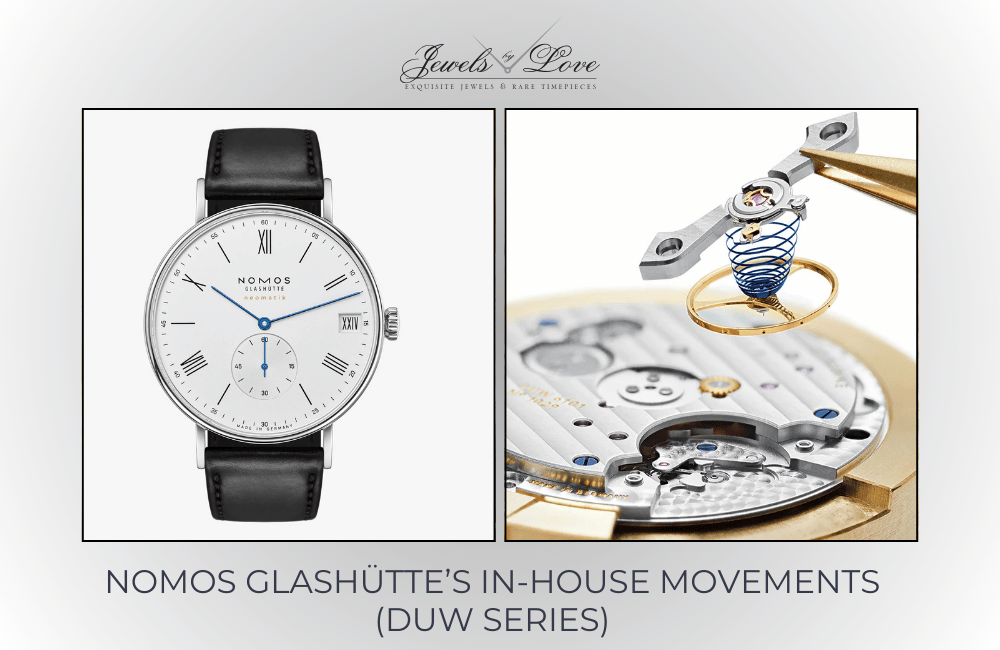
If you’ve ever admired a NOMOS watch and wondered what separates one movement from another, you’re asking the right question.
Most people know NOMOS Glashütte for clean dials and Bauhaus lines. Fewer realise how seriously the brand takes movements. Since the early 1990s, NOMOS has been moving step by step away from off-the-shelf bases and into full in-house production.
That journey hit a turning point in 2014 with the Swing System escapement, built internally and free from Swiss supply chains. From there came a new family name for its movements. DUW, short for Deutsche Uhrenwerke. If a caliber starts with DUW, it’s made in-house, start to finish.
This article focuses on every DUW movement NOMOS currently offers. Hand-wound. Automatic. Ultra-thin. Each crafted for a reason, and each does something a little differently.
You’ll find a clear breakdown of all DUW movements, what they’re built for, in a chart. So you can see the differences without squinting at spec sheets or guessing what matters.
NOMOS Automatic Movements (Self-Winding)
NOMOS approaches automatic movements with the same mindset it applies to design. Keep things clear. Make every component earn its place. The result is a lineup that covers everything from straightforward three-hand automatics to slim world-time calibers, all built around bi-directional winding and the in-house Swing System.
Below is a closer look at each automatic DUW movement and what sets it apart.
|
DUW Movements |
Series / Line |
Diameter |
Thickness |
Power Reserve |
Jewels |
Complications |
Key Characteristics |
|
DUW 3001 |
Neomatik |
28.8 mm |
3.2 mm |
~43 hours |
27 |
Time only |
Ultra-thin automatic, full rotor, foundation of the Neomatik family |
|
DUW 5001 |
Automatic |
31.0 mm |
4.3 mm |
~43 hours |
26 |
Time only |
Robust automatic architecture, traditional proportions |
|
DUW 5101 |
Automatic Date |
31.0 mm |
4.3 mm |
~42 hours |
26 |
Date |
Automatic with integrated date, classic NOMOS layout |
|
DUW 5201 |
Worldtime |
31.0 mm |
5.7 mm |
~42 hours |
26 |
World time, 24-hour display |
Push-button worldtime mechanism, travel-focused |
|
DUW 6101 |
Neomatik Date |
35.2 mm |
3.6 mm |
~42 hours |
27 |
Date (bidirectional quick-set) |
Peripheral date ring, forward & backward date correction, three crown positions |
|
DUW 3202 |
Neomatik Worldtimer |
31.0 mm |
4.75 mm |
~42 hours |
37 |
World time, home-time indicator |
Fully integrated worldtimer, thin for its complication |
DUW 5001
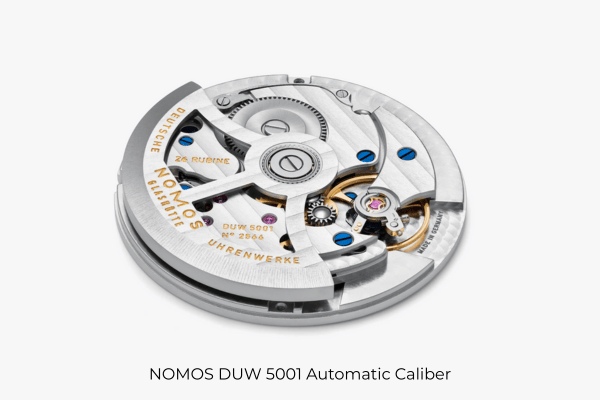
This is NOMOS’s classic automatic. Solid, proven, and built without distractions. At 4.3 mm thick and 31 mm wide, it fits comfortably inside larger cases like the Tangomat and Ludwig Automatic. There’s no date here, just hours, minutes, and seconds. Power reserve sits at around 43 hours, and winding efficiency is strong, thanks to its roots in the earlier Epsilon architecture. It’s adjusted in six positions and finished in the traditional Glashütte style with a three-quarter plate and visible blue hairspring. Quietly capable. Exactly what it needs to be.
DUW 5101
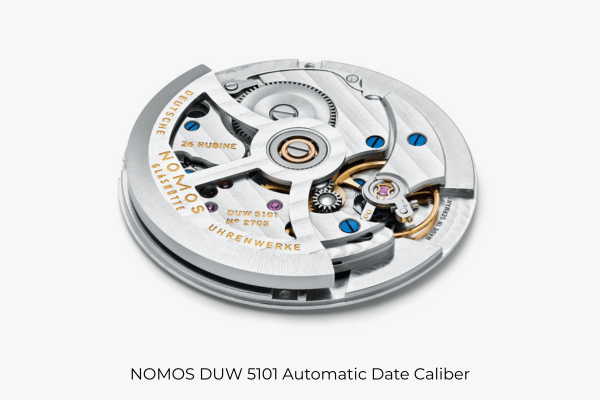
Take the 5001 and add a date. That’s the idea here, though the execution is more thoughtful than it sounds. Dimensions stay the same, but the added mechanism trims the power reserve slightly to about 42 hours. The date system itself is patented and designed to remain reliable over long use. You’ll find this movement in watches like the Tangomat Date and Club Automatic Date. It keeps the same accuracy standards and in-house escapement, making it a dependable everyday automatic with a practical upgrade.
DUW 5201
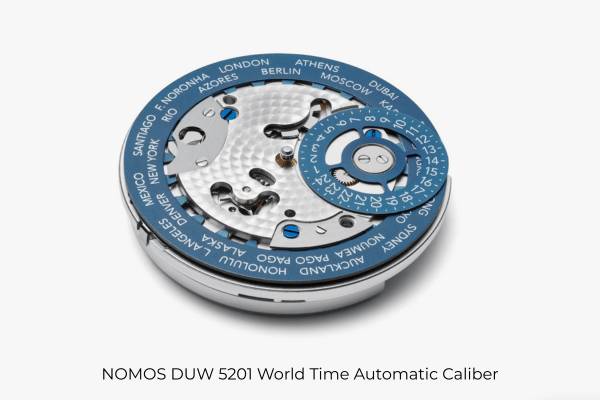
This is where things get more involved. DUW 5201 introduces a world-time function with a 24-hour indicator and a city ring that advances via a case pusher. It’s thicker at 5.7 mm, which is expected given the added mechanics, but still compact for what it offers. Power reserve sits at roughly 42 hours, with 26 jewels supporting the movement. This caliber made history for NOMOS as the first to debut with the Swing System. Despite the added functionality, it’s intuitive to use. One button, one step, new time zone.
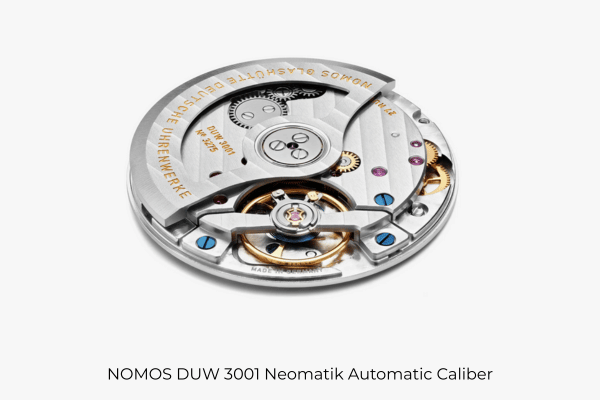
DUW 3001
The movement that changed the game for NOMOS automatics. Developed by NOMOS Glashütte, DUW 3001 is just 3.2 mm thick and allowed the brand to build slim automatic watches without sacrificing performance. Efficiency is the headline here. Friction losses are kept exceptionally low, which means a thinner mainspring can still deliver around 43 hours of running time.
The movement consists of 160 parts, is smaller in diameter, and tightly packed, with nearly all components layered within a narrow vertical space. It powers the Neomatik three-hand models and shows how far NOMOS pushed engineering to make slim automatics practical.
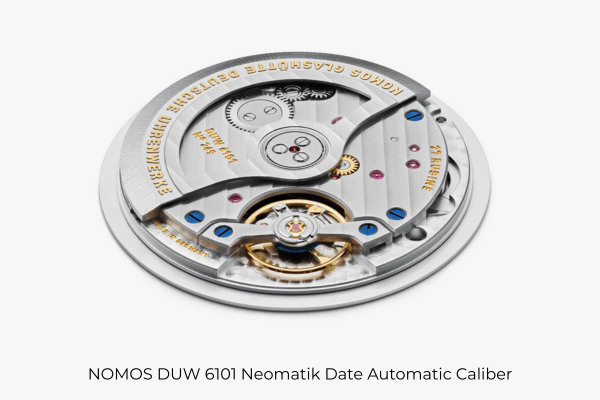
DUW 6101
This caliber takes the Neomatik platform and adds a date, without losing its slim profile. Thickness increases slightly to 3.6 mm, while the diameter grows significantly to allow an outer date ring. That design choice lets NOMOS Glashütte place large date displays at the edge of the dial, as seen in models like the Tangente Neomatik 41 Update. The date can be adjusted forward or backward, safely, with a shortened protection window around midnight. Development took years, and it shows.
The movement has 214 parts and also introduced a three-position crown for winding, date setting, and time setting. Power reserve is around 42 hours, supported by 27 jewels. It raised expectations for date mechanisms in this price bracket.
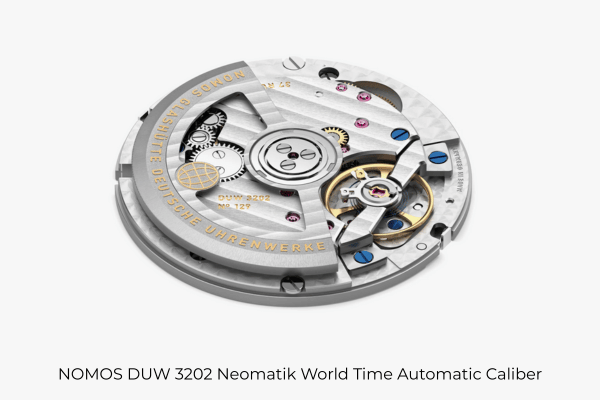
DUW 3202
The newest addition brings world time into the Neomatik family. At 4.75 mm thick, it remains slim for a complication of this kind. The movement integrates the world-time mechanism directly into its structure rather than layering it on top. There’s a 24-hour home time display, a city ring controlled by a pusher, and a higher jewel count to support the added parts. Power reserve stays at about 42 hours. Found in watches like the Club Sport Neomatik Worldtimer, this caliber makes frequent travel feel less fiddly and more intuitive.
NOMOS Hand-Wound Movements (Manual-Winding)
and-wound movements are where NOMOS built its name. Long before the brand introduced slim automatics, these calibers defined its identity. Even today, they remain central to the collection.
The DUW 4000 series covers all of NOMOS’s in-house manual movements equipped with the Swing System. Sizes vary. Complications come and go. Thickness stays impressively low. What follows is a clear look at each caliber and what it brings to the table.
|
DUW Movements |
Series / Line |
Diameter |
Thickness |
Power Reserve |
Jewels |
Complications |
Key Characteristics |
|
DUW 4001 |
Manual |
23.3 mm |
2.6 mm |
~53 hours |
17 |
Small seconds |
Compact hand-wound movement, long reserve for its size |
|
DUW 4001 Duo |
Manual Duo |
23.3 mm |
2.6 mm |
~53 hours |
17 |
Time only (two-hand) |
No second hand, ultra-clean dial layouts |
|
DUW 4101 |
Manual Date |
32.1 mm |
2.8 mm |
~42 hours |
23 |
Date |
Large-diameter manual caliber with integrated date |
|
DUW 4301 |
Manual Power Reserve |
23.3 mm |
2.8 mm |
~43 hours |
17 |
Power reserve |
Hand-wound with proprietary power-reserve display |
|
DUW 4401 |
Manual Date + Power Reserve |
32.1 mm |
2.8 mm |
~42 hours |
23 |
Date, power reserve |
Combines two complications in a slim manual format |
|
DUW 4601 |
Manual Date |
34.6 mm |
2.8 mm |
~52 hours |
23 |
Date |
Large hand-wound movement with extended reserve and open balance view |
|
DUW 1001 |
Atelier |
32.0 mm |
3.6 mm |
~84 hours |
29 |
Power reserve |
Twin-barrel long-reserve movement, high-end finishing |
|
DUW 2002 |
Atelier (Form) |
32.6 × 22.6 mm |
3.6 mm |
~84 hours |
23 |
Power reserve |
Shaped form movement designed for the Lux case geometry |
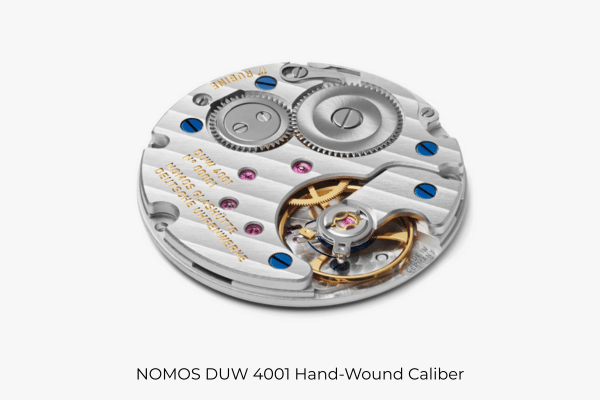
DUW 4001
This is the foundation. Small, slim, and focused on timekeeping alone. Measuring 23.3 mm across and just 2.6 mm thick, it fits perfectly inside NOMOS’s smaller cases. Despite its size, it delivers around 53 hours of power. That means you can skip a day of winding and still come back to a running watch. The movement uses 17 jewels and carries traditional Glashütte finishing that’s easy to appreciate through a sapphire back. You’ll find it inside smaller Tangente, Ludwig, and Tetra models, where restraint is the whole point.
DUW 4101
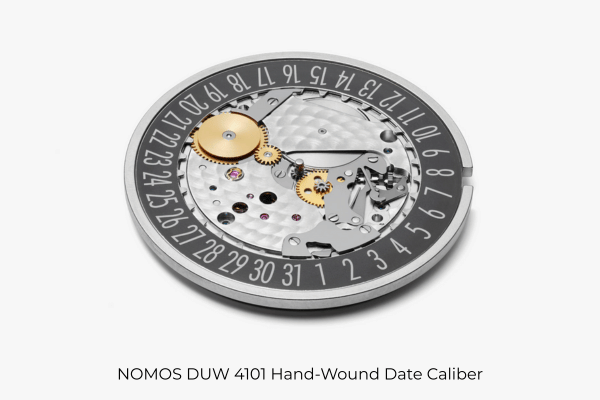
Step up in size and add a date. DUW 4101 measures 32.1 mm in diameter and remains under 3 mm thick. The date sits neatly at six o’clock, keeping the dial balanced. Power reserve comes in at about 42 hours. This was one of the first calibers to carry the Swing System and marked a turning point for the brand. It hacks, adjusts in six positions, and stays slim even with the added mechanism. It shows up in watches like the Metro Date and Orion Date, where the design needs a little more presence.
DUW 4301
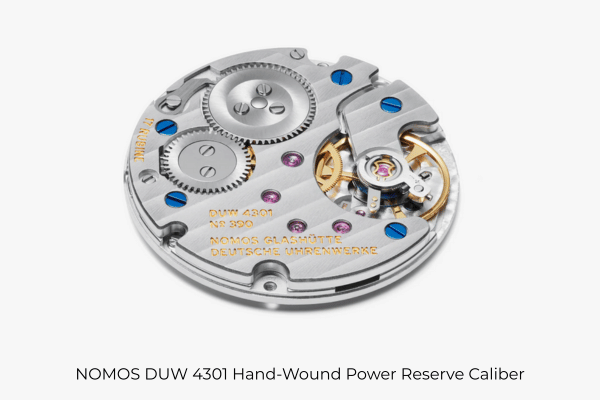
This movement adds a power reserve display without making things bulky. Built on the smaller 23.3 mm footprint, it remains just 2.8 mm thick and runs for roughly 43 hours. The reserve indicator works like a fuel gauge, giving a quick visual cue before the watch runs down. It’s practical and easy to read. Used in models such as the Tangente Gangreserve, this caliber shows how NOMOS adds function without clutter.
DUW 4401
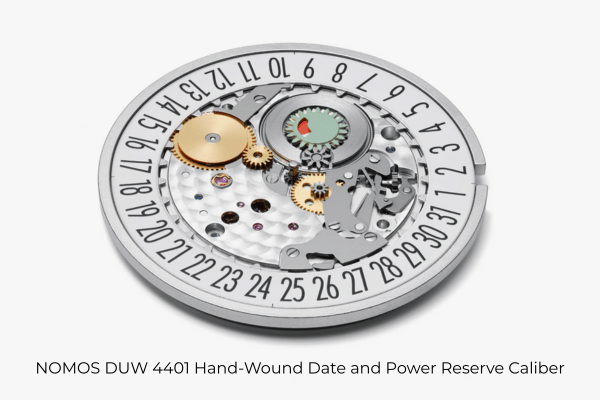
Date and power reserve together, still slim. DUW 4401 combines both complications in a 32.1 mm movement that measures 2.8 mm in height. Power reserve stays around 42 hours. This caliber was the first to debut the Swing System publicly and carried a lot of weight for the brand. Despite the added mechanics, the layout remains clean and legible. You’ll see it inside watches like the Tangente Datum Gangreserve and Metro Datum Gangreserve, where functionality and clarity go hand in hand.
DUW 4601
Larger cases needed a different approach, and this is where DUW 4601 comes in. At 34.6 mm in diameter, it allows the date ring to sit around the movement, opening up new dial layouts. Power reserve stretches to about 52 hours. Thickness remains at 2.8 mm. A skeletonized balance cock puts the blue balance spring on full display, which makes this movement especially engaging to watch in motion. Found in models like the Tangente 2 Date and Minimatik 39 Date, it reflects NOMOS’s move toward larger watches without abandoning restraint.
Across the range, these hand-wound movements stay remarkably thin. Even the most complicated versions hold the line at 2.8 mm. Power reserves hover around two days, with some pushing beyond that. All use the in-house escapement and follow Glashütte finishing traditions. For anyone who enjoys winding their watch and keeping things mechanical in the purest sense, this is where NOMOS feels most at home.
Atelier “High-End” Movements (Limited Production)
These movements sit at the very top of the NOMOS lineup. They’re made in small numbers, reserved for precious metal cases, and finished to a standard well beyond the brand’s regular production. Think showcase pieces rather than daily wearers.
|
DUW Movements |
Series / Collection |
Shape |
Diameter / Dimensions |
Thickness |
Power Reserve |
Jewels |
Complications |
Key Characteristics |
|
DUW 1001 |
Lambda |
Round |
32.0 mm |
3.6 mm |
~84 hours |
29 |
Power reserve |
Twin-barrel construction, long autonomy, hand-engraved balance cock, gold chatons |
|
DUW 2002 |
Lux |
Form (Tonneau) |
32.6 × 22.6 mm |
3.6 mm |
~84 hours |
23 |
Power reserve |
Shaped movement built specifically for Lux case, twin barrels, haute-horlogerie finishing |
DUW 1001
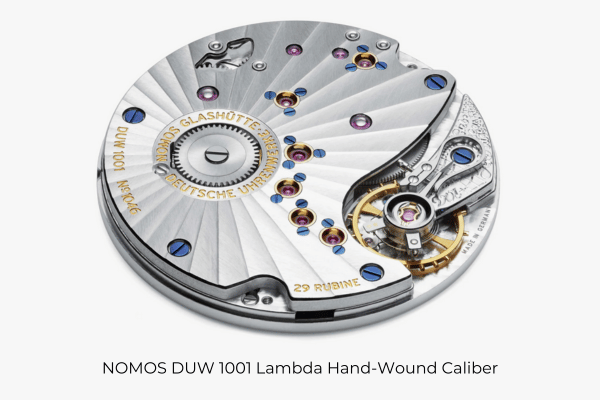
Introduced in 2013, this large hand-wound caliber delivers an 84-hour power reserve from twin barrels. A wide power reserve display defines the dial layout. At 3.6 mm thick, it remains restrained in profile. Gold chatons, hand engraving, a swan-neck regulator, and six-position adjustment mark it out as something special. This movement is used in NOMOS Lambda references, primarily in 18k white or rose gold, with a handful of rare steel editions produced in very limited numbers.
DUW 2002
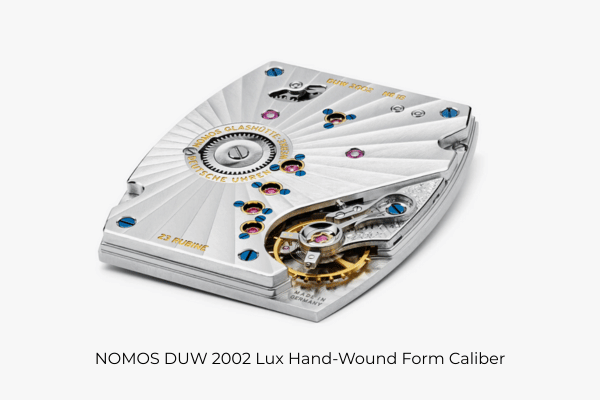
Developed specifically for the Lux, this rectangular movement mirrors the technical setup of the 1001, including the 84-hour reserve, but in a shaped format that fills the case precisely. Finishing follows the same approach, with engraved components and carefully polished surfaces throughout. Used in NOMOS Lux references, produced in small runs in white gold or rose gold.
Explore NOMOS Timepieces at Jewels By Love
Jewels By Love is an authorized luxury watches retailer located in St. Maarten traces its roots back to the 1800s, with the present custodians representing the sixth generation of jewellers and diamond specialists. That long view shapes how the brand approaches fine watchmaking, with an emphasis on knowledge, continuity, and respect for craft.
The NOMOS Club Sport 39 Limited Edition was created in memory of Love Mahtani, honouring his legacy and his close relationship with the brand. The watch is powered by the DUW 3001, NOMOS’s ultra-slim in-house automatic movement, chosen for its efficiency, reliability, and understated engineering.
At Jewels By Love, the team brings a deep understanding of NOMOS calibers, from hand-wound movements to Neomatik automatics.
You can explore the NOMOS collection on our website and contact our expert team for inquiries.