

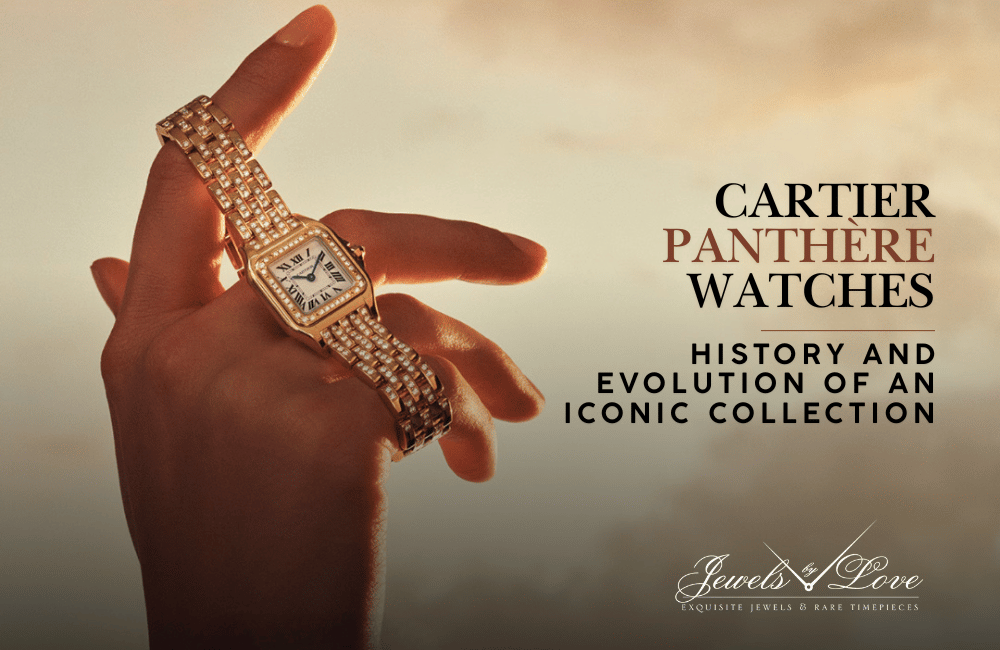
When Cartier introduced the Panthère in the early 1980s, the idea was clear. Create a watch that carries the ease of fine jewelry while still functioning as a daily timekeeper. Slim, flexible, and intentionally limited, it stopped focusing on complex features and tool-style designs. Instead, it focused on looking elegant and luxurious while simply telling the time.
The name came from one of Cartier’s most enduring symbols. The panther had already shaped the maison’s identity decades earlier, long before the Panthère watch existed. It stood for confidence, control, and elegance, qualities that translated naturally into the collection’s design language.
Over the years, the Panthère has changed in detail, materials, and execution, but never in intent. It remains a watch built around proportion, comfort, and visual balance rather than spectacle.
In this blog, you will explore Panthère’s origins, its design evolution, and the mechanical choices that support its character.
Curious? Let's get started.
Origin and Evolution of Panthère Timepieces
1914–1930s: The Panther Enters Cartier’s Visual Language
Even before the Panthere timepiece was created, the panther had already gained a strong position in the Cartier aesthetics.
In 1914, Louis Cartier requested illustrator George Barbier to design a watercolor titled La Dame à la Panther, which was the first formal introduction of the animal into the house.
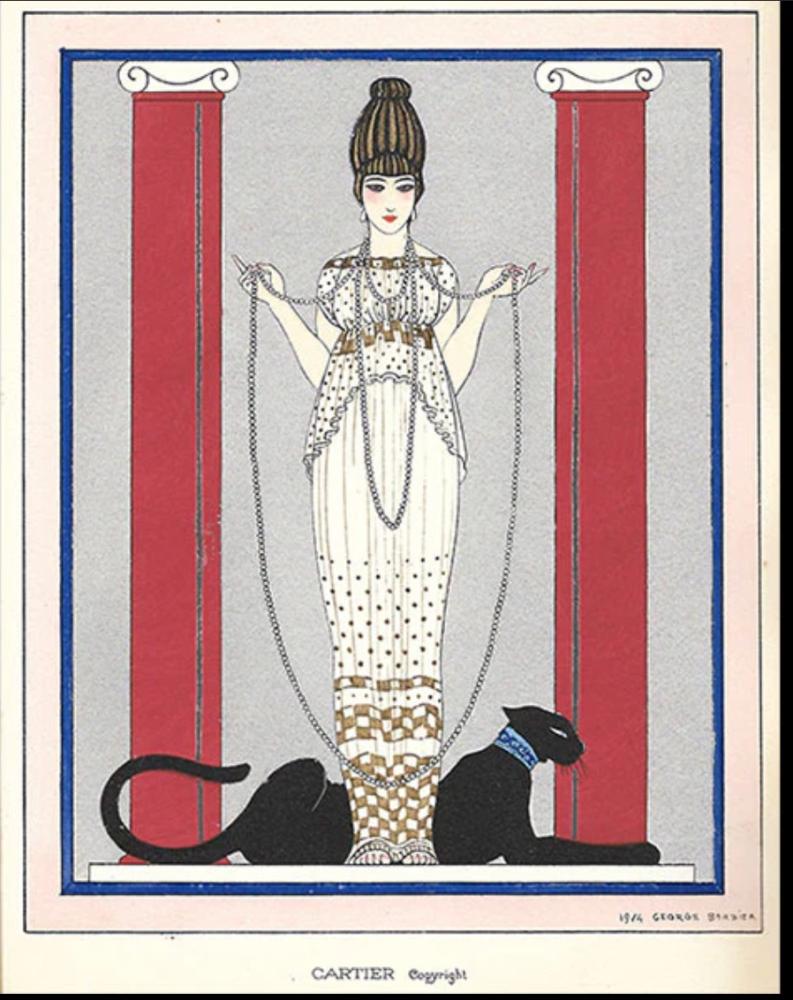
Image Caption: Illustration “La Dame à la Panthèr” created by George Barbier’s in 1914.
That same year, Cartier introduced a ladies’ wristwatch in platinum, decorated with onyx and diamonds arranged in a spotted pattern. This work is commonly known as the 1914 panther motif jewelry watch, and it still serves as the major point of reference to collectors in modern times.
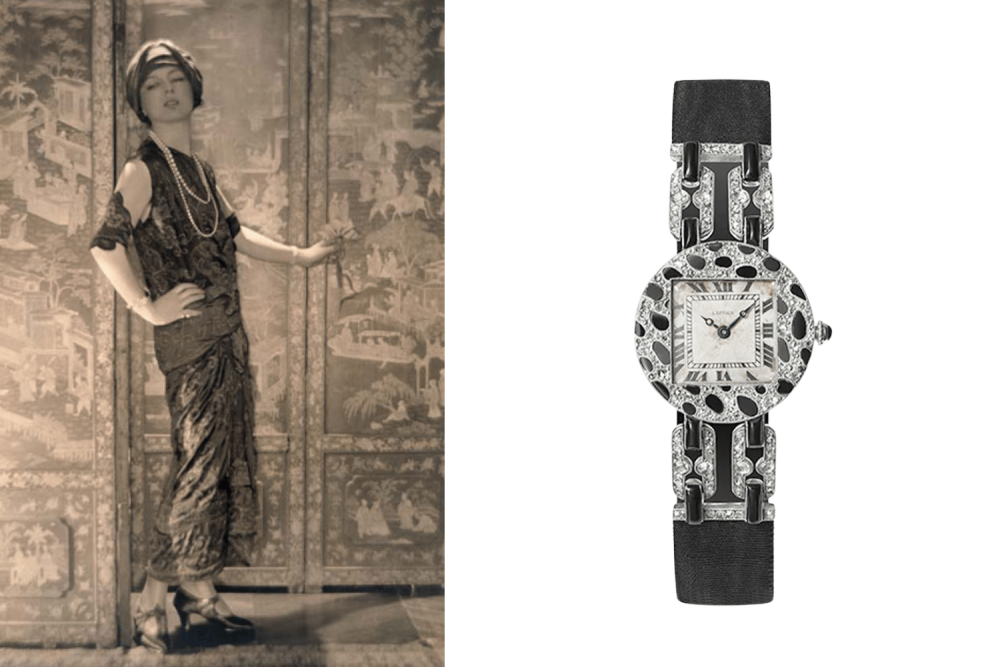
Caption: Jeanne Toussaint on the left, the creative force behind Cartier’s panther motif, alongside an early panther-inspired Cartier wristwatch on the right.
Jeanne Toussaint was behind this change. She became the Creative Director of Jewelry at Cartier and was also referred to as “La Panthere” within the house. With her, the panther shifted between ornamentation and identity. It was featured on high jewelry, brooches, vanity cases, and special commissions such as those made to the Duchess of Windsor. At the beginning of the twentieth century, the panther represented power, dominance, and sophistication. These concepts would be used to drive the Panthere watch.
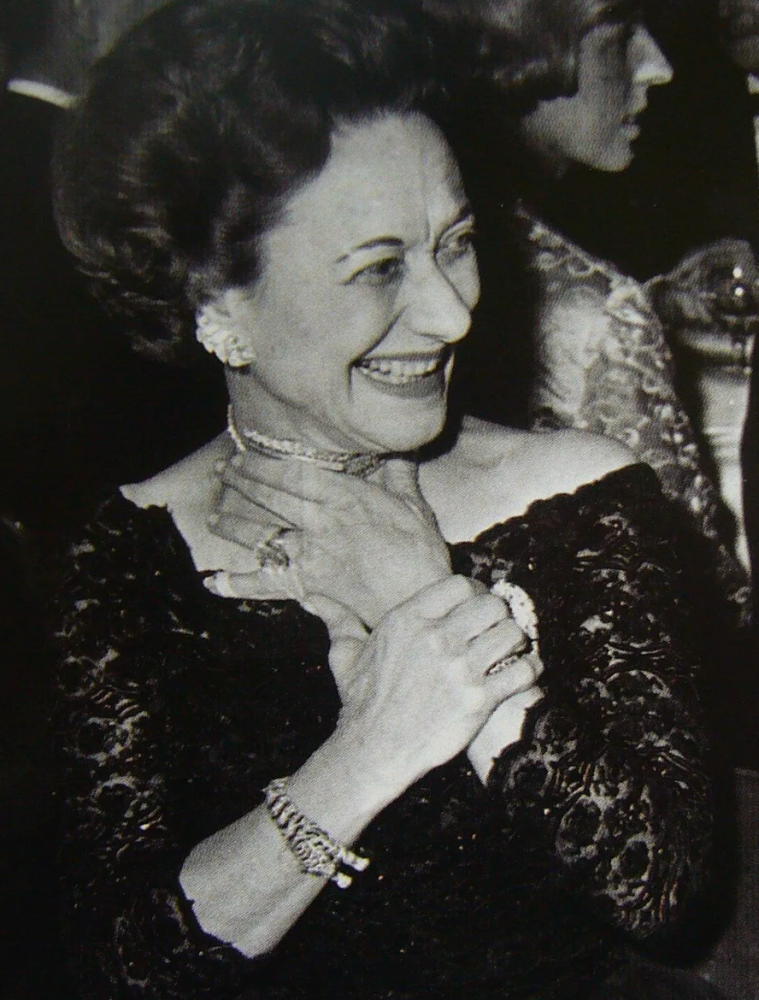
Image Caption: The Duchess of Windsor wearing a Cartier panther bracelet, a symbol of confidence and control long before the Panthère watch.
1983: The Birth of the Panthère de Cartier Watch
The Panthere de Cartier watch itself was not so timely. In the year 1983, Cartier launched the Panthere de Cartier, which was a new form of timepiece. This was not a reinterpretation of an older design, as the Tank or Santos was. It was created as a jewelry-first watch, a watch meant to be worn every day and in the form of a bracelet.
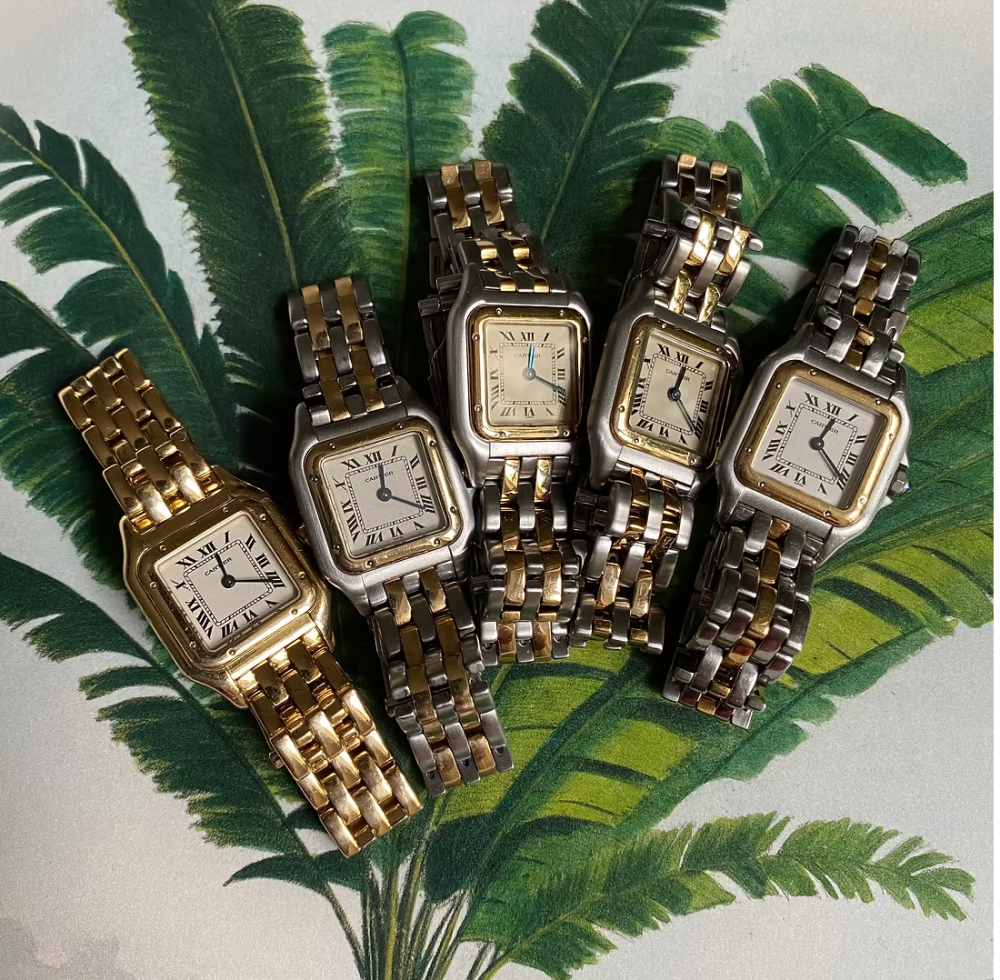
Image Caption: The Panthère de Cartier, introduced in 1983, featuring the Figaro-style bracelet and the softened square case inspired by the Santos-Dumont.
The case was inspired by the previous curves of Cartier, particularly Santos-Dumont, and its square shape and the visible screws in the bezel. But the proportions were toned down. The bracelet was the characteristic feature. Cartier produced a five-link bracelet called the Figaro-style bracelet, which was constructed with a flexible design that was movable and flat on the wrist. This bracelet was not a decoration. It was the core of the design.
The initial Panthere models were provided in yellow gold, white gold, and steel and gold mixes. Cartier selected Swiss quartz movements inside. This move was logical at the time. Quartz enabled the case to remain skinny, needed minimal maintenance, and aligned with the Panther in being used as a daily jewelry watch, and not a technical watch.
Since its inception, the Panthere had a definite idea of its desired identity. A timepiece that looks more like a bracelet. An architecture that is determined by comfort and proportion. And a direct continuation of something that Cartier had been perfecting for decades.
Late 1980s–1990s: Expansion Without Redesign
During this period, Cartier launched an entire collection of sizes that comprised Mini (19-21 mm), Small (22 mm), Medium (27 mm), and Large or Jumbo (29-31 mm). This meant that the Panthere could move perfectly on wrists, as much as it had in women's sizes, in unisex and even in men's sizes, without altering its proportions.
Gold remained central, while steel and two-tone models broadened its reach. Some references added a date window or central seconds, though these elements never defined the watch.
The fundamentals stayed the same. Square case. Five-link bracelet. Roman numerals. Cartier treated the Panthère as a complete idea, focusing on wearability rather than visual change.
2004: Discontinuation and the Pause That Followed
In 2004, Cartier discontinued the Panthère to make room for newer Santos lines. The watch had no replacement. As trends shifted toward larger designs, the Panthère simply paused. That absence preserved its identity.
2004 to 2016: The Years That Built the Following
Interest in the Panthère continued to rise after its 2004 discontinuation, which later helped drive its return. With no new models being released, it began to feel rare and hard to access. Stylists kept using it. Collectors kept searching for it. That period shaped its reputation and demand, which Cartier eventually recognized and acted on.
2017: The Return
In 2017, it relaunched in two sizes, 22 mm and 27 mm, with the square case, screwed bezel, 5-link bracelet with a discreet clasp, and quartz movement. The assortment reappeared in steel, yellow gold, rose gold, 2-tone, and gem-set, as well as spotted enamel design.
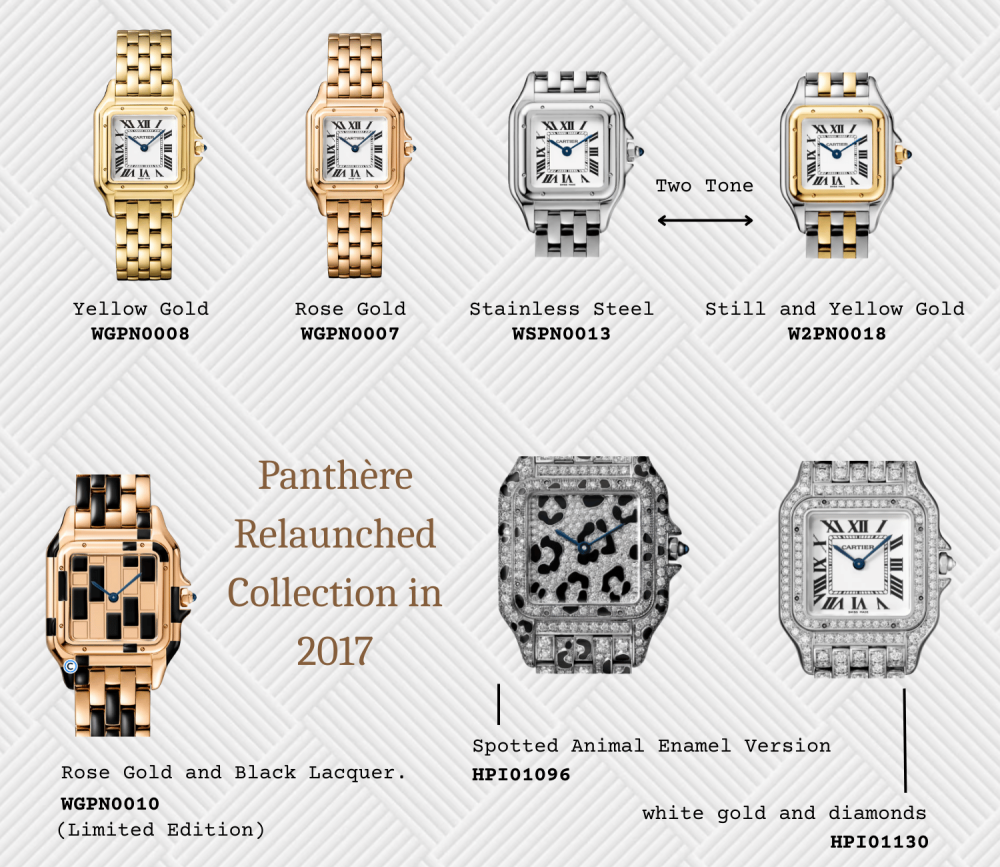
Image Caption: Panthère de Cartier models reintroduced in 2017.
Things were changed structurally but not visually. The bracelet was made more waterproof, and Cartier strengthened it, remaining at 3 bars, approximately 30 meters. These updates were important in a watch such as the Panthere. The bracelet is the watch.
In a nutshell The return was not novel. It was about making the original to be made comfortable.
2018–2019: Double-Tour, Triple-Loop, and the Return of the Manchette
The Panthere was introduced in 1983, then in 2004, and repurchased in 2017. In 2018, Cartier added a relaunch in the form of Double-Tour and Triple-Loop models after a year.
In such versions, all the focal point has been on the bracelet, and the Panthere is brought back into the limelight as just a piece of jewelry, which by chance, does have a purpose in telling time.
It was introduced in the Panthere de Cartier Double-Tour, model WGPN0013, in 18K Cartier yellow gold, and has a bracelet that wraps itself around a wrist twice. It has a 22mm by 30mm case with a 6mm thickness, quartz movements, hours and minutes, but with a blue spinel crown, and retains the dial, Roman numerals, blue steel hands, and water-resistance of 3 bar.
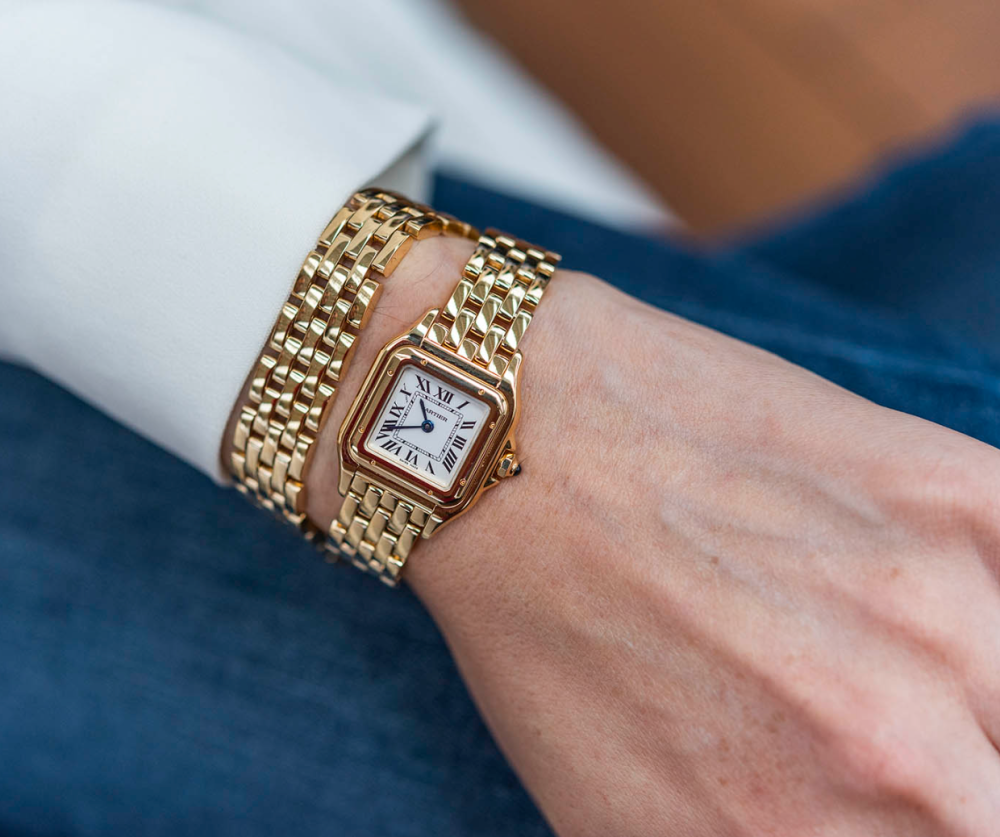
Image Caption: A woman wearing the Panthère de Cartier Double-Tour (reference WGPN0013), reintroduced in 2018.
The idea reached its peak with the Triple-Loop, reference WJPN0011. This Mini model in 18K white gold wraps three times around the wrist and is set with 99 brilliant-cut diamonds, including a diamond-set crown. The 20 mm x 25 mm case keeps the same slim profile and quartz movement.
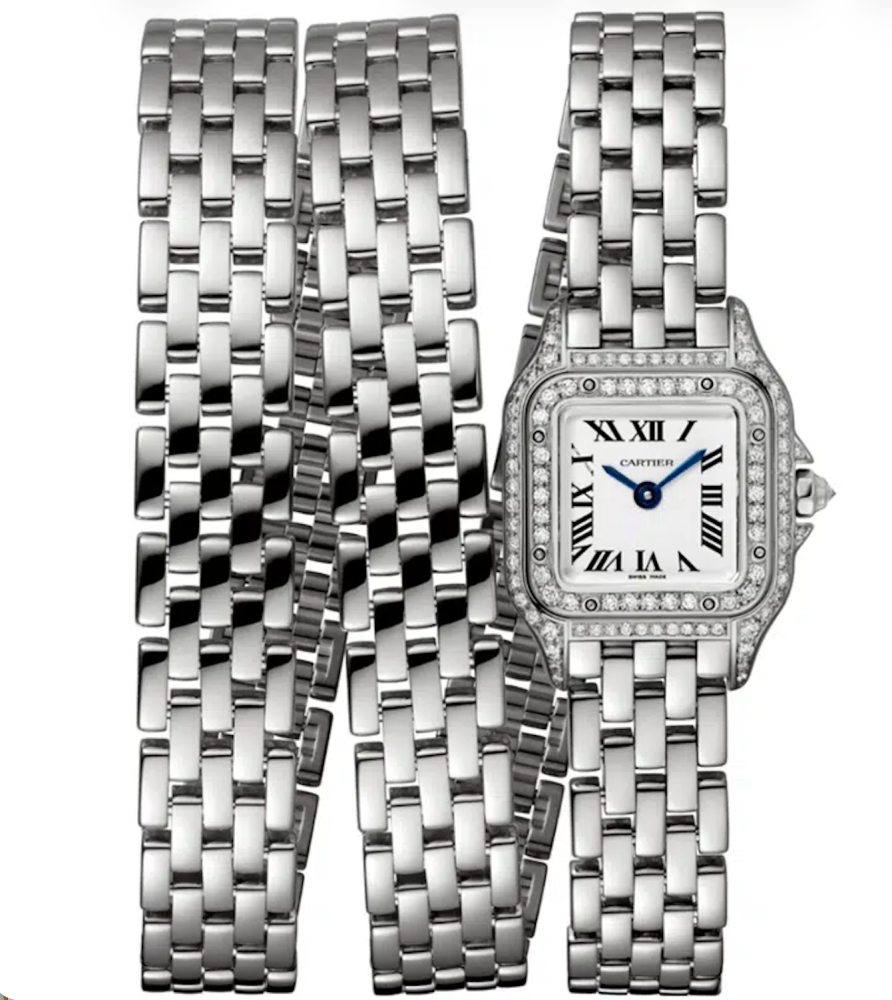
Image Caption: Panthère de Cartier Triple-Loop, reference WJPN0011, in 18K white gold with a three-wrap bracelet and diamond-set case and crown.
In 2019, Cartier revived a more radical expression with the Panthère de Cartier Manchette, reference WGPN0018. This cuff-style watch blurs the line between timepiece and high jewelry. Crafted in 18K yellow gold, it uses a compact 22 mm x 19 mm case set within a wide cuff measuring 31 mm across. The dial remains silvered with blued sword hands, protected by sapphire crystal, and powered by quartz.
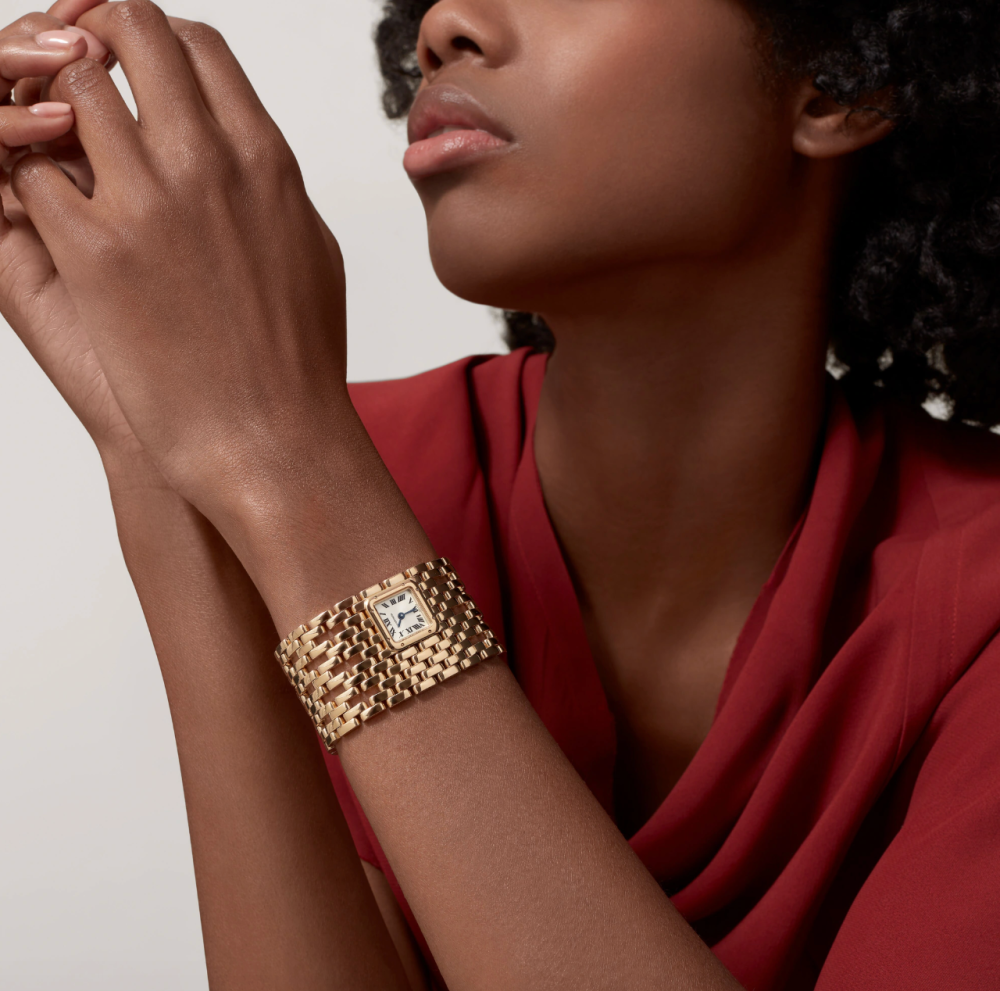
Image Caption: Panthère de Cartier Manchette, reference WGPN0018, worn as a bold gold cuff watch.
2023–2024: Continuation of Large Steep Model
In 2023 and 2024, the Panthère stayed exactly on course. The only addition was the Large steel model, reference WSPN0016.
This was a change in scale, not design. The 31 mm x 42 mm case keeps the same slim profile at 6.71 mm, runs on quartz, and displays hours and minutes only. Silvered dial, blued hands, blue spinel crown, and 3 bar water resistance remain unchanged.
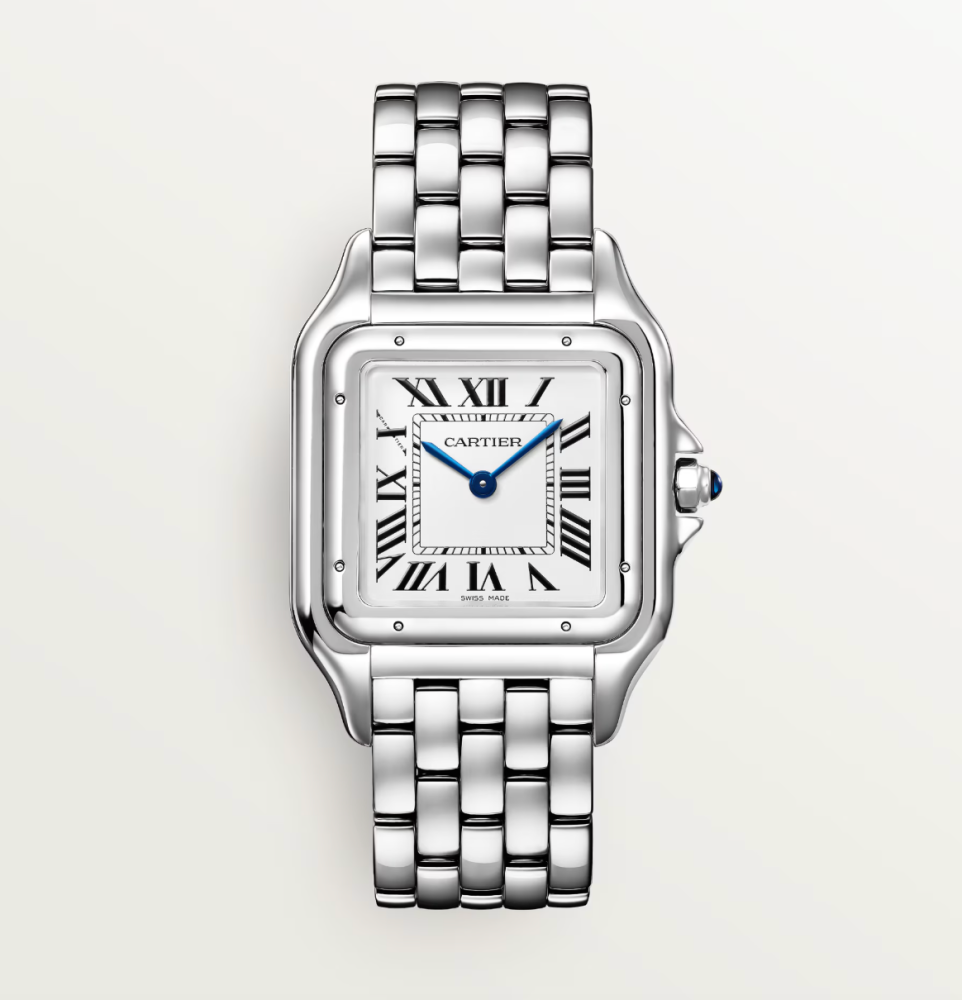
Image Caption: Panthère de Cartier Large in steel, reference WSPN0016, reintroduced with a larger case format.
2025: High-Jewelry Takes the Lead
In 2025, Cartier expanded the Panthère through surface, material, and form, while keeping the same time-only quartz foundation.
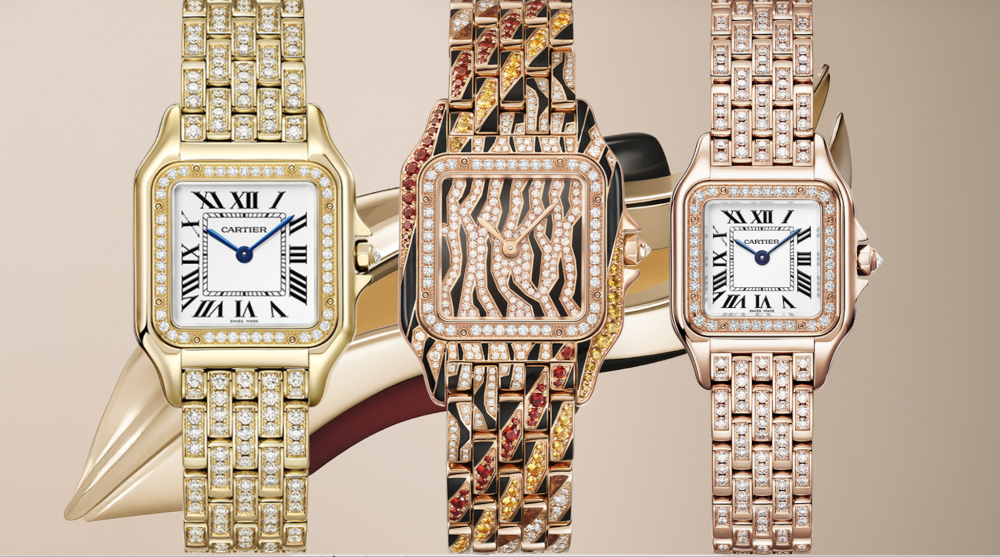
Image Caption: From left to right: Panthère de Cartier semi-set medium in yellow gold (ref. WJPN0060), Panthère de Cartier animal motif model in rose gold (ref. HPI01698), and Panthère de Cartier semi-set Mini in rose gold (ref. WJPN0063).
The clearest statement remains the Panthère de Cartier animal motif model, reference HPI01698. Crafted in 18K rose gold, this piece turns the entire watch into a continuous graphic surface. Diamonds, spessartites, and lacquer flow from the dial into the bracelet, creating an animal-skin pattern across the wrist. The medium case measures 36.5 mm x 26.7 mm, with a 6.8 mm thickness and 3 bar water resistance. This is the Panthère used as a canvas rather than a dial.
Alongside it, Cartier introduced more restrained jewelry expressions. The Panthère de Cartier semi-set medium in yellow gold, reference WJPN0060, keeps the dial calm while pushing diamonds into the case and bracelet. The semi-set Mini in rose gold, reference WJPN0063, reduces scale further, letting the bracelet dominate and the case act almost like a clasp.
The most radical addition in 2025 is the Panthère Bangle Watch. This design abandons the traditional bracelet altogether in favor of a solid precious-metal bangle. One end features a sculpted panther in motion. The other carries a discreet time display. Available in white gold with extensive diamond setting and in yellow gold with lacquer accents and colored stones, the bangle uses a quartz movement and displays hours and minutes only. It is offered in multiple wrist sizes rather than case dimensions.
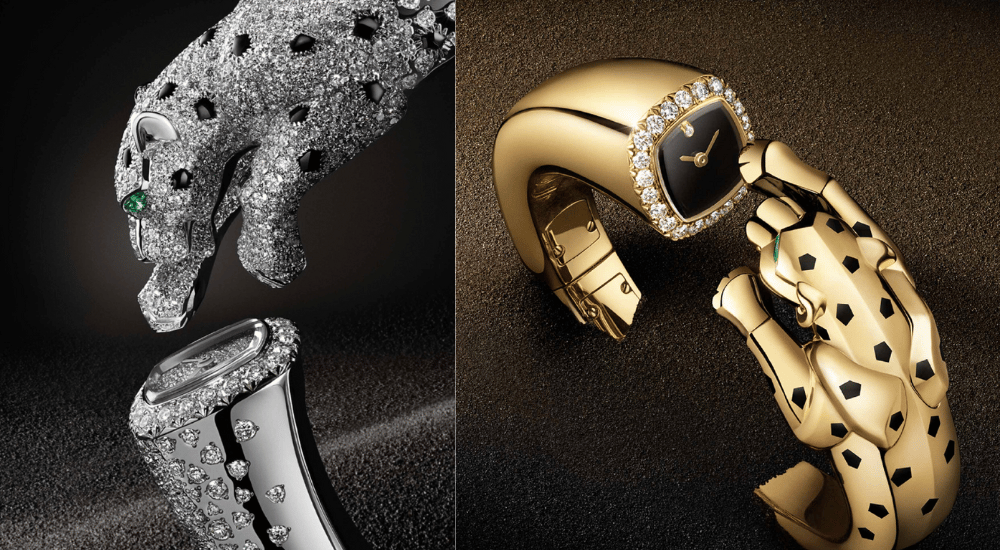
Image Caption: Left: Panthère Bangle Watch in white gold, fully diamond-set. Right: Panthère Bangle Watch in yellow gold with black lacquer accents and colored stones.
Explore the Cartier Collection at Jewels By Love
Jewels By Love is an authorized Cartier retailer, working in direct partnership with the maison and backed by a highly knowledgeable team with deep expertise in fine watches and jewelry. Every piece is sourced through official channels, ensuring complete authenticity.
Our boutique is located at 69B Front Street, Philipsburg, St. Maarten, Netherlands Antilles, a globally known duty- and tariff-free destination, allowing clients to enjoy better overall value on luxury timepieces without Cartier offering discounts.
You are welcome to visit our store in Philipsburg, explore the Cartier Panthère collection online, or contact our team directly for any enquiries. We’re always happy to assist with expert guidance and personalized support.