

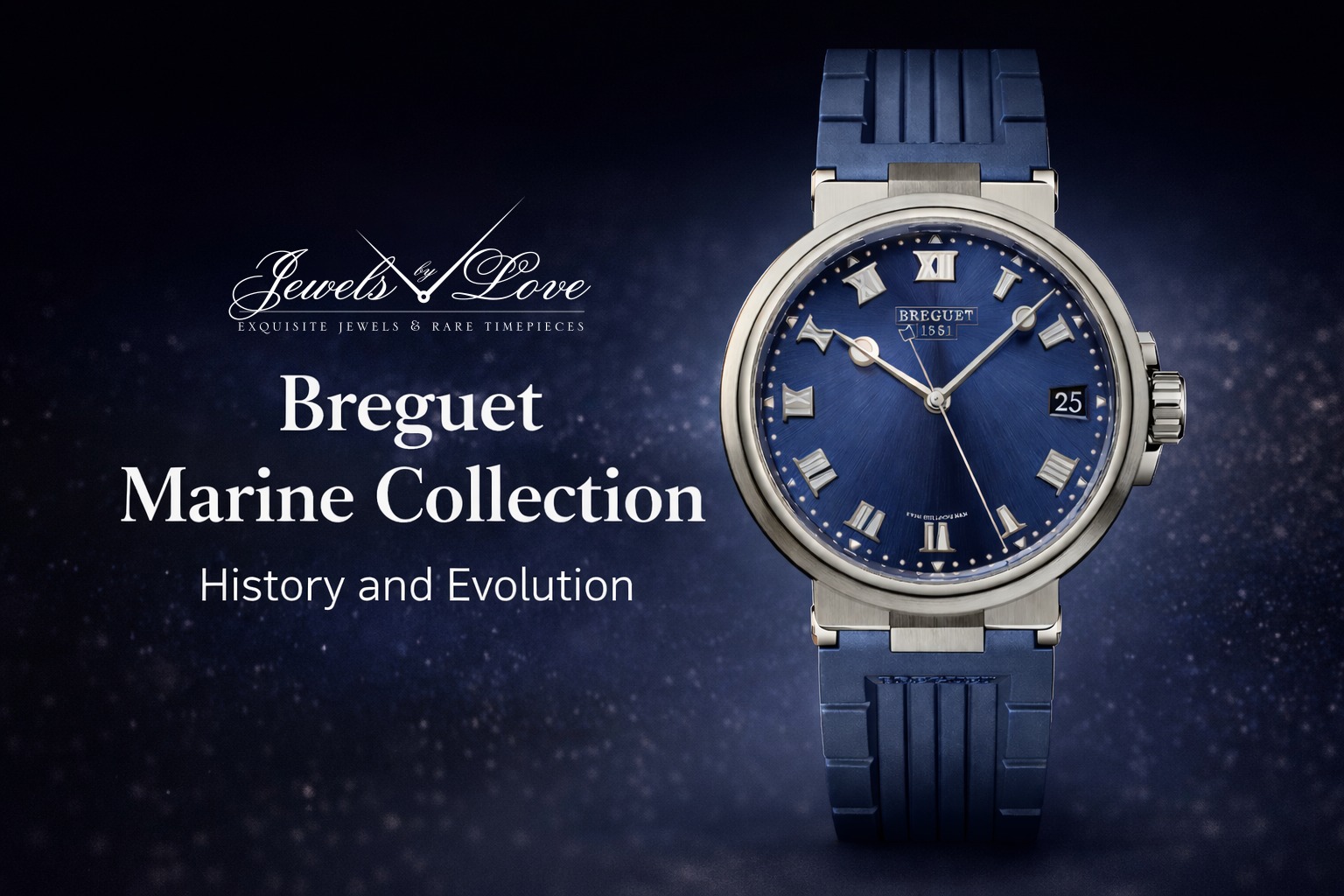
In the distinguished realm of haute horlogerie, marine jewelry watches occupy a unique position. Breguet's marine collection contributes to the great watchmaking tradition that has secured much significance. Over the years, as this significance has grown, the fondness for these assets has also increased. Led by the historic and pathbreaking vision of Abraham-Louis Breguet, this tradition retains its essence to date. Crafting, designing, weaving, structuring, and perfecting this tradition, its beauty continues to appeal to collectors and wearers.
Breguet's marine collection, attaining horological perfection and excellence, is an expression of Abraham-Louis Breguet's inspiring story. Having its roots in 1775 and becoming an embraced tradition in the current landscape, this is an inspiring tale.
Every timepiece in the collection reflects this tale while performing excellently under demanding conditions, ensuring water resistance, offering durability, and primarily blending with collectors' selections and elegant style.
An Overview of Breguet’s Timeless Legacy
Established in 1775 by Abraham-Louis Breguet, the well-known French horologist, Breguet originated as a brand brimming with aesthetics, innovation, and craftsmanship. From a watchmaking workshop at 39 Quai de l’Horloge, nestled in the Ile de la Cité, Paris, to one of the most celebrated brands in the sector, the visionary founder gave the world a horological revolution.

Image caption: Street view of Librairie du Palais at 39 Rue
Breguet has come to epitomize luxury watchmaking globally. Its journey carries the timeless legacy of unparalleled craftsmanship, innovation, and the vision to redefine the foundations of haute horlogerie.
At the heart of this legacy is the founder’s enduring passion for invention, which led to the origin of the most impressive pieces in history.
The History and Evolution of Marine Collection
Legacy of the Sea (1815)
The distinguishing Breguet marine collection we admire today has its origins back to 1815. 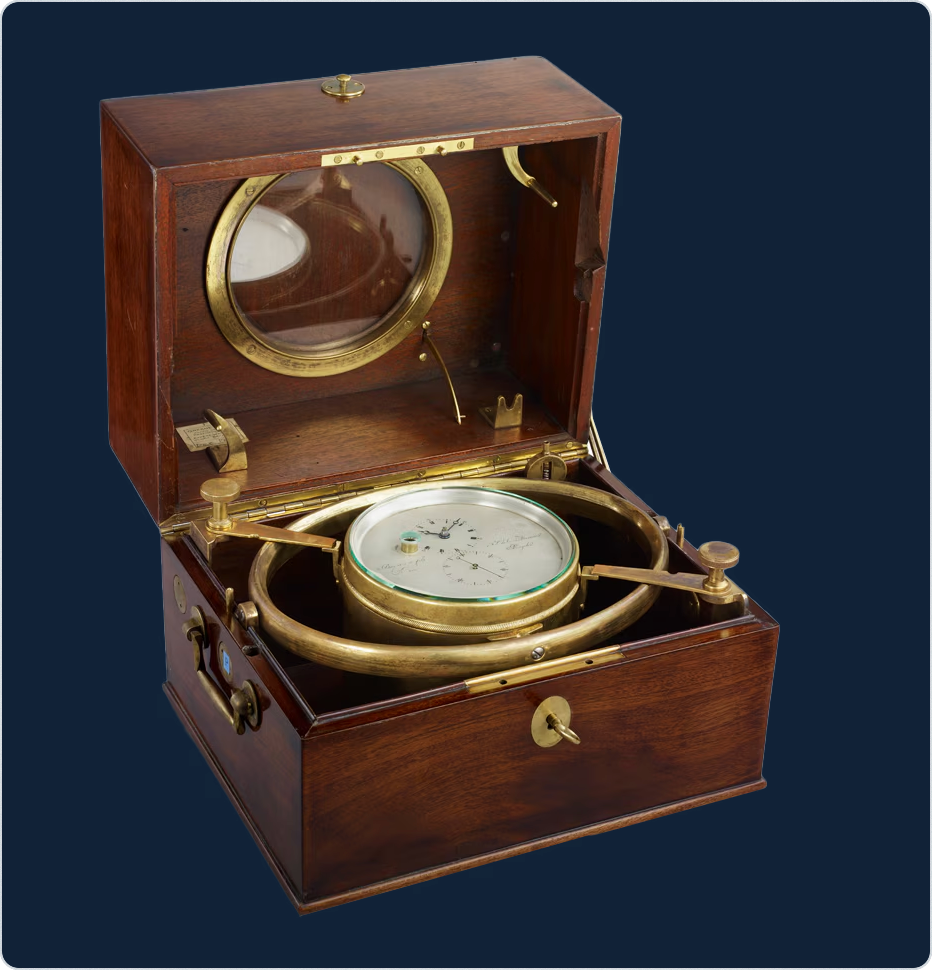
Image caption: 1815 marine chronometer in mahogany case with brass gimbal suspension.
This was the time when Abraham-Louis Breguet became the Chronometer-Maker to the French Royal Navy. During that time, maritime navigation was solely dependent on precise timekeeping.
His marine chronometers turned out to be instrumental for survival. These were engineered to ensure accuracy, determine durability, and establish legibility, even when the conditions were highly demanding.
Abraham-Louis Breguet's honor of being officially appointed as the watchmaker to the naval distinction eventually inspired the development of unique watch collections.
During the initial years, though, Breguet’s original marine chronometers were pocket instruments. They were designed to facilitate ship navigation rather than to serve as wristwatches.
The essential principles were laid that continued to define the Marine line. These principles ensured mechanical endurance, precision even under pressure, mechanical resilience, and uncompromised clarity of display.
First Modern Marine Wristwatch (1990s)
When Breguet reintroduced the Marine name in 1990, it wasn’t chasing the sports watch trend. It was reviving a title earned in 1815. The early Marine references, particularly the 3400 series, remained unmistakably Breguet.
Fluted casebands, engine-turned guilloché dials cut on traditional rose engines, Roman numerals, blued pomme hands. The watches were robust, yes, typically offering around 100 metres of water resistance, but they wore like refined nautical instruments rather than aggressive tool watches.
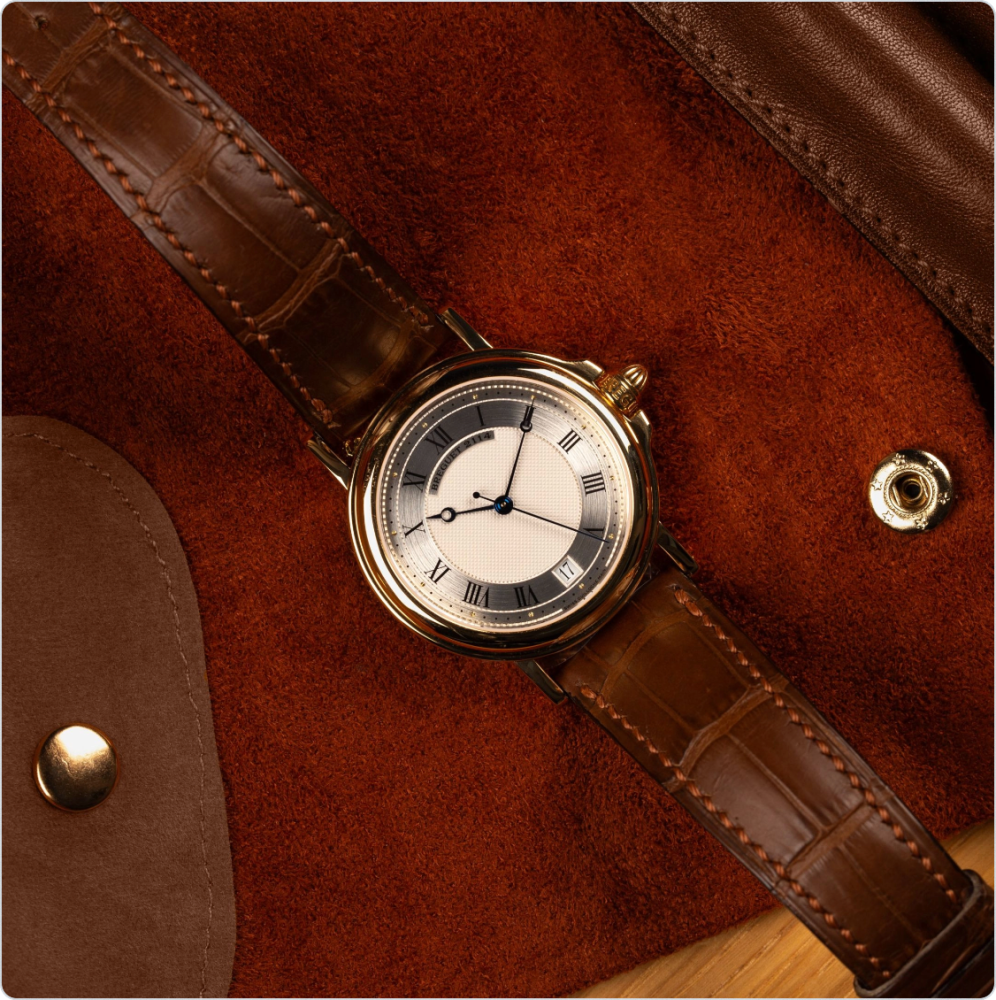
Image caption - Breguet Marine 3400 in yellow gold (circa 1990) with guilloché dial and automatic movement. (source)
Inside were automatic calibres finished to classical standards, often visible through sapphire casebacks. Decoration mattered. Proportion mattered. Nothing felt industrial. This first era defined Marine as a cultivated maritime watch, elegant, technically serious, but restrained. It's sporty in performance, but not in appearance.
The Sportier Shift (2004–2005)
The real pivot came in 2004. The Marine 5817 signalled that Breguet was ready to compete in the modern sport-luxury segment without surrendering its identity.
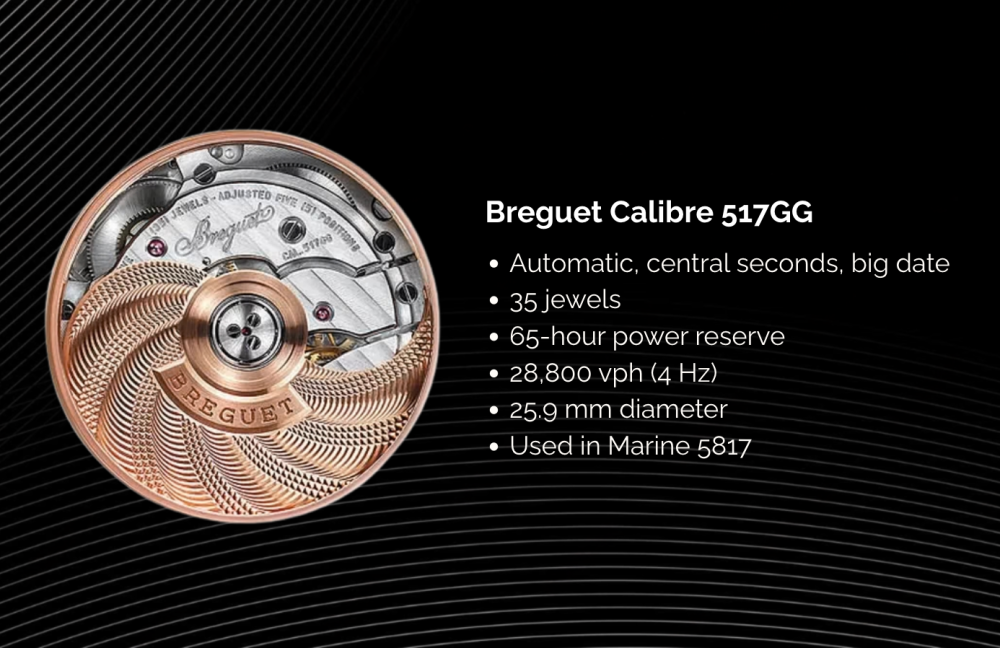
The case measured 39mm and carried stronger crown guards, a more assertive bezel, and clearer wrist presence. Water resistance remained at 100 metres, but the watch now looked purposeful. Beneath the dial sat the automatic Calibre 517GG, beating at 28,800 vph and offering a power reserve of roughly 65 hours. The large date at six o’clock was both practical and visually grounding. It wasn’t decorative excess; it was mechanical clarity.
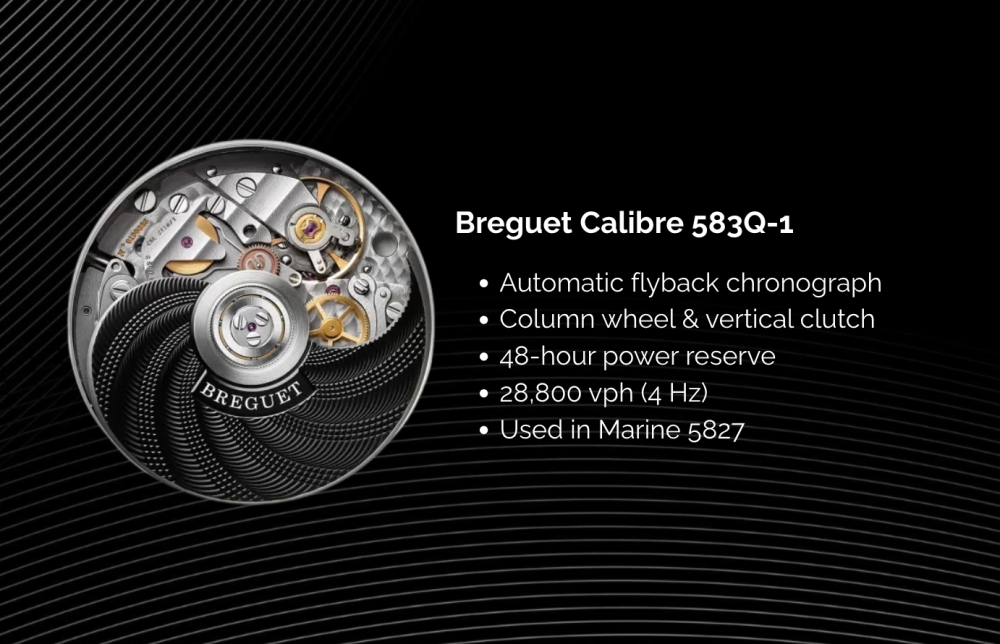
Then, in 2005, came the Marine Chronograph 5827. Larger at 42mm, powered by the Calibre 583Q, it introduced a column-wheel chronograph with flyback capability and around 48 hours of autonomy. The flyback function in particular reinforced Marine’s instrument credentials. This was no longer just a refined nautical watch. It had become a credible sport chronograph, still framed by hand-guilloché finishing and classical detailing.
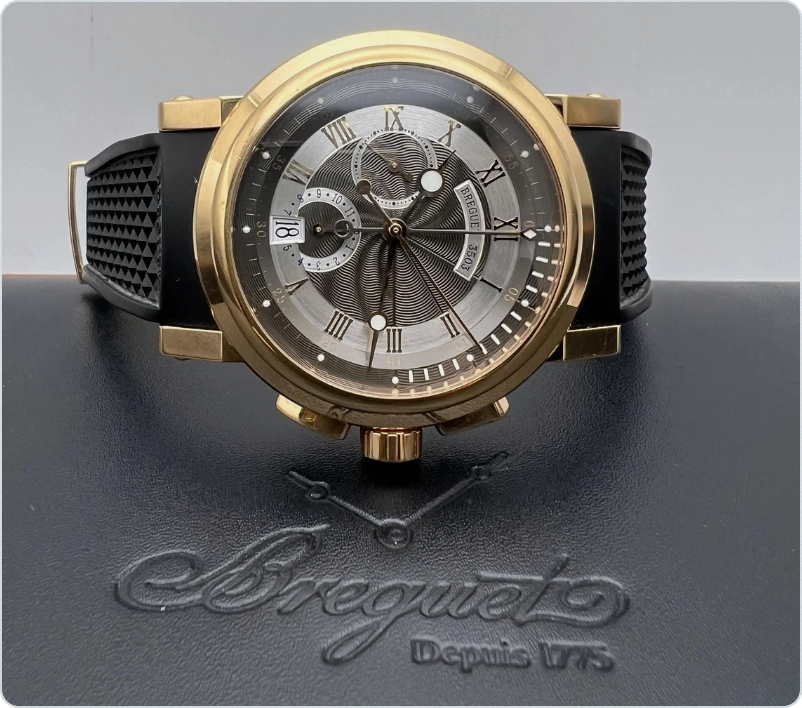
Image caption - Breguet Marine Chronograph in rose gold with hand-guilloché dial and black rubber strap.
Between 2004 and 2016, Marine matured. It bridged tradition and sport, but it had not yet fully reinvented itself.
Redesign and Technical Leap (2017–2018)
The transformation arrived in stages during 2017 and was fully realised at Baselworld 2018. This was not a cosmetic refresh. It was architectural.
The case was reengineered with integrated lug modules. The lines sharpened. Crown guards became sculptural rather than ornamental. The dial adopted a wave-pattern guilloché directly referencing the sea. Sapphire casebacks became standard, inviting scrutiny rather than hiding the mechanics. Proportions were recalibrated for modern wrists.
Three references defined the new generation
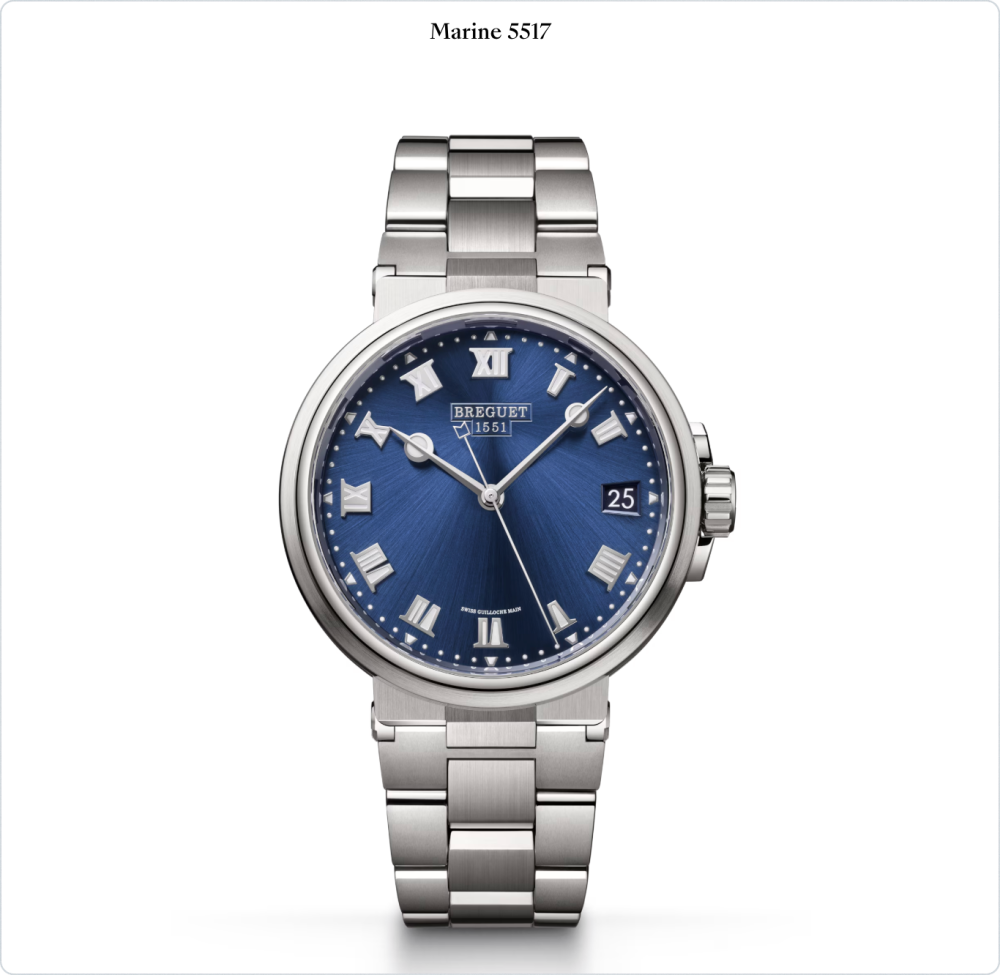
Marine 5517
The Marine 5517 distilled the collection into a contemporary three-hand platform. Its 40mm case, available in gold or titanium, maintained 100 metres of water resistance while slimming visually through better integration.
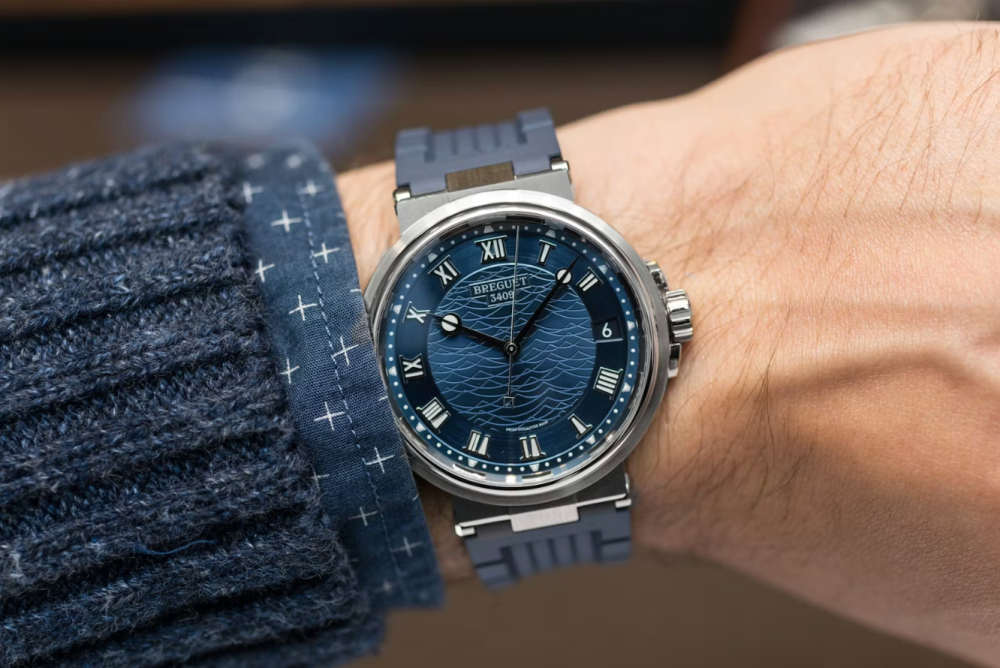
Image caption - Breguet Marine 5517 in titanium with blue wave-pattern dial and rubber strap.
Inside, the automatic Calibre 777A marked a serious technical step forward: 4 Hz frequency, around 55 hours of power reserve, and crucially a flat silicon balance spring and silicon escapement components. Silicon improved magnetic resistance, long-term stability, and efficiency. The gold rotor, engraved with a naval motif, remained pure Breguet theatre. Tradition and modern chronometry are aligned.
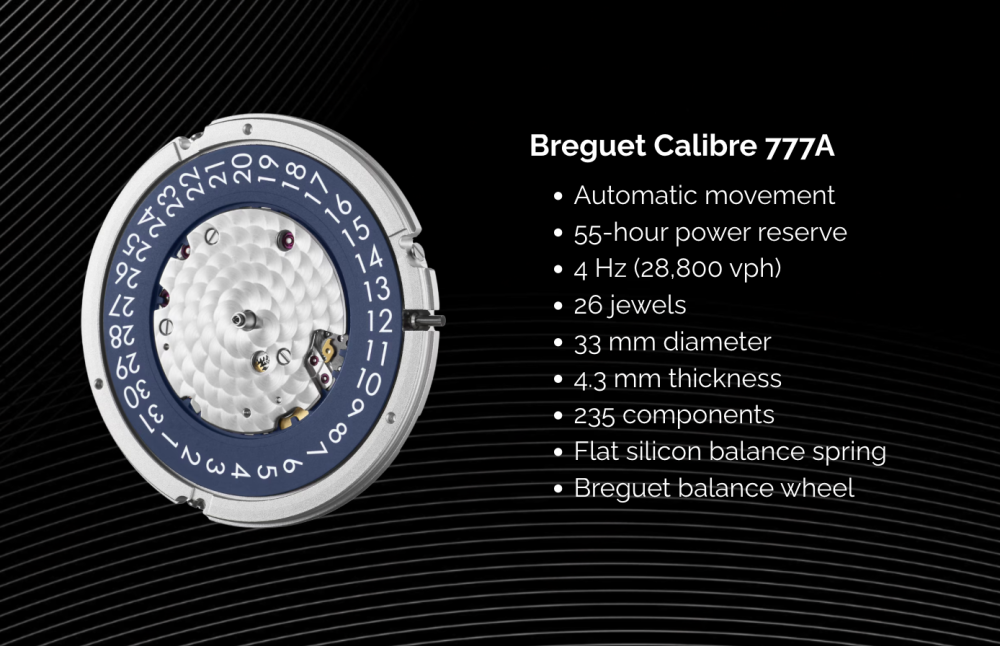
Marine Chronograph 5527
The Marine Chronographe 5527 expanded the architecture to 42.3mm and introduced the integrated Calibre 582QA.
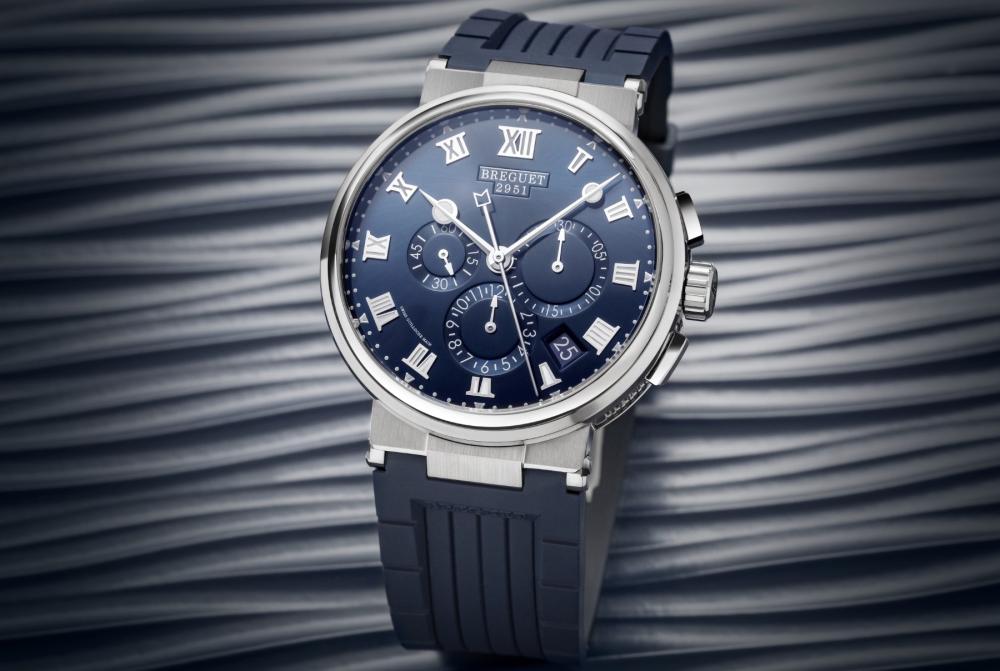
Image Caption: Breguet Marine Chronographe 5527 in titanium with blue dial and rubber strap.
Column wheel. Vertical clutch. 4 Hz. Approximately 48 hours of power reserve. The vertical clutch ensured smooth chronograph engagement without the seconds-hand jump common in lesser systems. This was serious chronograph engineering, not modular add-ons.
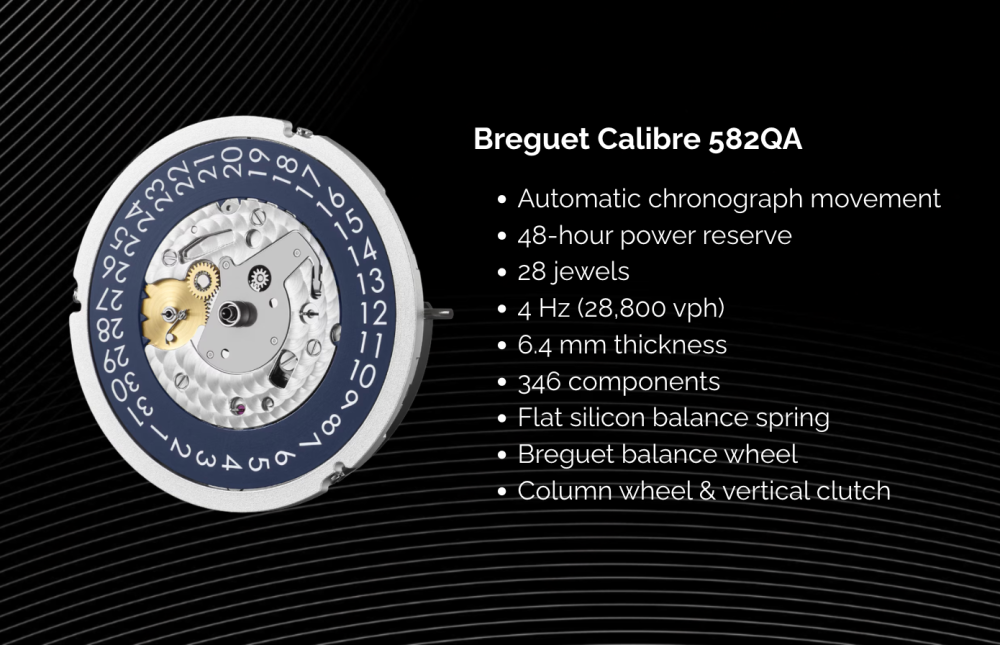
Marine Alarme Musicale 5547
The Marine Alarme Musicale 5547 demonstrated range. Powered by the automatic Calibre 519F/1, it combined a mechanical alarm, dual time zone, and date within a balanced 40mm case. But the real character lies in the alarm itself.
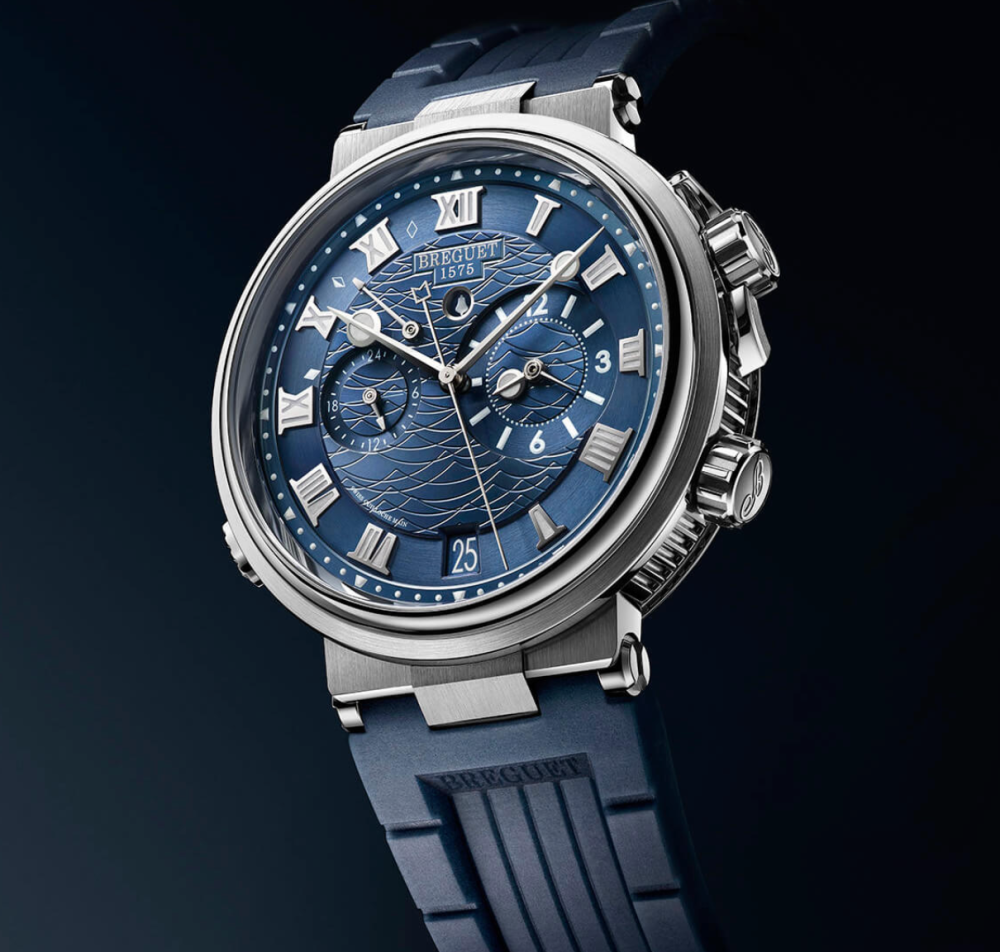
Image captain - Breguet Marine Alarme Musicale 5547 in titanium with blue guilloché dial and rubber strap.
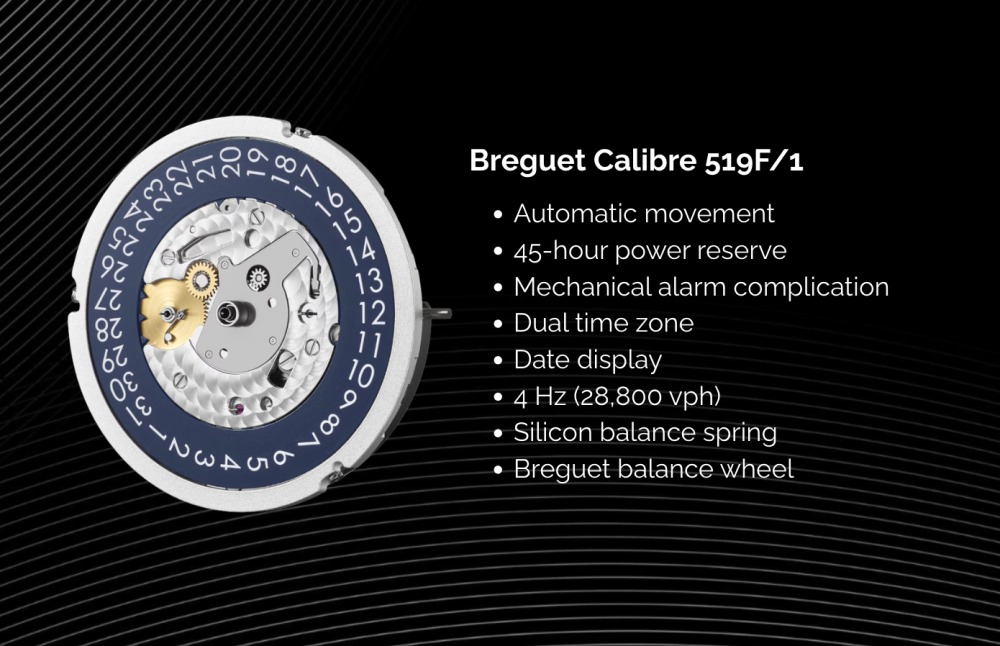
This is not a simple buzzer complication. The 5547 features a dedicated alarm barrel, independently wound and controlled, allowing the wearer to set a precise reminder. When activated, a hammer strikes a gong, producing a clear, resonant tone audible yet refined. It is a traditional mechanical solution, not an electronic shortcut.
The alarm power reserve is displayed on the dial, along with a bell-shaped indicator that confirms activation. A pusher integrated into the case allows easy control, while the crown manages winding and time-setting functions.
Alarm complications are rare in modern luxury sports watches because they require additional architecture, space, and acoustic tuning. In 5547, the alarm is not decorative. It reinforces Marine’s historical identity as a functional maritime instrument, practical, purposeful, and mechanically expressive.
It is one of the few sports watches where the complication genuinely enhances the narrative.
From 2018 onward, Marine stopped evolving incrementally and began operating as a fully contemporary sports collection complete with silicon technology, titanium executions, and integrated design language, yet still anchored by hand-cut guilloché and traditional finishing.
Explore the Breguet Marine Collection at Jewels By Love
Jewels By Love is an authorized Breguet retailer, family-owned since the 1800s and now led by the fifth and sixth generations. Located at 69 B Front Street, Philipsburg, St. Maarten, a duty-free location that offers access to authentic timepieces.
Discover the Breguet Marine collection in-store or online. For inquiries, contact us. Our knowledgeable team is ready to guide you.